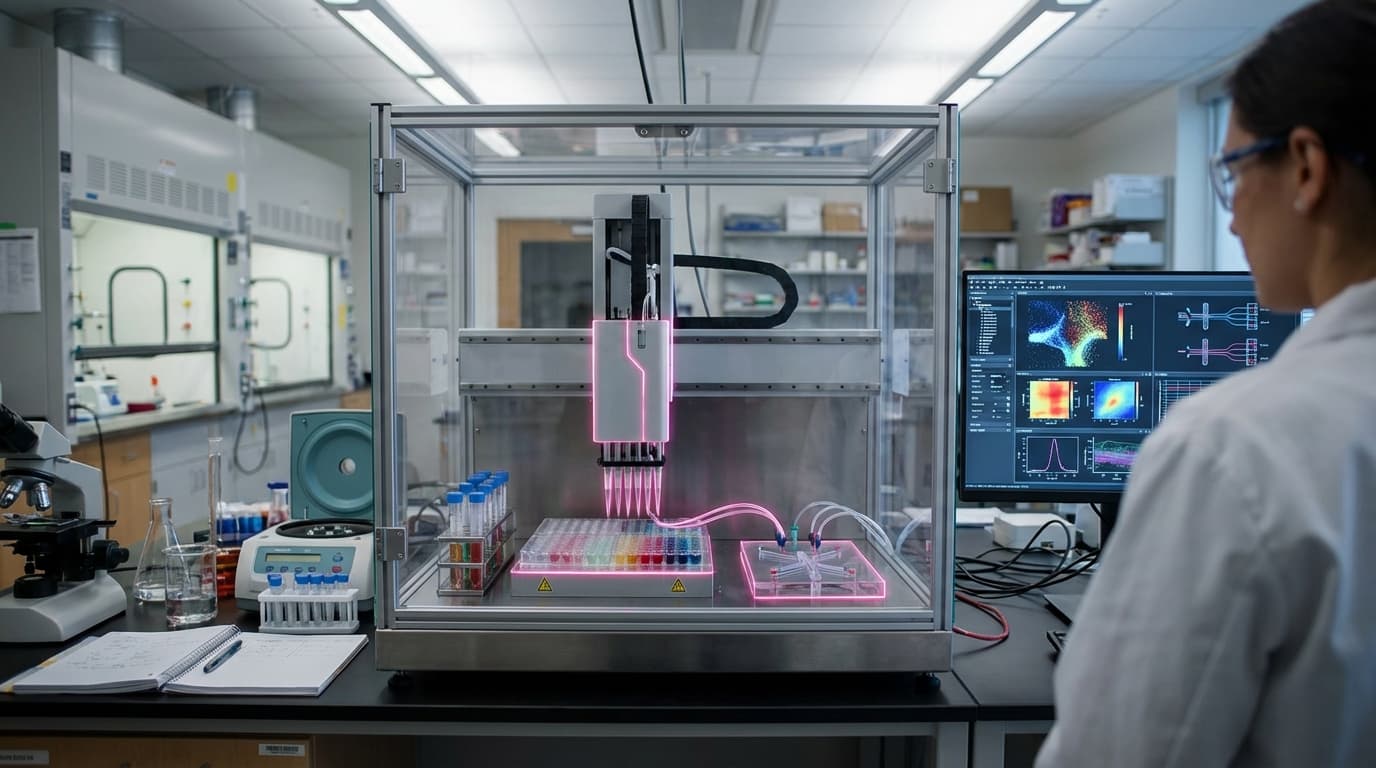
Autonomous Lab Systems
Autonomous lab systems are fully robotic wet laboratories integrated with large language model (LLM)-based experiment planning systems that can autonomously design, execute, and analyze experiments, iterating through research targets like regenerative medicine approaches or longevity compounds without human intervention. These systems combine robotic automation for handling samples, reagents, and equipment with AI systems that can plan experiments, interpret results, and design follow-up experiments, accelerating discovery by running experiments continuously (24/7) with high precision and reproducibility that exceeds human capabilities. Companies like Emerald Cloud Lab, Strateos, and research institutions are developing these systems.
This innovation addresses the time-intensive and labor-intensive nature of biological research, where scientists spend significant time on routine experimental tasks rather than on analysis and design. By automating the entire experimental cycle, these systems can explore research spaces much more rapidly and systematically than human researchers. The technology is being applied to drug discovery, protein engineering, and biological research.
The technology is particularly valuable for high-throughput research where many experiments need to be run, enabling rapid exploration of experimental spaces. As the technology improves, it could become standard for certain types of research. However, ensuring reliability, handling unexpected situations, and integrating with existing research workflows remain challenges. The technology represents an important evolution in research capabilities, but requires continued development to achieve the reliability and flexibility needed for widespread use. Success could dramatically accelerate biological research and drug discovery, but the technology must prove itself in diverse research contexts and integrate effectively with human researchers.
Related Organizations
United States · Company
Provides a highly automated cloud laboratory where scientists can design and run experiments remotely via code.
United States · Company
A company providing remote access to automated robotic laboratories for drug discovery.
Canada · Consortium
A global consortium based at the University of Toronto focused on self-driving labs.

A clinical-stage techbio company decoding biology by integrating technological innovations across biology, chemistry, automation, and data science.

A biotech company providing robotic automation solutions for labs.

A clinical-stage biotechnology company using generative AI for end-to-end drug discovery and research.

Argonne National Laboratory
United States · Research Lab
U.S. Department of Energy multidisciplinary science and engineering research center.
United States · Company
A software company developing laboratory automation scheduling and orchestration tools.
United States · Company
A company designing and building innovative laboratory automation systems.
Supporting Evidence
Research this in Signals
Signals turns a topic into a sourced research record you can inspect and rerun. Your first scan is free, and this one starts with Autonomous Lab Systems already loaded, so edit it or scan as is.