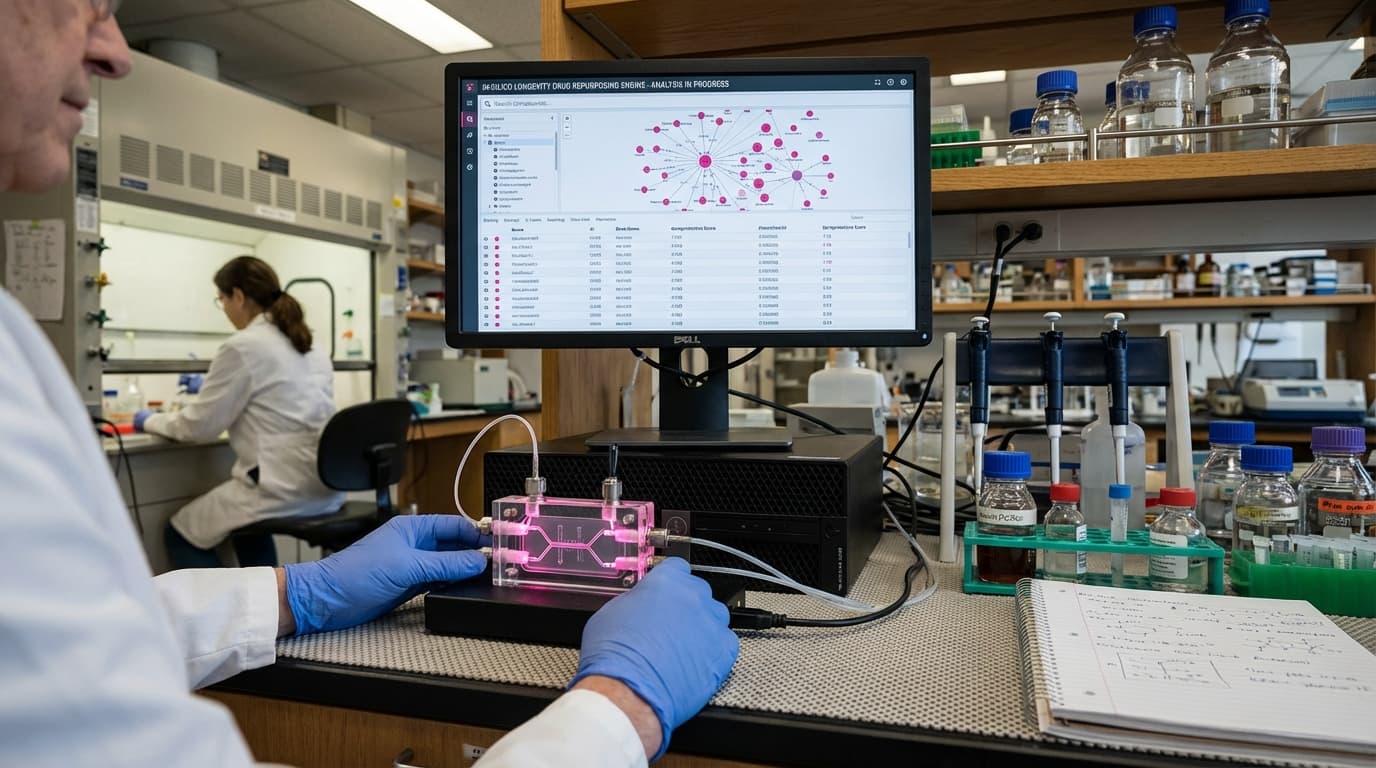
In-Silico Longevity Drug Repurposing Engines
In-silico longevity drug repurposing engines are computational platforms that use AI to analyze massive pharmacological databases and real-world patient data to identify off-label geroprotective (anti-aging) effects in existing approved drugs that weren't originally developed for longevity applications, such as rapamycin or metformin alternatives. By simulating molecular docking (how drugs bind to proteins) and pathway interactions (how drugs affect biological pathways), these engines can predict which existing drugs might have anti-aging effects, significantly shortening the timeline for validating safe longevity interventions compared to developing entirely new drugs. Companies and research institutions are developing these platforms.
This innovation addresses the challenge of developing longevity therapeutics, where creating new drugs is slow and expensive, but many existing drugs might have anti-aging effects that haven't been discovered. By computationally screening existing drugs, these systems can identify promising candidates much faster than experimental screening. The approach is particularly valuable for longevity research where repurposing existing, safe drugs could accelerate progress.
The technology is particularly valuable for longevity research, where repurposing existing drugs could provide faster paths to anti-aging interventions. As the technology improves, it could become a standard approach for drug discovery in various fields. However, ensuring prediction accuracy, validating computational findings experimentally, and navigating regulatory pathways for repurposed drugs remain challenges. The technology represents an important tool for accelerating drug discovery, but requires continued development to achieve the accuracy needed for reliable predictions. Success could accelerate the development of longevity therapeutics by identifying promising existing drugs, but computational predictions must be validated experimentally and the regulatory pathway for repurposed drugs must be navigated.
Related Organizations

Clinical-stage biotechnology company mapping molecular pathways of aging to develop therapies for immune aging.

A clinical-stage biotechnology company using generative AI for end-to-end drug discovery and research.

The world's first biomedical research institution exclusively dedicated to research on aging and age-related disease.
National Institute on Aging (NIA)
United States · Government Agency
A division of the U.S. NIH dedicated to aging research.

A longevity biotech company using high-throughput robotics ('WormBot') and AI.
Denmark · Research Lab
Lab at the University of Copenhagen focused on aging and DNA damage.
United States · Company
A pioneer in drug repurposing using AI and project-based discovery.
United Kingdom · Company
AI-powered tech company dedicated to drug repurposing for rare diseases.
United Kingdom · Company
A life sciences company developing therapies to modify aging.

Supporting Evidence
Research this in Signals
Signals turns a topic into a sourced research record you can inspect and rerun. Your first scan is free, and this one starts with In-Silico Longevity Drug Repurposing Engines already loaded, so edit it or scan as is.