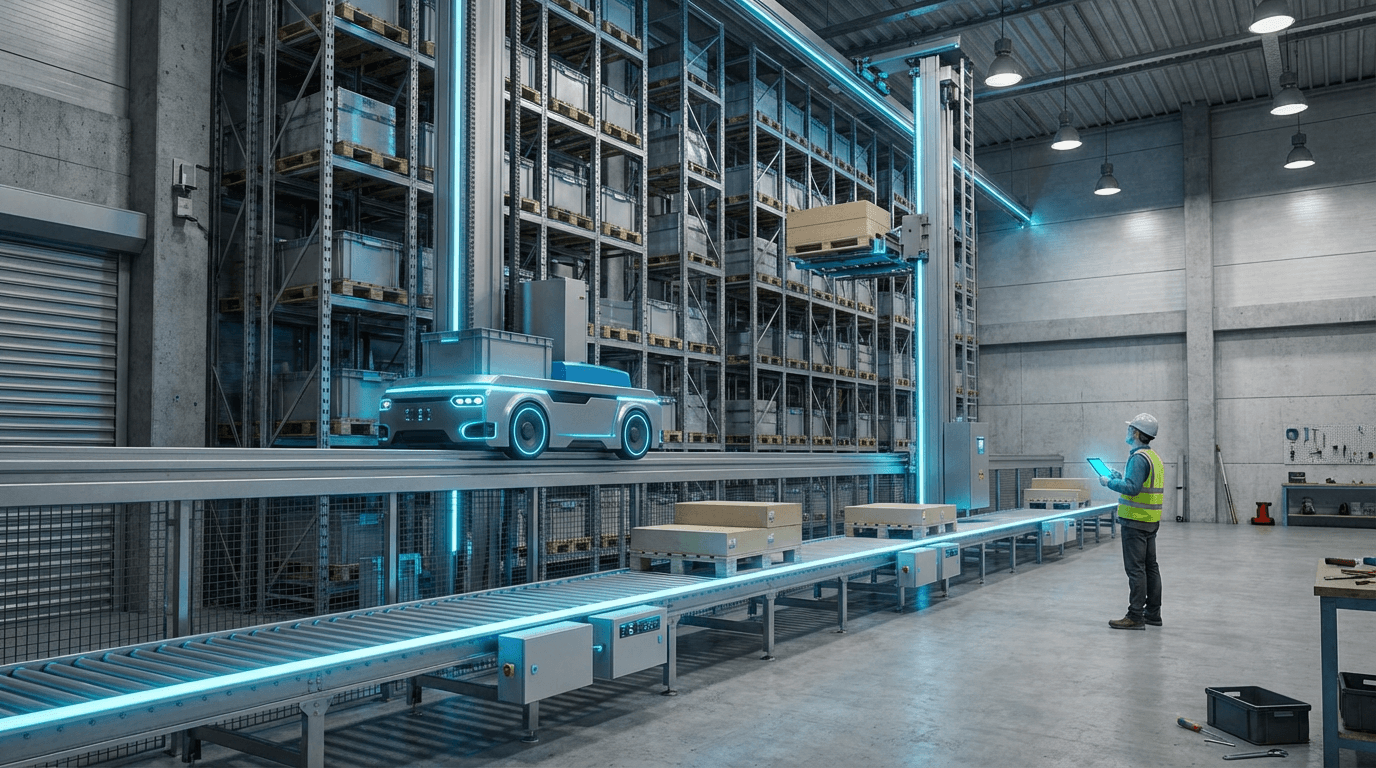
Automated Storage and Retrieval Systems (AS/RS)
Automated Storage and Retrieval Systems represent a fundamental shift in warehouse operations, replacing manual material handling with computer-controlled mechanisms that store and retrieve goods with minimal human intervention. These systems integrate vertical racking structures with sophisticated mechanical components—including stacker cranes, shuttle vehicles, and conveyor networks—all coordinated through warehouse management software. The core principle involves maximizing vertical space utilization while maintaining rapid access to inventory. Stacker cranes travel along fixed rails between high-density storage racks, reaching heights that would be impractical or unsafe for human operators, while shuttle systems move horizontally within storage levels to position items precisely. Advanced AS/RS installations incorporate sensors, barcode scanners, and real-time tracking to maintain inventory accuracy and optimize storage locations based on demand patterns and product characteristics.
The logistics industry faces mounting pressure to reduce operational costs while simultaneously meeting expectations for faster order fulfillment and same-day delivery. Traditional warehousing approaches struggle with these competing demands, as they require extensive floor space, large labor forces, and often suffer from picking errors and inventory discrepancies. AS/RS addresses these challenges by dramatically increasing storage density—often achieving three to five times the capacity of conventional racking within the same footprint—while simultaneously reducing labor requirements and improving accuracy rates. The technology enables facilities to operate continuously with minimal staffing, supporting lights-out warehousing where entire sections function autonomously during off-hours. This capability proves particularly valuable in industries facing labor shortages or operating in regions with high wage costs. Beyond efficiency gains, AS/RS reduces workplace injuries associated with repetitive lifting and reaching, while providing precise inventory control that minimizes stock discrepancies and supports just-in-time manufacturing strategies.
Major retailers, third-party logistics providers, and manufacturers have increasingly adopted AS/RS technology over the past decade, with implementations ranging from compact goods-to-person systems in urban fulfillment centers to massive automated distribution facilities serving regional markets. The technology has evolved to accommodate diverse product types, from small pharmaceutical items requiring climate control to heavy automotive components, with modular designs allowing facilities to scale capacity incrementally as demand grows. Recent developments integrate AS/RS with robotic picking systems and artificial intelligence-driven warehouse execution platforms that optimize storage assignments and retrieval sequences in real-time. As e-commerce continues reshaping supply chain requirements and warehouse real estate costs rise in urban areas, AS/RS adoption is accelerating beyond early-adopter segments into mid-market operations. The convergence of AS/RS with emerging technologies like autonomous mobile robots and predictive analytics suggests a future where warehouses function as highly orchestrated, self-optimizing systems capable of adapting dynamically to fluctuating demand patterns and product mixes.
Related Organizations

Pioneer of cube storage automation, using a grid of robots on top of stacked bins to dig for and retrieve inventory.

A global leader in material handling systems that designs automated storage solutions adapted for high-density automated cemeteries.

A supplier of integrated automated technology, software, and services to optimize the supply chain.

Creator of the Skypod system, a fleet of autonomous robots that can move in three dimensions (climbing racks) to retrieve bins.

A leading provider of modular warehousing and logistics solutions, including high-bay warehouses and shuttle systems.

Develops the Ocado Smart Platform, featuring 'The Hive'—a grid where thousands of washing-machine-sized robots swarm to pick groceries.

A global market leader for value-added logistic process automation at airports and in the parcel market.

Pioneer of Autonomous Case-handling Mobile Robot (ACR) systems, allowing robots to pick and carry specific totes rather than whole racks.

Provides intelligent automated material handling solutions that drive distribution and fulfillment productivity.

Provides intelligent automation solutions for intralogistics and manufacturing.

Global leader in autonomous mobile robots (AMRs) for logistics, known for shelf-to-person robots that coordinate in large fleets.
Supporting Evidence
Research this in Signals
Signals turns a topic into a sourced research record you can inspect and rerun. Your first scan is free, and this one starts with Automated Storage and Retrieval Systems (AS/RS) already loaded, so edit it or scan as is.