







Nano-Fulfillment Centers
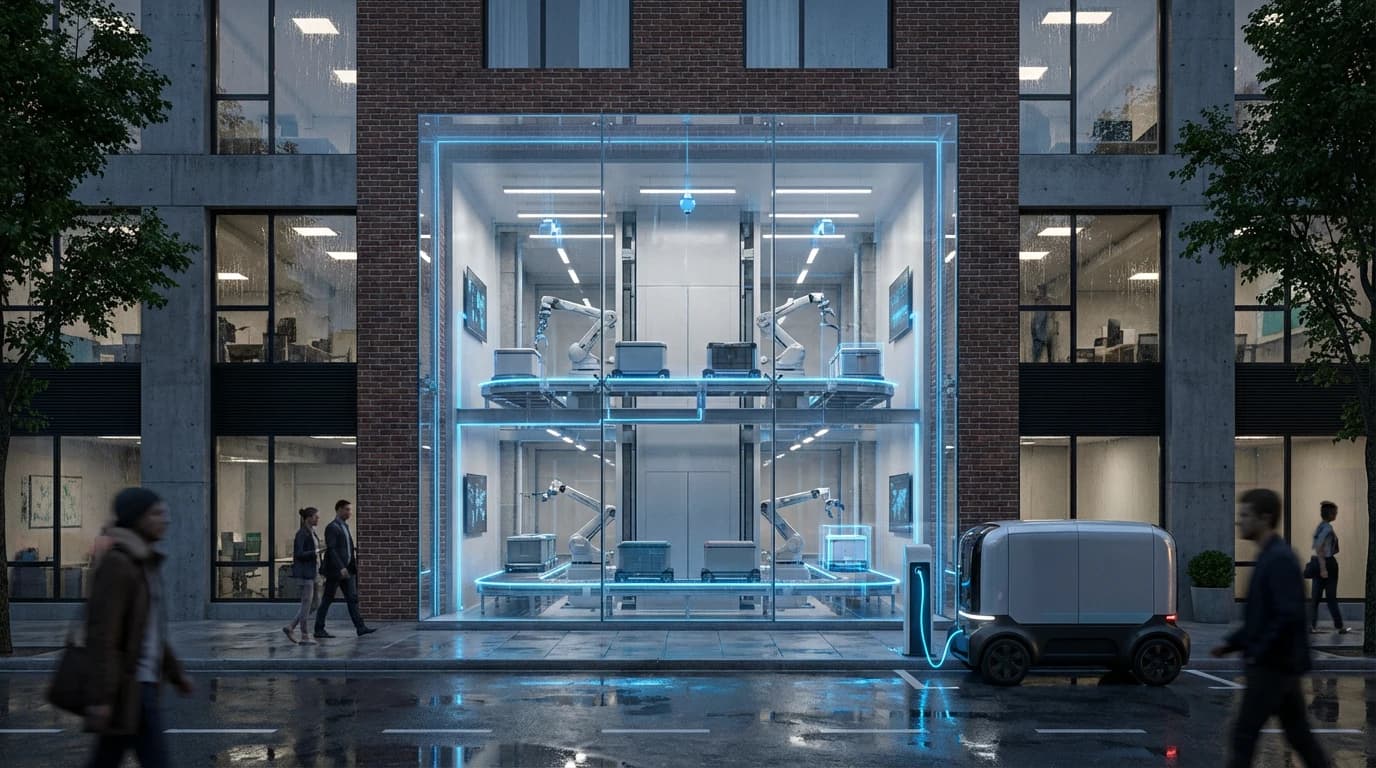
Urban Micro-Fulfilment Centers
Small, highly automated warehouses embedded in cities for ultra-fast delivery.
Urban micro-fulfilment centers represent a fundamental reimagining of warehouse infrastructure, shifting from sprawling suburban distribution facilities to compact, highly automated nodes embedded within city centers. These facilities typically occupy 3,000 to 10,000 square feet—roughly the size of a small grocery store—yet leverage vertical storage systems, robotic picking technologies, and sophisticated inventory algorithms to achieve storage densities that rival much larger conventional warehouses. The technical architecture relies on automated storage and retrieval systems (AS/RS), often featuring cube-based or shuttle-based robotics that navigate three-dimensional grids to retrieve products in minutes rather than hours. Advanced warehouse management systems coordinate inventory placement based on predictive analytics, positioning high-velocity items for immediate access while optimizing space utilization through dynamic slotting algorithms. This combination of dense automation and strategic urban placement enables these centers to fulfill orders within one to two hours of receipt, fundamentally compressing the traditional supply chain timeline.
The proliferation of micro-fulfilment centers addresses several critical challenges facing modern retail and logistics operations. E-commerce growth has created consumer expectations for same-day and even same-hour delivery, yet traditional hub-and-spoke distribution models struggle to meet these demands economically in dense urban markets. Long-haul transportation from distant warehouses increases both delivery costs and carbon emissions, while also limiting inventory responsiveness to local demand fluctuations. Micro-fulfilment centers solve these problems by positioning inventory within a few miles of end consumers, dramatically reducing last-mile delivery distances and enabling retailers to compete with the convenience of physical stores. They also provide grocery retailers and quick-commerce platforms with a viable alternative to converting entire stores into dark stores—dedicated fulfillment-only locations—allowing businesses to maintain customer-facing retail spaces while still supporting rapid delivery. By decentralizing inventory across multiple urban nodes, these facilities also enhance supply chain resilience, reducing the impact of disruptions at any single location.
Major grocery chains, quick-commerce startups, and third-party logistics providers have begun deploying micro-fulfilment centers in metropolitan areas worldwide, with installations ranging from standalone facilities to in-store automation systems integrated within existing retail footprints. These centers frequently coordinate with diverse last-mile delivery options, including electric cargo bikes, autonomous delivery robots, and gig-economy couriers, creating flexible fulfillment networks that can adapt to varying urban geographies and delivery time windows. The technology has proven particularly valuable for grocery and fresh food delivery, where speed and temperature control are critical, as well as for urban pharmacies and convenience retail. As cities continue to densify and consumer expectations for delivery speed intensify, micro-fulfilment centers are becoming essential infrastructure for urban logistics networks. Industry analysts note that this trend aligns with broader movements toward distributed inventory systems and hyperlocal commerce, suggesting that the future of urban retail will increasingly blur the boundaries between warehousing, retail, and delivery operations into integrated, automated fulfillment ecosystems.
TRL
8/9Deployed
Impact
4/5
Investment
5/5
Category
Applications
Related Organizations
Pioneer of cube storage automation, using a grid of robots on top of stacked bins to dig for and retrieve inventory.
Developer
Care enablement platform that automates triage and patient intake (acquired Gyant).
Developer

Gopuff
United States · Startup
Instant delivery service operating a vast network of micro-fulfillment centers (dark stores) across US and European cities.
Deployer
Develops a 3D robotic supply chain system inspired by ant colonies, condensing warehouse aisles into a single vertical storage structure.
Developer
Creator of the Skypod system, a fleet of autonomous robots that can move in three dimensions (climbing racks) to retrieve bins.
Developer
Grocery technology company building 'Carrot Warehouses', which are micro-fulfillment centers enabling 15-minute delivery for partners.
Deployer
Develops the Ocado Smart Platform, featuring 'The Hive'—a grid where thousands of washing-machine-sized robots swarm to pick groceries.
Developer
Offers 'Autopicker', a mobile robot that can pick items directly from shelves while moving.
Developer
A supplier of integrated automated technology, software, and services to optimize the supply chain.
Developer
What was expected
Published forecasts about this technology, graded against what happened in Hindsight.
The Evolution to Nano-Fulfillment Centers
Supporting Evidence
Evidence data is not available for this technology yet.
Research this in Signals
Scan Urban Micro-Fulfilment Centers for yourself.
Signals turns a topic into a sourced research record you can inspect and rerun. Your first scan is free, and this one starts with Urban Micro-Fulfilment Centers already loaded, so edit it or scan as is.