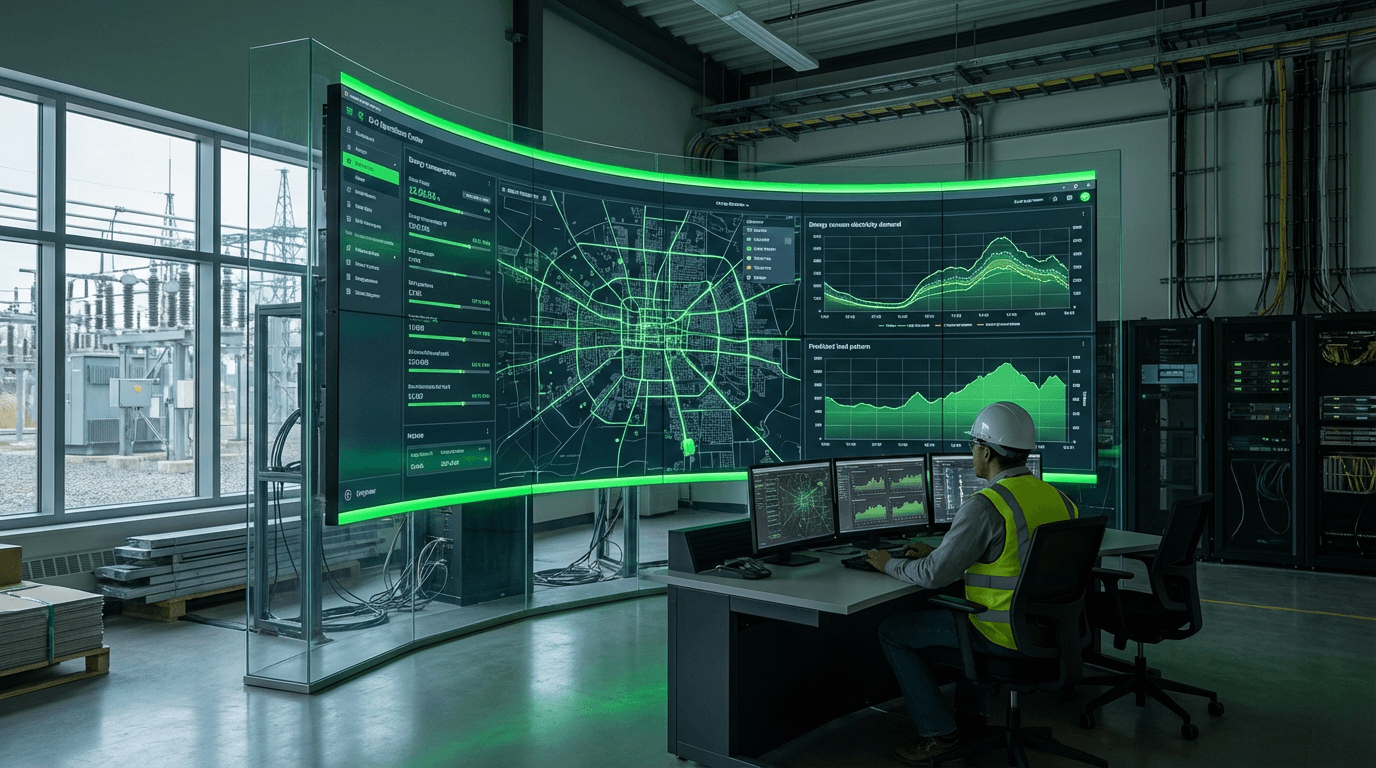
AI Demand Forecasting & Load Prediction
AI demand forecasting and load prediction represents a fundamental shift in how utilities and grid operators anticipate electricity consumption patterns. Traditional forecasting methods relied on historical averages and simple statistical models that struggled to account for the complex interplay of factors influencing power demand. Modern deep learning architectures, particularly recurrent neural networks (RNNs), long short-term memory (LSTM) networks, and transformer models, can simultaneously process vast streams of heterogeneous data—weather patterns, economic indicators, consumer behavior signals, grid topology information, and real-time sensor data—to generate predictions across multiple time horizons, from minutes ahead to seasons in advance. These models learn intricate non-linear relationships that conventional approaches miss, such as how temperature changes affect air conditioning loads differently across neighborhoods, or how economic activity patterns shift consumption during holidays and special events. The systems continuously refine their predictions as new data arrives, adapting to emerging patterns and anomalies in near real-time.
The electricity sector faces mounting pressure to balance supply and demand with increasing precision as renewable energy sources introduce greater variability into generation portfolios. AI-driven forecasting addresses this challenge by enabling utilities to optimize unit commitment decisions—determining which power plants to activate and when—with far greater confidence and efficiency. More accurate predictions reduce the need for expensive peaking plants held in reserve and minimize curtailment of renewable generation. Grid operators can better coordinate demand response programs, signaling large industrial consumers or aggregated residential loads to adjust consumption during predicted peak periods. In wholesale electricity markets, improved forecasting translates directly to competitive advantage, allowing generators and traders to submit more strategic bids and reduce exposure to price volatility. Research suggests these systems can reduce forecasting errors by 20-40% compared to traditional methods, potentially saving utilities millions in operational costs while improving grid reliability.
Early deployments of AI forecasting systems are already demonstrating tangible benefits across diverse grid environments. Several major utilities have integrated machine learning platforms into their energy management systems, reporting improved accuracy in day-ahead and hour-ahead predictions that directly inform dispatch decisions. Distribution system operators are leveraging these tools to manage increasingly complex edge-of-grid dynamics as distributed energy resources proliferate. The technology proves particularly valuable in regions with high renewable penetration, where accurate short-term solar and wind forecasts must be combined with load predictions to maintain system stability. As smart meter deployments expand globally, the granularity and volume of available data continue to improve, creating a virtuous cycle where better data enables more sophisticated models that in turn justify further infrastructure investment. Looking forward, these forecasting capabilities will become essential infrastructure for managing bidirectional power flows, electric vehicle charging coordination, and the integration of energy storage systems—all critical components of the transition toward decarbonized, resilient power grids.
Related Organizations

Uses AI to disaggregate energy meter data, providing itemized appliance-level insights to utilities and consumers.

AI-based forecasting and trade optimization for renewable energy.

AI and Machine Learning solutions for the energy industry, focusing on the grid edge.


Developers of the Gemini family of models, which are trained from the start to be multimodal across text, images, video, and audio.

Provider of AI solutions for smart grids and energy communities.

Deeptech company providing optimization software for energy markets.

Released Arctic, an enterprise-grade Mixture-of-Experts language model designed for complex enterprise workloads.

Supporting Evidence
Research this in Signals
Signals turns a topic into a sourced research record you can inspect and rerun. Your first scan is free, and this one starts with AI Demand Forecasting & Load Prediction already loaded, so edit it or scan as is.