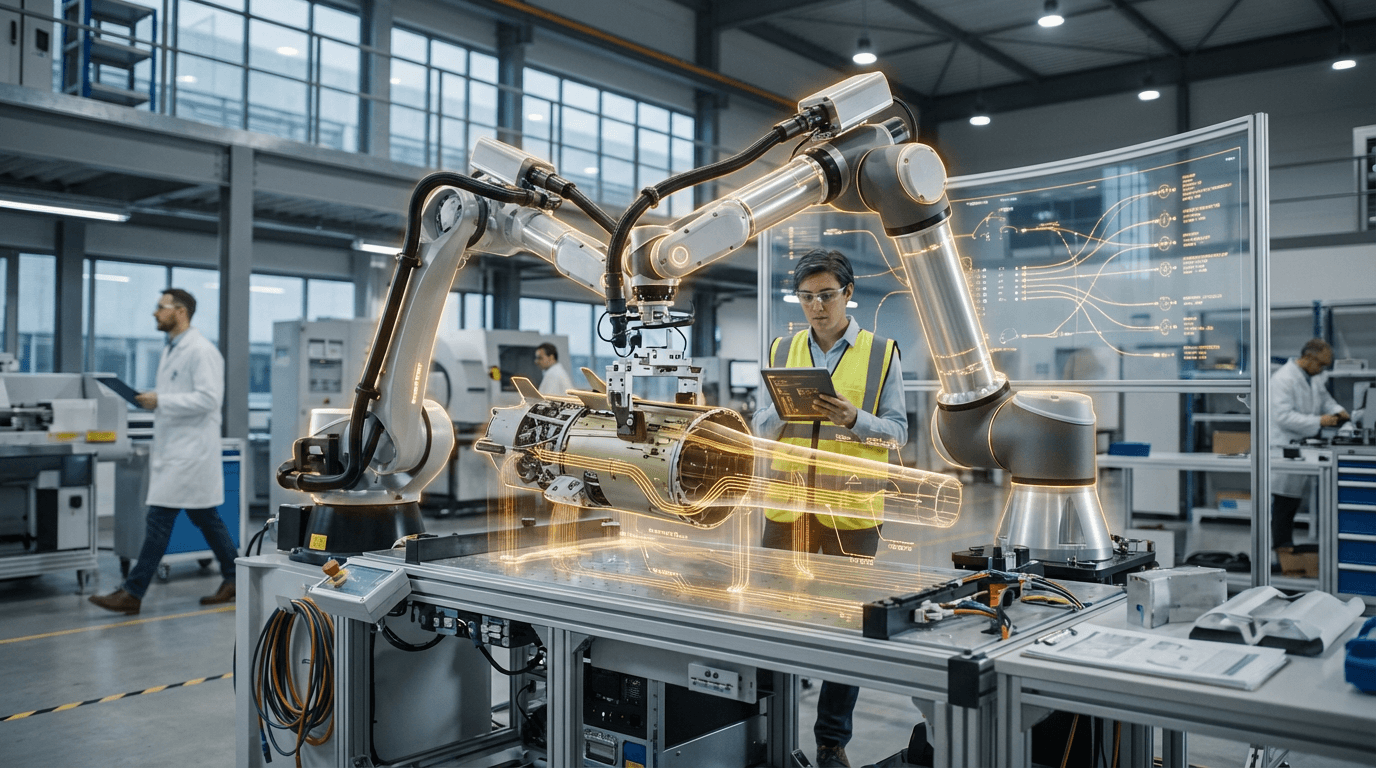
Digital Thread & Model-Based Enterprise
Digital Thread and Model-Based Enterprise represent a fundamental shift in how manufacturing organizations manage product information throughout the entire lifecycle. Traditional manufacturing workflows have long relied on fragmented data systems where design specifications, manufacturing instructions, quality records, and service histories exist in separate silos—often in incompatible formats ranging from paper drawings to disparate software platforms. The Digital Thread addresses this fragmentation by creating a unified digital framework that connects every piece of product-related information through a continuous data stream. At its foundation, this approach leverages 3D CAD models enriched with product manufacturing information (PMI) as the authoritative source, replacing traditional 2D drawings. These models contain not just geometric data but also embedded annotations specifying tolerances, surface finishes, inspection requirements, and assembly instructions. Model-Based Definition (MBD) techniques ensure that downstream processes—from CNC machining to quality inspection—consume data directly from these intelligent 3D models, eliminating translation errors and version control issues that plague paper-based systems.
The manufacturing sector faces mounting pressure to accelerate time-to-market while simultaneously improving quality and reducing costs—objectives that often conflict under traditional workflows. Digital Thread architecture resolves this tension by enabling unprecedented visibility and traceability across the value chain. When design engineers modify a component, those changes propagate automatically through manufacturing work instructions, inspection programs, and supplier specifications, dramatically reducing the cycle time for engineering changes. This connectivity proves particularly valuable in regulated industries like aerospace and medical devices, where demonstrating compliance requires exhaustive documentation linking as-designed specifications to as-manufactured reality and in-service performance. The system captures process parameters from machine tools, inspection results from coordinate measuring machines, and field performance data from connected products, creating a closed-loop feedback mechanism. Quality issues detected during production or in service can be traced back to specific design decisions, material batches, or manufacturing conditions, enabling root cause analysis that was previously impossible with disconnected data systems.
Early adopters in aerospace and automotive sectors have demonstrated substantial benefits, with some organizations reporting 30-50% reductions in engineering change processing time and significant improvements in first-time quality rates. Commercial MBE platforms now integrate with enterprise resource planning systems, product lifecycle management software, and manufacturing execution systems to create end-to-end digital continuity. Advanced implementations leverage this comprehensive data foundation to train machine learning models that predict quality issues, optimize process parameters, and recommend design improvements based on manufacturing feasibility and field performance patterns. As additive manufacturing and other advanced production technologies become more prevalent, the Digital Thread becomes increasingly critical—these processes generate vast amounts of process data that must be captured and analysed to ensure part quality and enable certification. Looking forward, the convergence of Digital Thread architectures with digital twin simulations and industrial IoT platforms promises to create truly intelligent manufacturing ecosystems where physical and digital realms remain synchronized throughout a product's entire existence, from initial concept through end-of-life recycling.
Related Organizations

Software corporation specializing in 3D design and digital mock-ups.

The Digital Manufacturing Institute, a DoD-funded institute focused on advancing the digital thread.

The US federal agency leading the global competition to select and standardize post-quantum cryptographic algorithms.
PTC
United States · Company
Offers ThingWorx, a platform that connects industrial devices, people, and systems.

Offers the Xcelerator portfolio, enabling comprehensive digital twins for spacecraft design, manufacturing, and operations.

Provider of an open, low-code PLM platform designed to support the digital thread across disparate systems.

Hexagon AB
Sweden · Company
A global leader in sensor, software, and autonomous solutions, providing reality capture for digital twins.

Provides MES and MRO software specifically designed to maintain the digital thread in complex discrete manufacturing.


Industrial automation leader offering FactoryTalk Analytics, which uses ML to identify equipment anomalies.

Supporting Evidence
Research this in Signals
Signals turns a topic into a sourced research record you can inspect and rerun. Your first scan is free, and this one starts with Digital Thread & Model-Based Enterprise already loaded, so edit it or scan as is.