In-Space Manufacturing (ISM)
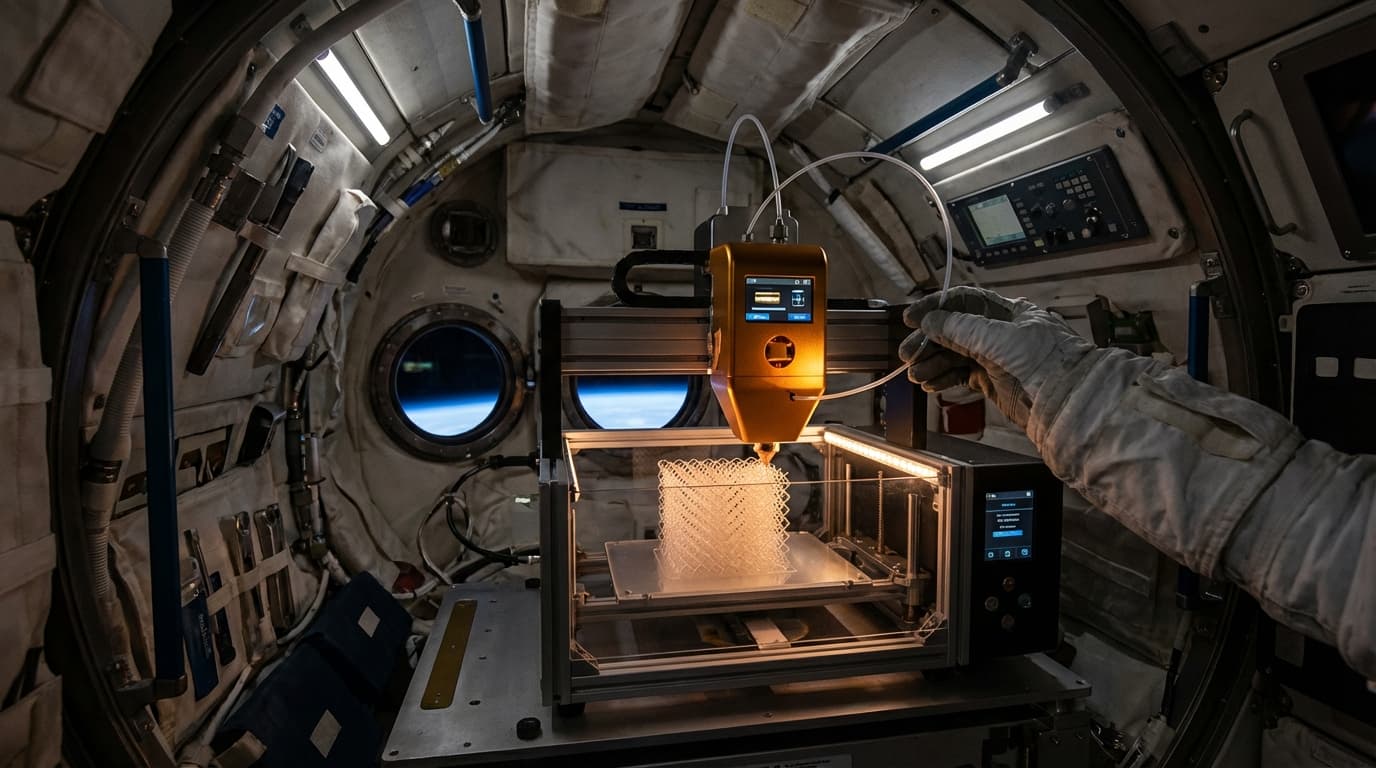
In-Space Manufacturing represents a paradigm shift in how humanity approaches the production of advanced materials and components by leveraging the unique conditions of microgravity environments. Unlike terrestrial manufacturing, which must contend with gravitational forces that cause sedimentation, convection currents, and structural deformation during production processes, orbital facilities operate in conditions where these constraints are effectively eliminated. This fundamental difference enables the creation of materials with unprecedented purity and structural perfection. The absence of gravity allows for uniform crystal growth without density-driven separation of components, eliminates buoyancy-driven fluid flows that can introduce defects, and permits the formation of perfectly spherical droplets and uniform coatings that are impossible to achieve on Earth. Key technical mechanisms include containerless processing, where materials float freely without touching vessel walls that could introduce contamination, and the ability to maintain precise temperature gradients without interference from convective mixing. These capabilities are particularly valuable for producing advanced optical fibers like ZBLAN fluoride glass, which exhibits significantly lower signal loss than silica-based alternatives when manufactured in microgravity, as well as ultra-pure semiconductor crystals and protein crystals for pharmaceutical research.
The emergence of viable in-space manufacturing addresses critical limitations in terrestrial production of high-performance materials that command premium market values. Industries ranging from telecommunications to pharmaceuticals face fundamental physical barriers when attempting to produce certain materials on Earth, where gravity-induced imperfections compromise performance or render production entirely unfeasible. For optical fiber manufacturers, the ability to produce ZBLAN fibers in orbit could revolutionize long-distance data transmission, as these fibers theoretically offer 100 times lower attenuation than conventional silica fibers, though terrestrial production introduces crystallization defects that negate this advantage. Similarly, the semiconductor industry continues to pursue ever-more-perfect crystal structures for advanced electronics, while pharmaceutical companies seek better protein crystal samples for drug development—both applications where microgravity manufacturing offers measurable advantages. The declining cost of orbital access, driven by reusable launch systems and increasing competition in the commercial space sector, has transformed what was once purely experimental into an economically plausible manufacturing strategy. This shift enables new business models where the extraordinary value of defect-free materials justifies the expense of orbital production and return logistics.
Early commercial demonstrations have already validated the technical feasibility of in-space manufacturing, with several companies conducting pilot programs aboard the International Space Station and planning dedicated orbital facilities. Research initiatives have successfully produced ZBLAN fiber samples, grown protein crystals for pharmaceutical analysis, and demonstrated bioprinting techniques in microgravity that could eventually support tissue engineering applications. Industry analysts note that the initial focus remains on products where even small quantities command high prices—materials where the cost per kilogram can reach hundreds of thousands or millions of dollars, making orbital production economically justifiable despite current launch expenses. As launch costs continue their downward trajectory and orbital infrastructure becomes more accessible, the range of viable in-space manufacturing applications is expected to expand beyond these ultra-premium materials. This technology represents a convergence of advancing space access capabilities with persistent terrestrial manufacturing limitations, positioning orbital facilities as specialized production nodes within global supply chains. The trajectory suggests a future where certain high-value materials are routinely manufactured in space, with Earth-based facilities handling mass production while orbital factories serve niche markets demanding absolute material perfection that only microgravity can deliver.
Related Organizations

NASA's lead center for the In-Space Manufacturing (ISM) project, focusing on on-demand fabrication and repair.

Provides in-space 3D printing and bioprinting capabilities, having acquired Made In Space and Techshot.

Developing the ForgeStar platform, a returnable satellite for in-space manufacturing of next-generation materials.

Develops orbital manufacturing capsules designed to produce pharmaceuticals in microgravity and return them to Earth.


Leads the EAGLE-1 mission and the SAGA program to build a European quantum communication infrastructure in space.

Provides commercial access to space, including the Bishop Airlock on the ISS used for deploying satellites and hosting experiments.

Developing large, scalable space infrastructure using in-space welding.

Provides modular bioreactors and services for microgravity research and manufacturing.

Developing general-purpose space robots for on-orbit servicing and assembly.
Supporting Evidence
Research this in Signals
Signals turns a topic into a sourced research record you can inspect and rerun. Your first scan is free, and this one starts with In-Space Manufacturing (ISM) already loaded, so edit it or scan as is.