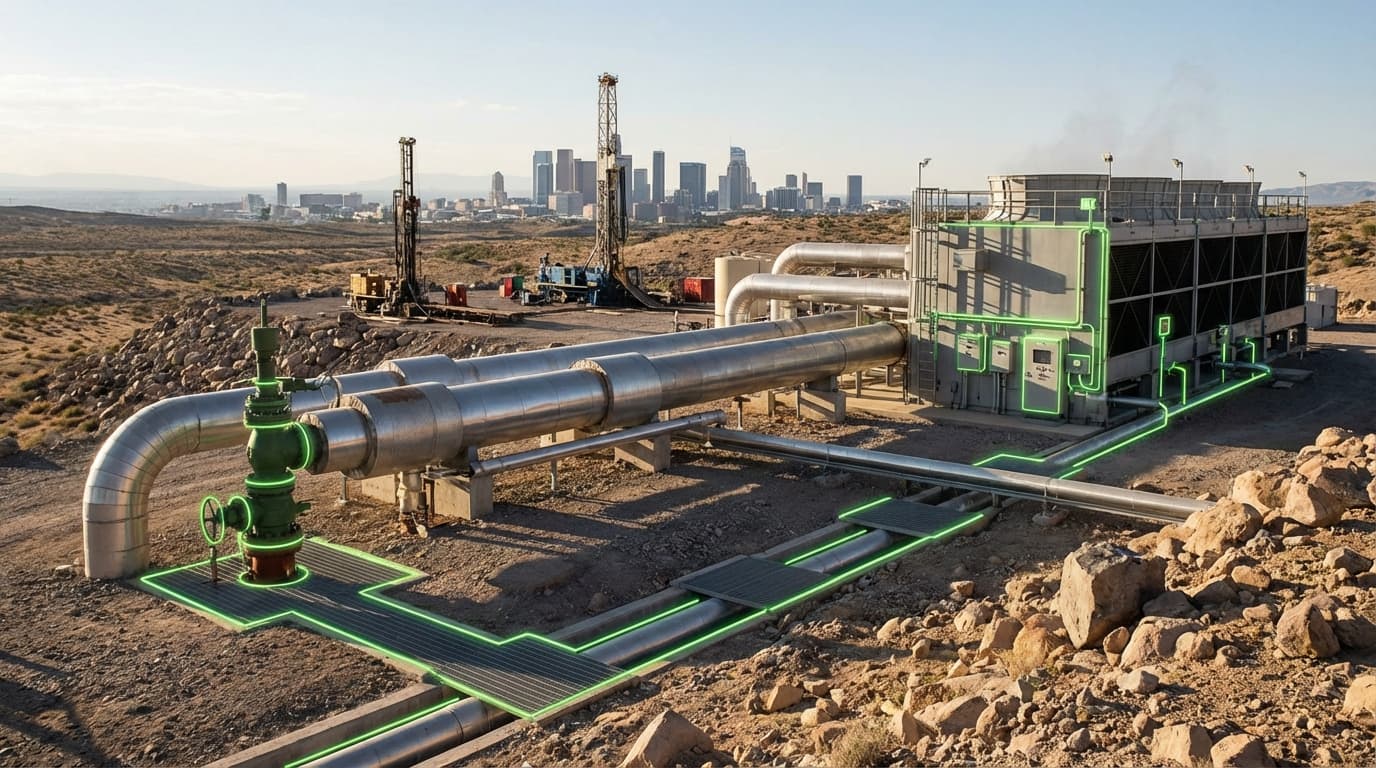
Geothermal Enhanced Systems
Enhanced geothermal systems (EGS) drill two or more wells into hot, impermeable rock and use hydraulic stimulation or precision blasting to create fractures that act as heat exchangers. Water injected down one well circulates through the engineered reservoir and returns up another, carrying heat that drives turbines or provides industrial steam. 3D seismic imaging, fiber-optic sensing, and microseismic monitoring keep stimulation within targeted zones, minimizing induced seismic risk.
Operators like Fervo Energy, AltaRock, and Ormat are co-opting oilfield rigs, directional drilling, and automation to cut costs and bring geothermal to sedimentary basins in Utah, Nevada, Germany, and Australia. Pairing EGS with carbon capture sites or hydrogen hubs provides a firm, emissions-free heat source near heavy industry. Governments view EGS as a jobs transition for oilfield workers, offering grants and tax credits to retool rigs and train crews.
EGS is TRL 6 but still needs proof of multi-year reservoir stability, affordable drilling at >5 km, and public acceptance. DOE’s FORGE program and EU Horizon projects provide shared testbeds to validate technologies, while insurance products are emerging to cover drilling risk. If successful, EGS could unlock terawatts of 24/7 clean energy under regions previously deemed geothermal-poor.
Related Organizations

Develops Eavor-Loop, a closed-loop geothermal system that circulates fluid through sealed wellbores.
Adapts horizontal drilling and distributed fiber optic sensing from the oil and gas industry to geothermal.
Utah FORGE
United States · Research Lab
A dedicated underground field laboratory sponsored by the DOE for developing EGS technologies.

Focuses on SuperHot Rock (SHR) geothermal energy technology development.

Combines geothermal energy with energy storage using fracture technology to harvest heat and pressure.
Canada · Company
Developing a large-scale geothermal power facility in Saskatchewan using horizontal drilling.

Develops PLASMABIT technology for contactless plasma drilling and milling of hard rock.

Develops GreenLoop technology to retrofit existing non-productive wells for geothermal power generation.

Developing millimeter-wave drilling technology to vaporize rock and reach superhot geothermal depths.
Supporting Evidence
Research this in Signals
Signals turns a topic into a sourced research record you can inspect and rerun. Your first scan is free, and this one starts with Geothermal Enhanced Systems already loaded, so edit it or scan as is.