









Ubiquitous Sensor Distribution
This page is a narrower case of it.
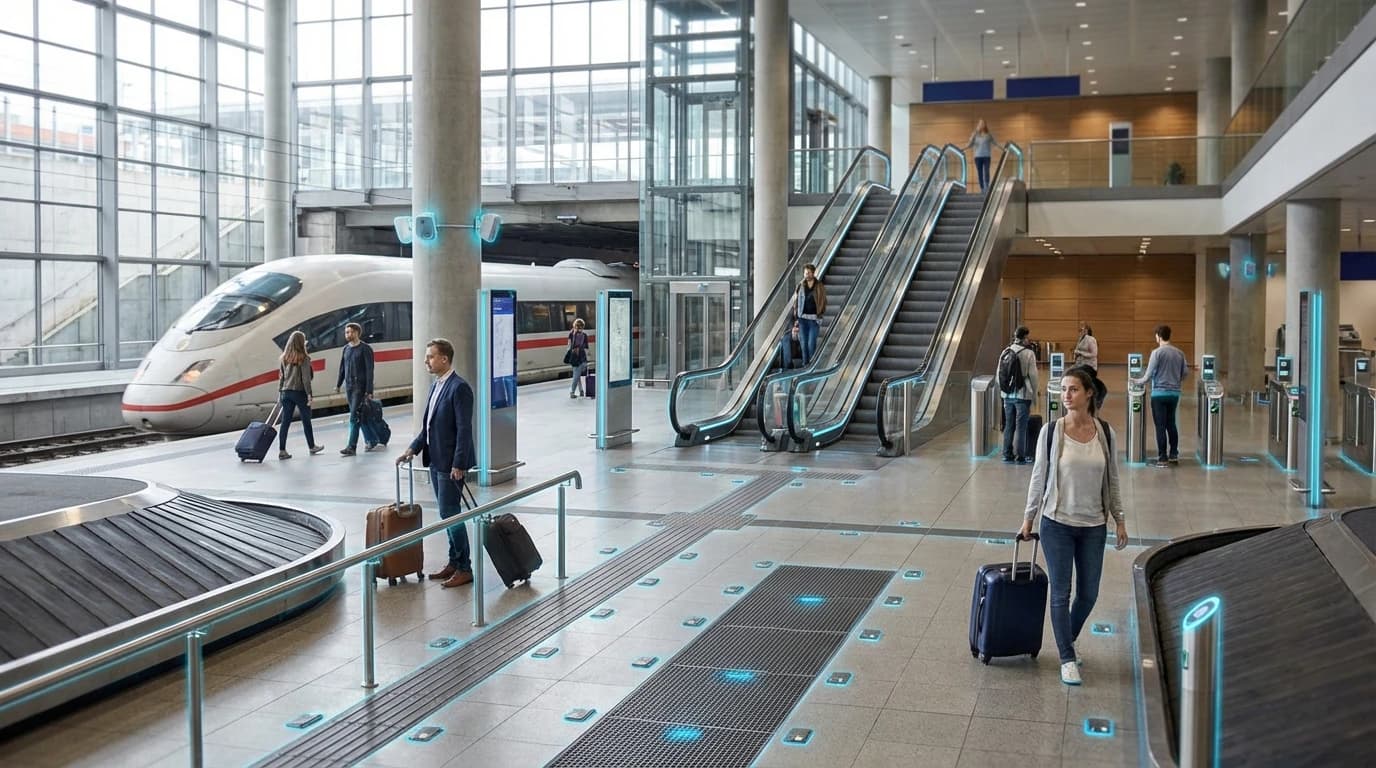
Mobility Hub IoT Sensors represent a comprehensive network of interconnected devices strategically deployed throughout transportation facilities to capture continuous streams of data about passenger movement, vehicle operations, and environmental conditions. These sensor systems typically combine multiple technologies including passive infrared sensors for occupancy detection, Bluetooth Low Energy beacons for tracking passenger flow patterns, air quality monitors measuring particulates and CO2 levels, acoustic sensors detecting unusual sounds or crowd density, and computer vision cameras with edge processing capabilities. The architecture relies on a distributed mesh network where individual sensors communicate with local gateways that aggregate and transmit data to cloud-based analytics platforms. Unlike traditional surveillance or monitoring systems that operate in isolation, these IoT networks function as integrated ecosystems where data from diverse sensor types is fused to create a holistic understanding of hub operations in real time.
The fundamental challenge these systems address is the operational complexity inherent in managing facilities where thousands or millions of passengers transit daily through interconnected spaces. Airports, train stations, and seaports face persistent difficulties in predicting bottlenecks, maintaining optimal environmental conditions, responding to security incidents, and allocating staff efficiently across vast terminal areas. Traditional approaches relying on manual observation or periodic surveys cannot capture the dynamic nature of passenger flows or identify emerging problems before they cascade into major disruptions. Mobility Hub IoT Sensors overcome these limitations by providing continuous visibility into every corner of the facility, enabling operators to detect anomalies within seconds rather than minutes or hours. This capability transforms reactive management into proactive optimization, where cleaning crews are dispatched based on actual restroom usage patterns, gate assignments are adjusted according to real-time crowd density, and ventilation systems respond automatically to occupancy levels rather than running on fixed schedules.
Major transportation hubs worldwide have begun deploying these sensor networks, with early implementations demonstrating measurable improvements in operational efficiency and passenger satisfaction. Research indicates that facilities equipped with comprehensive IoT monitoring can reduce average passenger processing times, optimize energy consumption through demand-responsive building systems, and enhance security response capabilities by automatically alerting staff to unusual patterns or unattended objects. The technology is particularly valuable during peak travel periods or unexpected disruptions, when real-time data enables rapid reconfiguration of passenger routing and resource allocation. As sensor costs continue to decline and analytics platforms become more sophisticated, these systems are evolving beyond simple monitoring toward predictive capabilities that anticipate congestion before it occurs and recommend optimal interventions. The trajectory points toward fully autonomous mobility hubs where IoT sensor networks form the nervous system of facilities that continuously adapt to passenger needs without human intervention.
Provides predictive collaboration and flow management technology for airports, integrating various sensor data streams.
Develops 3D sensors and software for people flow measurement specifically tailored for airports and transportation hubs.
Develops LiDAR software solutions that process 3D data for spatial intelligence in transport hubs.
A leading IT provider for the air transport industry, offering Smart Path biometric solutions for seamless airport processing.
Provides an IoT platform for venue intelligence, formerly known as Skyfii, utilized in airports and transit centers.
Provider of LiDAR sensors and smart 3D solutions.
Builds anonymous people-counting sensors and software to help organizations measure how space is used.
Designs and manufactures wireless sensor network hardware for IoT applications.
A global networking leader that coined the term IoE, providing the infrastructure connecting people, data, and things.
Published forecasts about this technology, graded against what happened in Hindsight.
Ubiquitous Sensor Distribution
This page is a narrower case of it.
Signals turns a topic into a sourced research record you can inspect and rerun. Your first scan is free, and this one starts with Mobility Hub IoT Sensors already loaded, so edit it or scan as is.