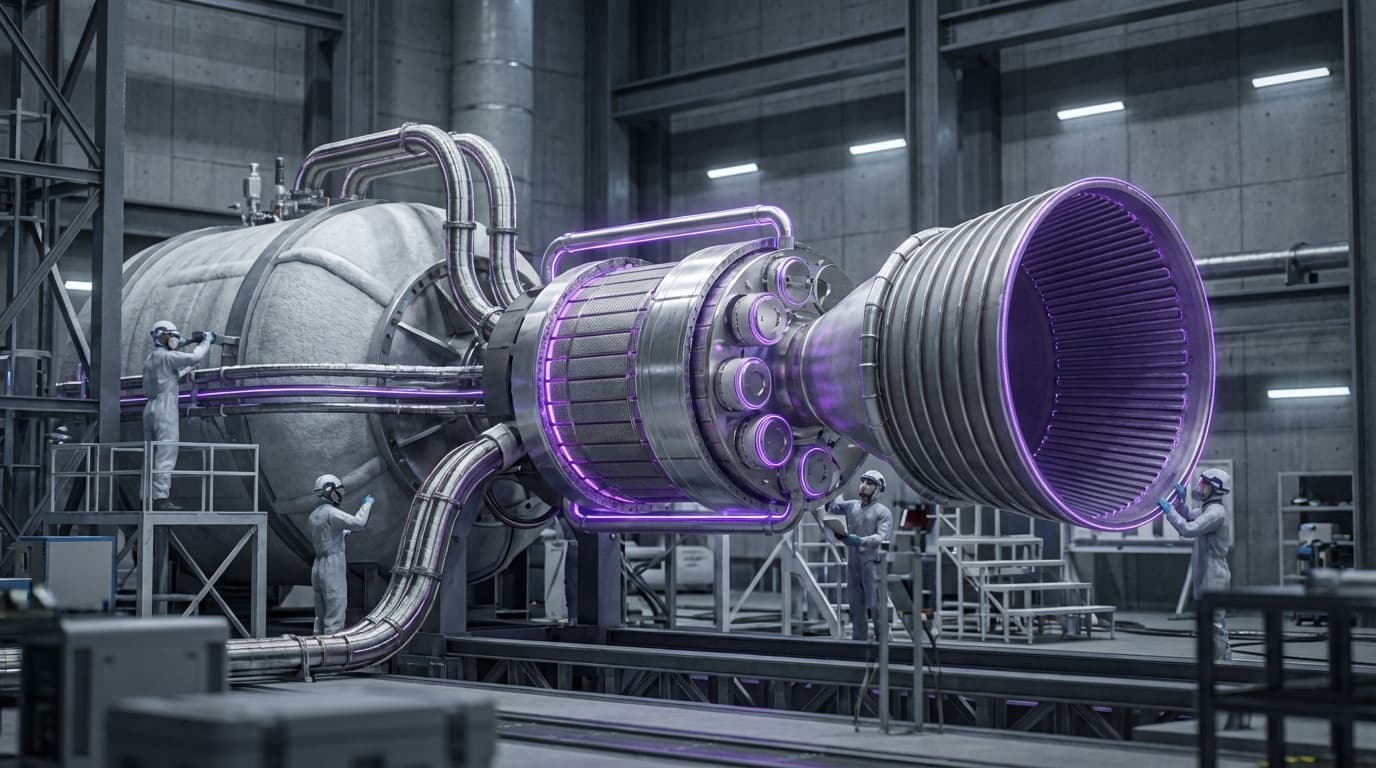
Nuclear Thermal Propulsion
Nuclear thermal propulsion uses nuclear reactors to heat cryogenic propellant (typically hydrogen) to extremely high temperatures, then expels it through a nozzle to generate thrust. This approach provides much higher specific impulse (efficiency) than chemical rockets while maintaining high thrust, enabling rapid transit to Mars and other destinations. NASA, DARPA, and commercial teams are developing systems using low-enriched uranium that are safer and more politically acceptable than previous high-enriched designs.
This innovation addresses the fundamental challenge of interplanetary travel, where chemical rockets require long transit times that expose crews to radiation and psychological stress. Nuclear thermal propulsion can cut transit times to Mars in half compared to chemical propulsion, reducing mission risk and enabling more practical human exploration. The technology also enables reusable deep-space tugs that can efficiently transport cargo throughout cislunar space and beyond.
The technology is essential for enabling practical human exploration of Mars and the outer solar system, where transit times and propellant efficiency are critical. As these systems are developed and demonstrated, they could enable a new era of rapid interplanetary travel. However, the technology faces challenges including public acceptance, regulatory approval, and technical development of reliable, safe nuclear systems for space. The technology represents a potential game-changer for human space exploration, but requires careful development and public engagement to address concerns about nuclear systems in space.
Related Organizations

A supplier of nuclear components and fuel to the U.S. government.


Conducts advanced demonstrations like LCRD (Laser Communications Relay Demonstration) and DSOC (Deep Space Optical Comm).

Produces laser communication terminals for the SDA and other defense applications.

Developing micro-reactors for nuclear thermal and nuclear electric propulsion in space.

The government agency responsible for the United Kingdom's civil space programme.

Developer of the Xe-100 high-temperature gas-cooled small modular reactor and TRISO-X fuel.


Provides engineering services and software for aerospace projects.
Supporting Evidence
Research this in Signals
Signals turns a topic into a sourced research record you can inspect and rerun. Your first scan is free, and this one starts with Nuclear Thermal Propulsion already loaded, so edit it or scan as is.