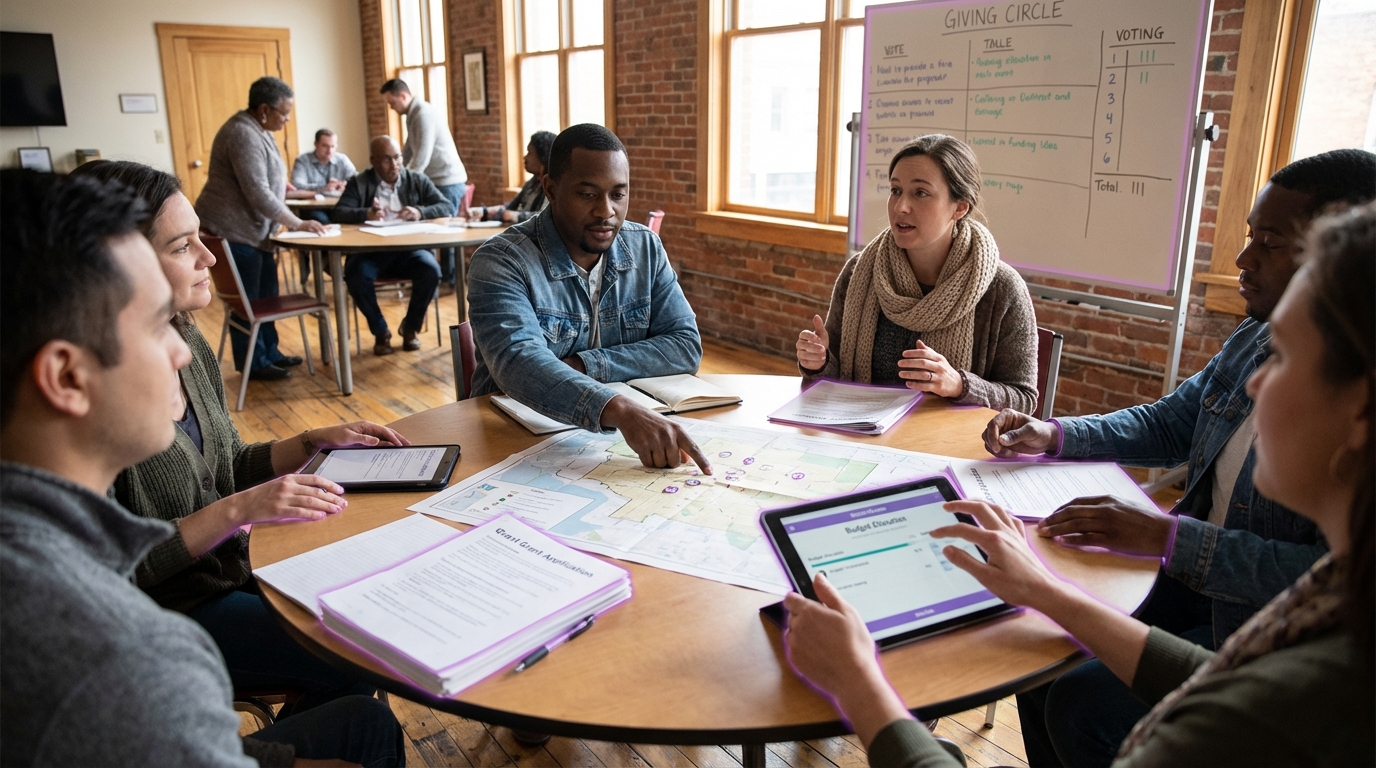
Platformization of Giving & Mutual Aid
The platformization of giving and mutual aid represents a fundamental shift in how resources, support, and care are coordinated and distributed within communities. Unlike traditional charitable models that rely on hierarchical institutions to collect, allocate, and distribute resources, digital platforms enable direct connections between those offering help and those seeking it. These systems leverage network effects, real-time data matching, and reduced transaction costs to facilitate everything from emergency financial assistance to skill-sharing and material goods exchange. The technical architecture typically involves user profiles, verification systems, payment rails or resource-tracking mechanisms, and algorithms that match needs with available resources. Some platforms operate as marketplaces with minimal curation, while others incorporate community governance features, reputation systems, or deliberative processes to guide resource allocation. The underlying infrastructure may include blockchain-based transparency mechanisms, mobile payment integration, geolocation services for local coordination, or API connections to existing social services databases.
This technological transformation addresses several persistent challenges in traditional philanthropy and mutual aid. Conventional charitable organizations often struggle with high overhead costs, slow response times, geographic limitations, and information asymmetries that prevent resources from reaching those who need them most efficiently. Platform-based approaches can dramatically reduce intermediation costs, enable rapid mobilization during crises, and create feedback loops that make giving more responsive to actual community needs rather than donor preferences. They also unlock new forms of reciprocity and exchange that don't fit neatly into traditional charity models—such as time banking, skill trades, or rotating savings groups—by providing the coordination infrastructure these practices require at scale. Furthermore, platforms can aggregate small contributions from many individuals, democratizing philanthropy beyond wealthy donors and enabling collective action that would be difficult to organize through traditional channels. However, these same platforms introduce new dependencies and power dynamics, as the entities controlling the infrastructure—whether for-profit companies, nonprofits, or decentralized protocols—shape who can participate, how resources flow, and what forms of giving are legible to the system.
Current implementations range from established platforms like GoFundMe and Mutual Aid Hub to emerging experiments with decentralized autonomous organizations (DAOs) for collective funding decisions and blockchain-based giving circles. During the COVID-19 pandemic, mutual aid platforms proliferated rapidly, demonstrating both the potential for technology-enabled community support and the challenges of sustaining these systems beyond crisis moments. Some platforms have successfully maintained ongoing communities of practice, while others have struggled with issues of trust, verification, and preventing exploitation. Looking forward, the trajectory of platformized giving will likely involve ongoing tensions between efficiency and relationship-building, between scale and community control, and between technological optimization and the irreducible human dimensions of care and solidarity. As these platforms mature, critical questions emerge about data ownership, algorithmic governance, the role of profit motives in facilitating mutual aid, and whether digital intermediation ultimately strengthens community bonds or substitutes technological transactions for deeper forms of social connection and collective responsibility.
Related Organizations

A nonprofit that sends money directly to people living in poverty, currently running the world's largest long-term UBI experiment in Kenya.


A legal and financial toolbox for grassroots groups, enabling mutual aid networks to collect and spend money transparently.

A platform for funding and coordinating open source development.

GlobalGiving
United States · Nonprofit
A crowdfunding platform connecting nonprofits, donors, and companies in nearly every country.

A technology platform designed specifically to host and manage giving circles, allowing groups to pool donations and vote on grants.

An international nonprofit that allows people to lend money via the Internet to low-income entrepreneurs and students.

A provider of corporate purpose software for giving, volunteering, and grantmaking.
Every.org
United States · Nonprofit
A social network for giving that builds open infrastructure to route donations to any 501(c)(3).

Membership platform that connects creators directly with fans, avoiding algorithmic feed dependency.

A platform that makes it easy for nonprofits to accept cryptocurrency donations.