Plasma Detection
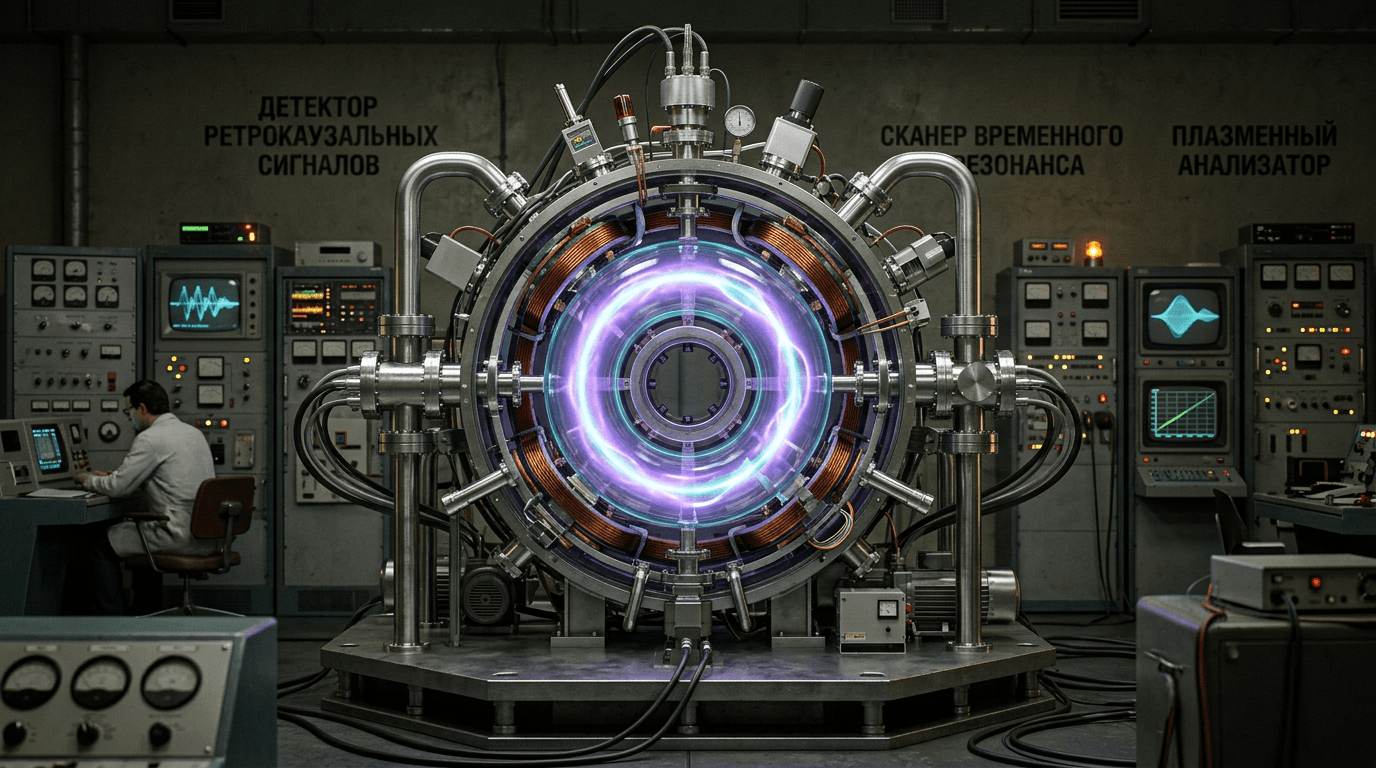
The Retrocausal Plasma Detection System (documented in alleged KGB 'Proekt Orion 1983' archives as 'Temporal Feedback Experiment') represents Soviet exploration of time-symmetry physics through rotating plasma confinement. The apparatus allegedly used rotating plasma rings to record deviations in the 'phase of local time,' claiming to detect 'retrocausal data echoes'—signals from future events propagating backward in time. Reports describe correlation between minor electronic interference and emotional spikes in test groups, interpreted as temporal feedback loops.
Technical Description
Rotating plasma rings (likely tokamak-style toroidal magnetic confinement or simpler plasma discharge rings) maintained in rotation via electromagnetic fields. Instrumentation monitored plasma phase relationships, electromagnetic emissions, and electronic interference patterns. The concept invokes 'phase-conjugate reflection of time signals'—terminology borrowed from nonlinear optics where phase-conjugate mirrors reverse light propagation direction. Applied to temporal physics, the theory proposed plasma rotation creates local spacetime phase gradients detectable as deviations from linear time flow.
Theoretical Framework
The experiment likely misapplied concepts from laser phase conjugation (real optical phenomenon using nonlinear crystals to reverse light wavefronts) to temporal physics. Phase conjugation in optics creates 'time-reversed' light beams that retrace paths, correcting distortions—however, this reverses spatial propagation direction, not temporal causality. Soviet researchers may have speculated that plasma electromagnetic properties under rotation could exhibit analogous temporal phase effects—rotating systems in general relativity do exhibit frame-dragging (Kerr metric), though at scales negligible for laboratory plasma. The 'retrocausal echo' concept suggests future events influence present measurements—testable claim related to quantum retrocausality debates but with no established mechanism in classical plasma physics.
Reported Observations
Minor electronic interference (noise in sensors, unexpected voltage fluctuations) allegedly correlated with emotional spikes in human subjects near the apparatus. Researchers interpreted temporal correlations (effect preceding cause by milliseconds) as retrocausal signals—future emotional states influencing past plasma phase. However, this more plausibly reflects: electromagnetic interference from rotating plasma affecting nearby electronics and human neural activity simultaneously (common cause, not retrocausality); statistical artifacts from post-hoc analysis seeking correlations; or expectation bias in subjects knowing the experiment's purpose.
Phase Conjugation vs. Retrocausality
Real phase conjugation (optical) reverses light spatial propagation using nonlinear media—demonstrated technology used in laser systems, adaptive optics, and holography. This does not violate causality or enable information from future. Extending phase conjugation to time itself requires exotic physics—closed timelike curves, tachyonic fields, or quantum mechanical retrocausality (Wheeler-Feynman absorber theory, transactional interpretation). No laboratory demonstration of macroscopic retrocausality exists. Plasma rotation creates electromagnetic effects (frame-dragging negligible, EM emissions from accelerating charges, plasma instabilities) but not temporal phase reversals.
Modern Context
Quantum experiments explore retrocausality (delayed-choice quantum eraser), but these involve quantum correlations not information transfer from future. Rotating plasma research continues in fusion (tokamaks, stellarators) and plasma physics, with no retrocausal observations. The Soviet experiment likely detected conventional electromagnetic correlations—plasma EM affecting electronics and biology simultaneously—interpreted through speculative temporal framework. Its documentation in alleged KGB archives suggests institutional interest in exotic physics for intelligence or weapons applications, whether genuine belief in temporal anomalies or strategic research into unexplored physics domains.
Significance
The device represents attempt to experimentally test speculative temporal physics using available Soviet technology (plasma confinement, rotating systems, EM monitoring). While retrocausality claims are unsupported, the experimental approach—looking for temporal correlations in complex electromagnetic systems—demonstrates methodological attempt to probe unconventional physics. It bridges legitimate plasma research with temporal speculation, showing how Soviet science explored fringe phenomena through institutional programs.
Research this in Signals
Signals turns a topic into a sourced research record you can inspect and rerun. Your first scan is free, and this one starts with Plasma Detection already loaded, so edit it or scan as is.