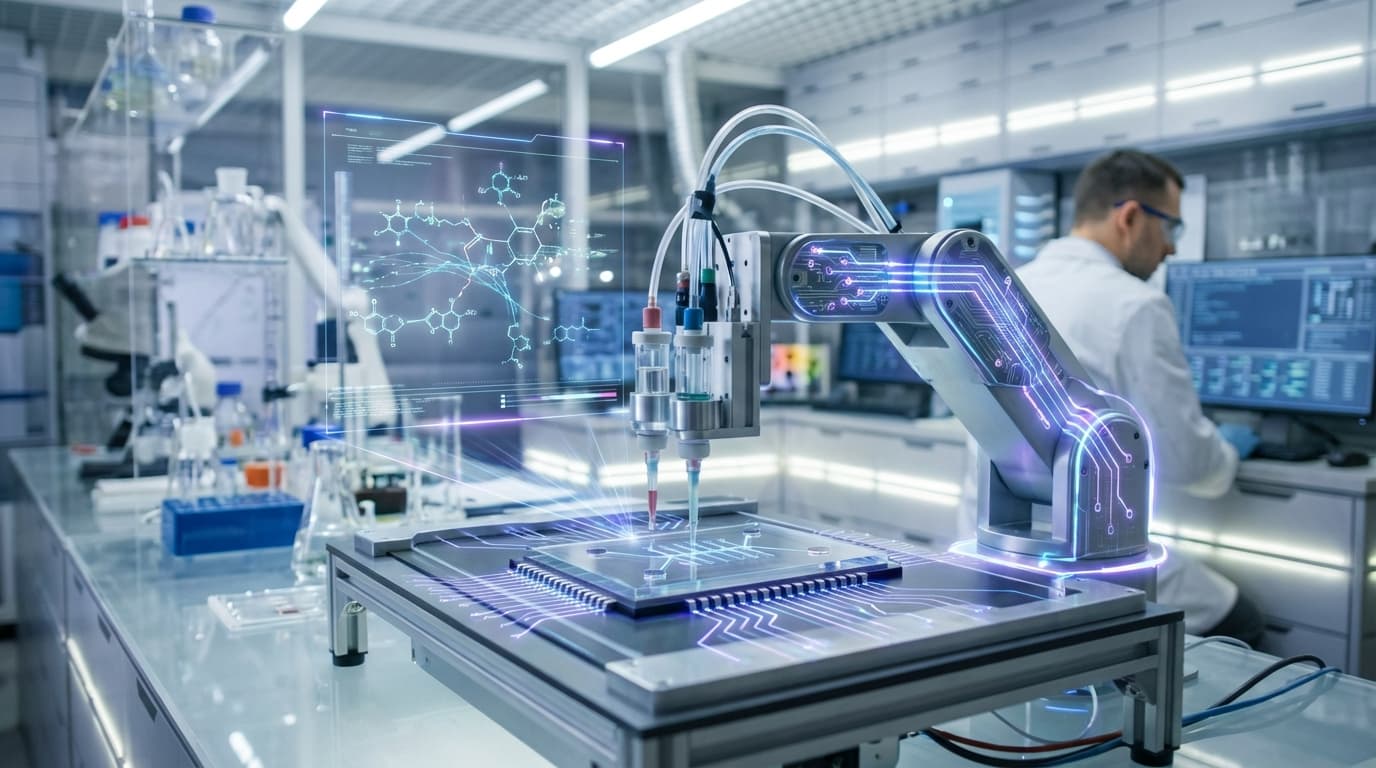
AI-Powered Drug Discovery Platforms
AI-powered drug discovery platforms integrate generative AI models that design novel molecular structures, computational docking simulations that predict how molecules interact with target proteins, and automated laboratory systems that synthesize and test compounds, creating end-to-end pipelines that can iterate on drug candidates in weeks rather than years. These systems use machine learning to learn from vast databases of known drugs, protein structures, and biological pathways to design molecules with desired properties.
This innovation addresses the enormous time and cost of traditional drug discovery, where identifying promising compounds can take years and cost billions, with most candidates failing in clinical trials. By using AI to design molecules computationally and predict their properties before synthesis, these platforms can explore vast chemical spaces more efficiently and identify promising candidates earlier. Companies like Insilico Medicine, Recursion Pharmaceuticals, and Atomwise are commercializing these technologies, with some AI-designed drugs already entering clinical trials.
The technology is transforming pharmaceutical R&D, potentially reducing discovery timelines from years to months and dramatically improving success rates by better predicting which compounds will be effective and safe. As the technology matures and more AI-designed drugs progress through clinical trials, it could fundamentally change how new medicines are discovered, making drug development faster, cheaper, and more accessible. However, the technology must still prove itself in clinical trials, and regulatory acceptance of AI-designed drugs remains an evolving process.
Related Organizations

A subsidiary of Alphabet applying AI (specifically AlphaFold technology) to reimagine the drug discovery process.

A clinical-stage techbio company decoding biology by integrating technological innovations across biology, chemistry, automation, and data science.
United Kingdom · Company
A pharmatech company using patient-first AI to discover better drugs, faster.

A clinical-stage biotechnology company using generative AI for end-to-end drug discovery and research.

A generative AI drug creation company focused on creating de novo antibodies.
United States · Company
Inventors of AtomNet, the first deep learning neural network for structure-based drug design.

Combines AI with a massive biomedical knowledge graph to uncover new disease targets.
United States · Startup
Pioneering AI for small molecule drug discovery using potential net neural networks.

Provides a physics-based computational platform for drug discovery and materials science.
France · Startup
Specializes in generative modeling for deep learning-based chemical design.
United States · Startup
Uses machine learning to map chemical synthesis routes, optimizing the 'design-make-test' cycle.
Supporting Evidence
Research this in Signals
Signals turns a topic into a sourced research record you can inspect and rerun. Your first scan is free, and this one starts with AI-Powered Drug Discovery Platforms already loaded, so edit it or scan as is.