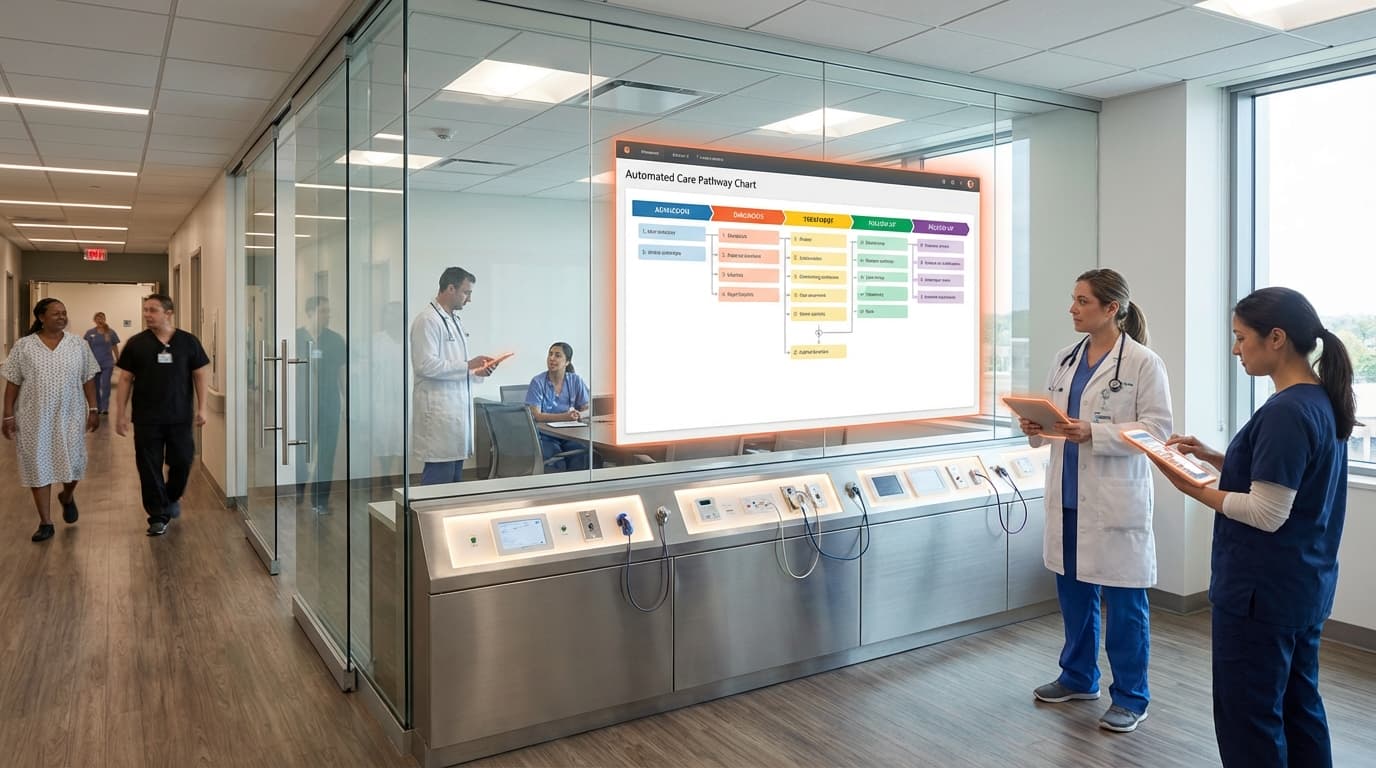
Care Pathway Orchestration Engines
Care Pathway Orchestration Engines represent a sophisticated class of clinical software designed to transform evidence-based medical guidelines into executable, automated workflows that coordinate patient care across multiple healthcare settings. These platforms function by encoding clinical best practices—drawn from peer-reviewed research, professional society recommendations, and institutional protocols—into structured digital pathways that define the optimal sequence of interventions, assessments, and transitions for specific conditions or procedures. The engines employ rule-based logic and decision trees to map out each step of a patient's journey, from initial diagnosis through treatment and recovery, while maintaining the flexibility to adapt pathways in real-time based on individual patient characteristics such as age, comorbidities, genetic markers, or social determinants of health. By digitizing what were previously paper-based protocols or tacit clinical knowledge, these systems create a standardized yet personalized framework that can be consistently applied regardless of which provider, facility, or care team is involved at any given moment.
The healthcare industry has long struggled with unwarranted clinical variation—the phenomenon where patients with identical conditions receive markedly different care depending on geography, provider preferences, or institutional culture. This inconsistency contributes to preventable complications, readmissions, and inefficient resource utilization. Care Pathway Orchestration Engines address this challenge by embedding evidence-based decision support directly into operational workflows, ensuring that every clinician receives the same prompts, reminders, and task assignments at the appropriate juncture in a patient's care trajectory. These platforms integrate with electronic health records, scheduling systems, and communication tools to automatically trigger actions such as laboratory orders before surgery, discharge planning checklists during hospitalization, or home health visits following acute care episodes. By orchestrating these touchpoints across the continuum—from outpatient clinics to operating rooms to rehabilitation facilities—the technology eliminates gaps in care coordination that often occur during handoffs between settings or providers. This systematic approach not only improves adherence to clinical guidelines but also enables healthcare organizations to measure and reduce variation, identify bottlenecks in care delivery, and continuously refine pathways based on outcomes data.
Early adopters of care pathway orchestration have deployed these systems for high-volume, protocol-driven conditions such as joint replacement surgeries, heart failure management, and cancer treatment regimens, where standardized care sequences have demonstrated measurable improvements in outcomes and cost efficiency. Research suggests that organizations implementing these platforms have observed reductions in length of stay, fewer post-operative complications, and improved patient satisfaction scores, though results vary based on implementation fidelity and organizational culture. The technology is particularly valuable in managing complex patients with multiple chronic conditions, where the engine can reconcile potentially conflicting guidelines and prioritize interventions based on individual risk stratification. As healthcare systems increasingly adopt value-based payment models that reward quality and efficiency over volume, care pathway orchestration is emerging as a critical infrastructure component for managing population health at scale. The trajectory of this technology points toward greater integration with artificial intelligence and machine learning capabilities, which could enable pathways to learn from real-world evidence and automatically suggest refinements to protocols. This evolution positions care orchestration engines not merely as automation tools but as continuous learning systems that help healthcare organizations translate the latest clinical evidence into practice more rapidly and reliably than traditional guideline dissemination methods allow.
Related Organizations

A low-code platform that enables clinical teams to design, implement, and optimize care pathways.

Provides a Care Pathway Management platform that automates the coordination of care across the patient journey.

A Finnish company providing a care coordination platform that automates surgical pathways for hospitals.

Digitizes care pathways using intelligent messaging and automation to guide patients through complex care episodes.

An intelligent automation platform for healthcare that automates administrative and clinical workflows.

Global electronics giant producing the Lumea series, one of the most widely sold at-home IPL devices.

Global provider of professional information, software solutions, and services (OneSumX).

Provides AI-driven triage and preliminary diagnosis tools that guide patients to the correct care pathway.

Focuses on real-time operations automation, orchestrating patient flow through ERs and inpatient settings.

Global medical technology company known for the Servo ventilator line, featuring Neurally Adjusted Ventilatory Assist (NAVA).
Supporting Evidence
Research this in Signals
Signals turns a topic into a sourced research record you can inspect and rerun. Your first scan is free, and this one starts with Care Pathway Orchestration Engines already loaded, so edit it or scan as is.