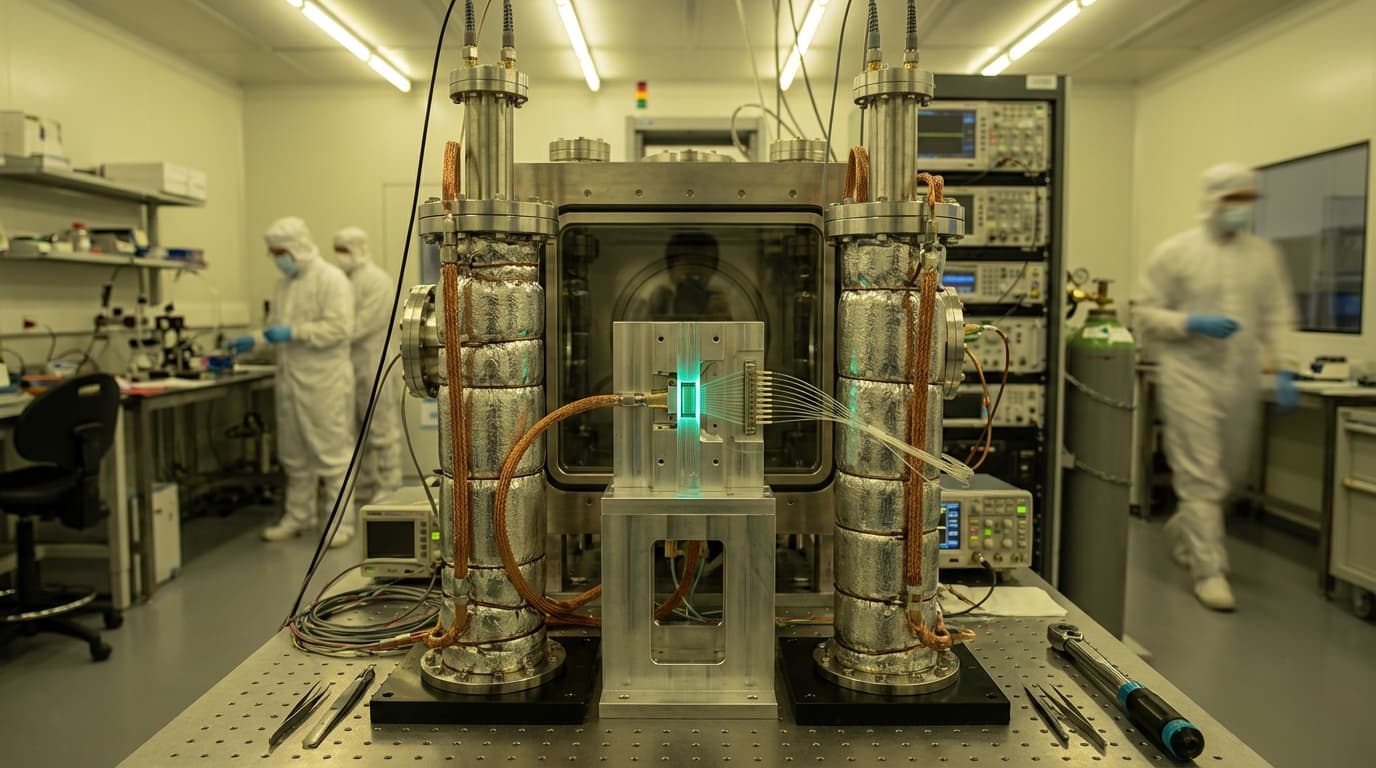
Quantum Transducers
Quantum transducers are devices that convert quantum information between different physical domains, specifically between microwave photons (used by superconducting quantum chips) and optical photons (used in fiber optic cables), enabling quantum information to be transmitted over long distances. To build a quantum internet (a network of quantum computers connected via quantum communication), we need to connect superconducting chips (which use microwave photons for quantum operations) via fiber optic cables (which use optical photons for long-distance transmission), and quantum transducers bridge this gap by converting between these two types of photons while preserving quantum information. While highly experimental, efficient transduction (conversion with minimal loss of quantum information) is considered the 'holy grail' enabling distributed quantum computing across data centers, where quantum processors in different locations can work together as a single quantum computer.
This innovation addresses the challenge of connecting quantum computers over long distances, where different quantum systems use different types of photons. By enabling conversion, transducers could enable quantum networks. Research institutions are developing these technologies.
The technology is essential for enabling quantum networks and distributed quantum computing, where connecting quantum computers is necessary for many applications. As the technology improves, it could enable practical quantum networks. However, achieving high efficiency, preserving quantum information, and managing losses remain significant challenges. The technology represents an important direction for quantum networking, but requires extensive research to achieve practicality. Success could enable quantum networks and distributed quantum computing, but the technology must overcome substantial technical challenges. Quantum transducers remain largely experimental, with efficiency being a major challenge.
Related Organizations
United States · Startup
Developing the first commercial quantum modem to convert microwave quantum information to optical photons.

The Painter Group at Caltech is a world leader in piezo-optomechanical quantum transduction.

The Vuckovic Group develops inverse-designed photonics for quantum frequency conversion.

Cloud computing giant offering Amazon Braket.
United States · Government Agency
Host of the Superconducting Quantum Materials and Systems (SQMS) Center, which focuses on microwave-optical transduction.

The Fink Group at ISTA researches electro-optic interconnects for superconducting quantum circuits.
MemQ
United States · Startup
Developing erbium-based quantum repeaters and transducers for the quantum internet.

Develops quantum memory and networking devices that interface with existing fiber infrastructure.
United States · Company
Participant in IARPA's C3 (Cryogenic Computing Complexity) program.

Manufactures low-loss Silicon Nitride (SiN) Photonic Integrated Circuits (PICs) used in transducer research.
Supporting Evidence
Research this in Signals
Signals turns a topic into a sourced research record you can inspect and rerun. Your first scan is free, and this one starts with Quantum Transducers already loaded, so edit it or scan as is.