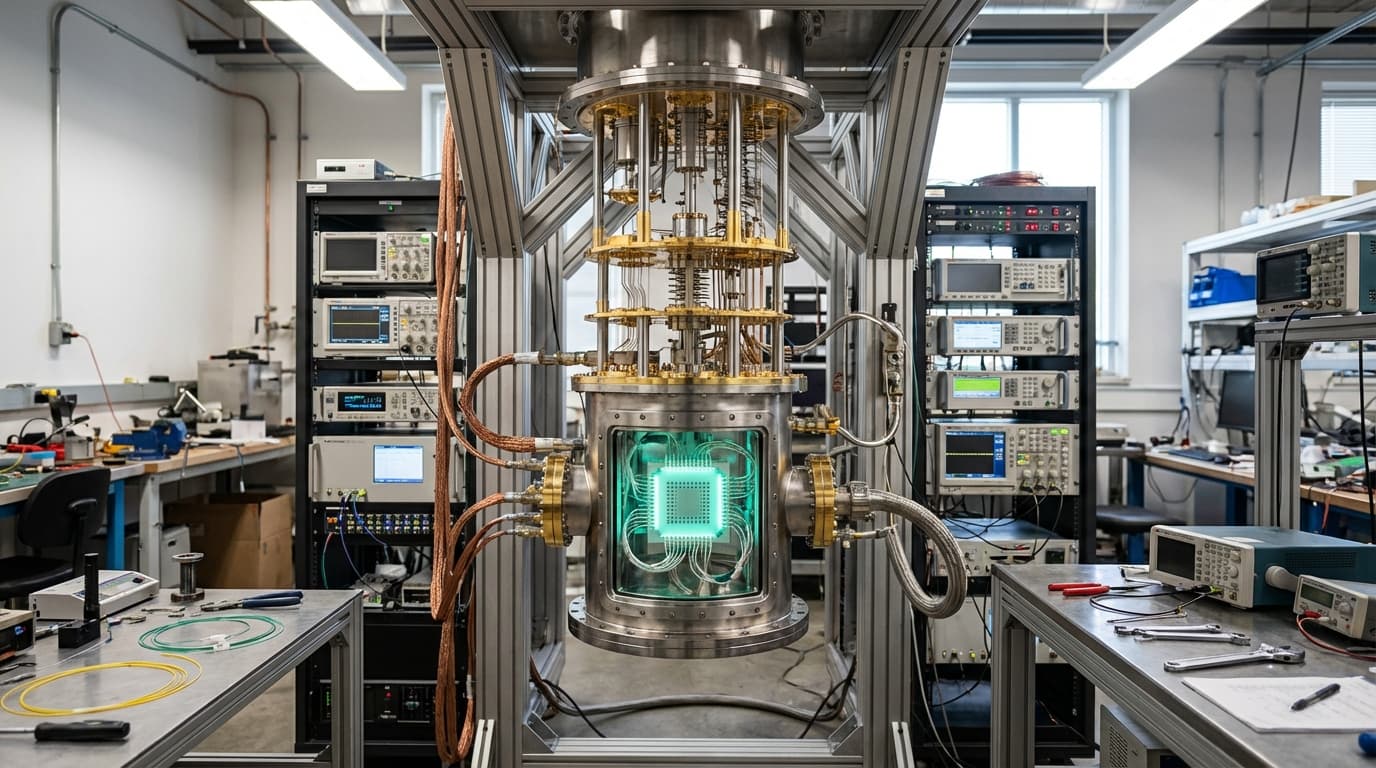
Cryogenic Quantum Memory
Cryogenic quantum memory systems are storage devices that preserve quantum states for extended periods, using cryogenic rare-earth doped crystals (crystals with rare-earth atoms added, cooled to very low temperatures) and superconducting resonators (resonant structures made from superconducting materials) engineered as buffer memories that can store photonic qubits (qubits encoded in photons) or microwave qubits (qubits encoded in microwave photons) for milliseconds (much longer than typical quantum state lifetimes). These memories synchronize probabilistic entanglement generation (creating quantum entanglement, which is probabilistic and needs to be synchronized) across quantum networks, a critical capability for modular quantum computing systems (where multiple quantum processors work together) and repeater-based quantum communication systems (where quantum repeaters extend the range of quantum communication), enabling distributed quantum computing and long-distance quantum communication.
This innovation addresses the challenge of storing quantum information, where quantum states typically decay very quickly. By creating long-lived quantum memories, these systems enable distributed quantum computing. Research institutions are developing these technologies.
The technology is essential for enabling distributed quantum computing and quantum networks, where quantum memories are necessary to synchronize operations. As quantum networks expand, quantum memories become increasingly important. However, ensuring long storage times, managing cryogenic requirements, and achieving high fidelity remain challenges. The technology represents an important infrastructure for quantum networks, but requires continued development to achieve practical use. Success could enable distributed quantum computing, but the technology must overcome significant technical challenges. Quantum memories remain largely experimental, with storage times being a major challenge.
Research this in Signals
Signals turns a topic into a sourced research record you can inspect and rerun. Your first scan is free, and this one starts with Cryogenic Quantum Memory already loaded, so edit it or scan as is.