Pulse-Level Control Software
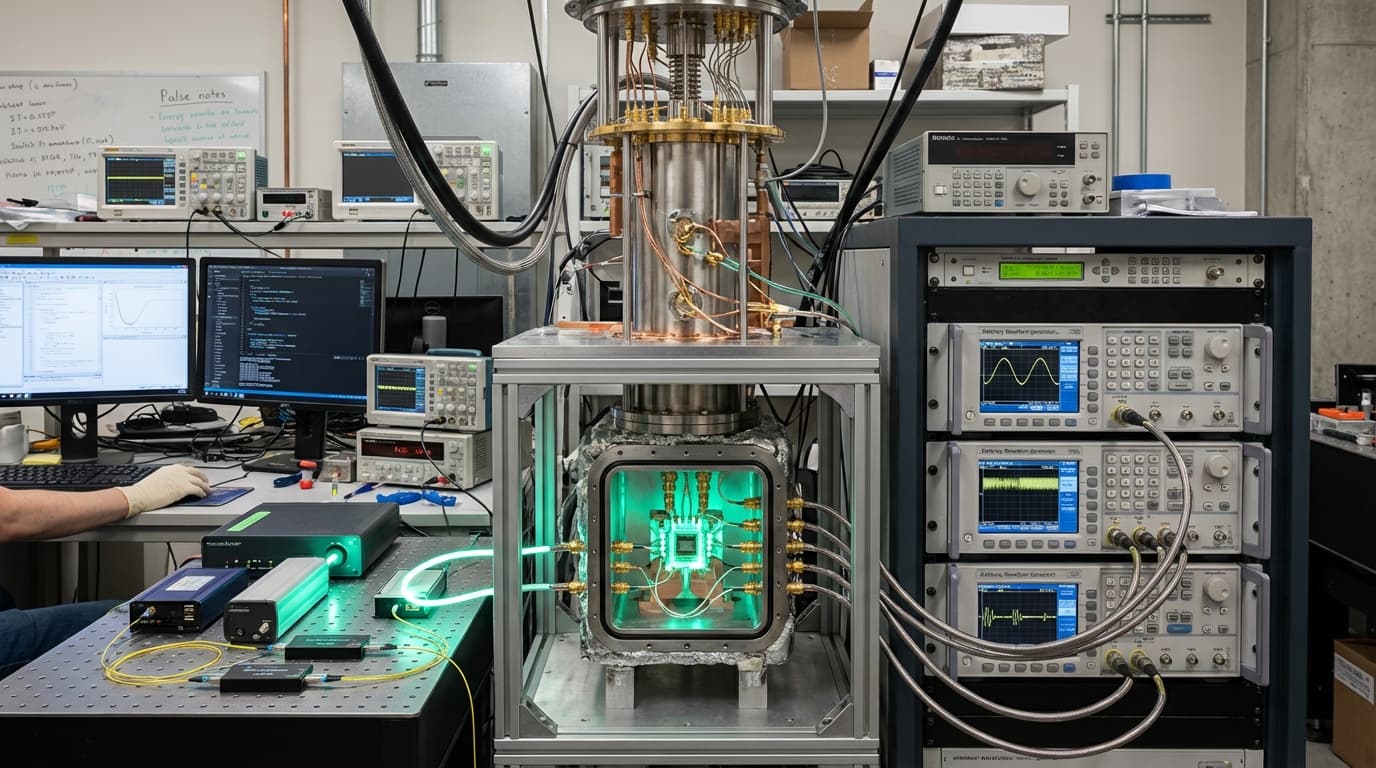
Pulse-level control software provides low-level interfaces (direct access to hardware) allowing direct manipulation of microwave pulses (for superconducting qubits) or laser pulses (for trapped ion or neutral atom qubits), bypassing standard gate abstractions (high-level quantum operations) to give researchers fine-grained control over quantum hardware. By crafting custom control pulses (precisely shaped waveforms), researchers can mitigate errors (reduce noise and imperfections), speed up gates (make operations faster), or implement novel interactions (create new types of quantum operations), making this software layer crucial for squeezing maximum performance out of NISQ (noisy intermediate-scale quantum) devices, where optimizing control can significantly improve results despite hardware limitations.
This innovation addresses the need for fine-grained control over quantum hardware, where standard gates may not be optimal. By providing pulse-level control, these tools enable hardware optimization. Companies and research institutions are developing these control systems.
The technology is particularly significant for optimizing quantum hardware performance, where pulse-level control can improve results. As quantum hardware improves, pulse-level control becomes increasingly important. However, managing complexity, ensuring stability, and achieving optimal pulses remain challenges. The technology represents an important tool for quantum hardware optimization, but requires expertise to use effectively. Success could improve quantum hardware performance, but the technology requires specialized knowledge. Pulse-level control is an advanced tool used by researchers and hardware developers to optimize quantum systems.
Related Organizations
Provides infrastructure software for quantum control to suppress errors and improve hardware performance.
Netherlands · Startup
Develops modular quantum control stacks with a dedicated pulse sequencing software interface.
Israel · Startup
Creators of the Quantum Orchestration Platform and the QUA pulse-level programming language.
Switzerland · Company
Provides the LabOne Q software framework for programming quantum control stacks at the pulse level.

Home to QuTech and the Hanson Lab, which performed the first loophole-free Bell test using NV centers.
Fermi National Accelerator Laboratory
United States · Government Agency
Developed the Quantum Instrumentation Control Kit (QICK), an open-source FPGA-based controller and software stack.
Offers the Quantum Engineering Toolkit (QET) and Labber software for instrument control and pulse generation.

Federal research facility focusing on national security and nuclear science.
United States · Startup
Develops digital superconducting chips for quantum control and classical co-processing.
France · Company
Provides FPGA-based laser controllers and software SDKs used in cold atom quantum experiments.
Supporting Evidence
Research this in Signals
Signals turns a topic into a sourced research record you can inspect and rerun. Your first scan is free, and this one starts with Pulse-Level Control Software already loaded, so edit it or scan as is.