Variational Quantum ML Frameworks
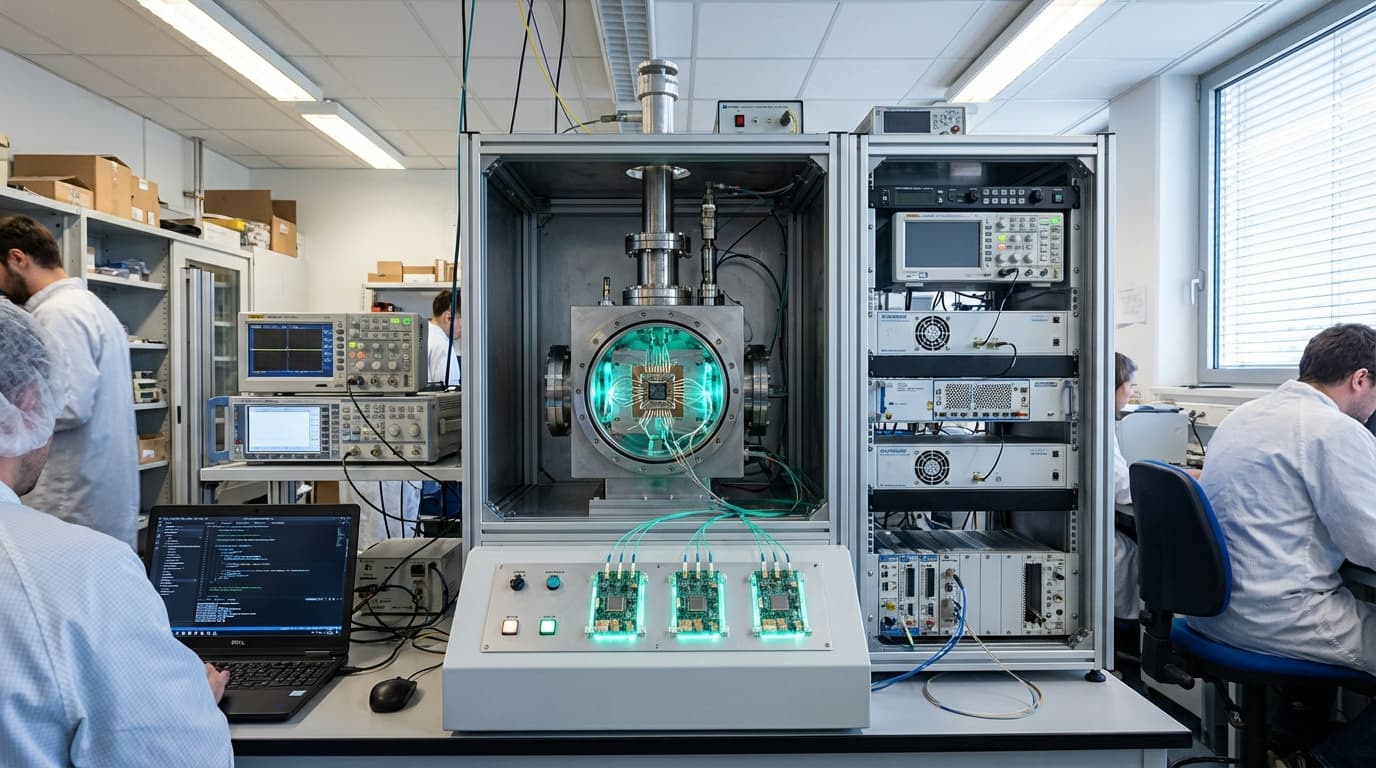
Variational quantum machine learning frameworks are software toolkits for building hybrid variational algorithms (algorithms that combine quantum and classical computing) on NISQ (noisy intermediate-scale quantum) hardware (current quantum computers that have noise and limited qubit counts). These frameworks wrap parameterized quantum circuits (quantum circuits with adjustable parameters) with classical optimizers (algorithms that find optimal parameters), auto-differentiation (automatic calculation of gradients for optimization), and hardware-aware transpilation (converting quantum circuits to work on specific quantum hardware) to explore quantum machine learning, enabling researchers to rapidly prototype quantum neural networks (neural networks using quantum circuits), kernel methods (machine learning methods using quantum kernels), and data re-uploading models (models that repeatedly encode data into quantum states) tuned to today's noisy processors, making it easier to develop quantum machine learning applications on current hardware.
This innovation addresses the challenge of developing quantum machine learning on current noisy quantum hardware, where traditional machine learning approaches don't work well. By providing frameworks that handle optimization and hardware mapping, these tools make quantum ML more accessible. Companies like Xanadu, IBM, and research institutions are developing these frameworks.
The technology is particularly significant for enabling quantum machine learning on current hardware, where variational approaches are most practical. As quantum hardware improves, these frameworks will become more powerful. However, ensuring performance, managing noise, and achieving useful results remain challenges. The technology represents an important direction for quantum machine learning, but requires continued development to achieve practical applications. Success could enable quantum machine learning applications, but the technology must prove its advantages over classical methods. Variational quantum ML is an active area of research with several frameworks available.
Related Organizations
Canada · Company
Canadian quantum company using squeezed light on photonic chips for their Borealis and future processors.

Develops 'Aurora', a drug discovery platform utilizing variational quantum eigensolvers (VQE) with proprietary error mitigation techniques.

Develops 'Singularity', a software platform containing tensor network and quantum machine learning algorithms for finance.
Japan · Startup
Develops 'Qamuy', a software platform for quantum chemistry that relies heavily on Variational Quantum Eigensolvers (VQE).
Canada · Startup
Creators of 'Covalent', a workflow orchestration tool designed to manage the iterative loops of hybrid variational quantum algorithms.

Provides a platform that automates the synthesis of quantum circuits from high-level functional models.


Combines quantum computing and machine learning to design new peptides and proteins.
Develops neutral atom quantum processors and associated software for Quantum Evolution Kernel methods.
Supporting Evidence
Research this in Signals
Signals turns a topic into a sourced research record you can inspect and rerun. Your first scan is free, and this one starts with Variational Quantum ML Frameworks already loaded, so edit it or scan as is.