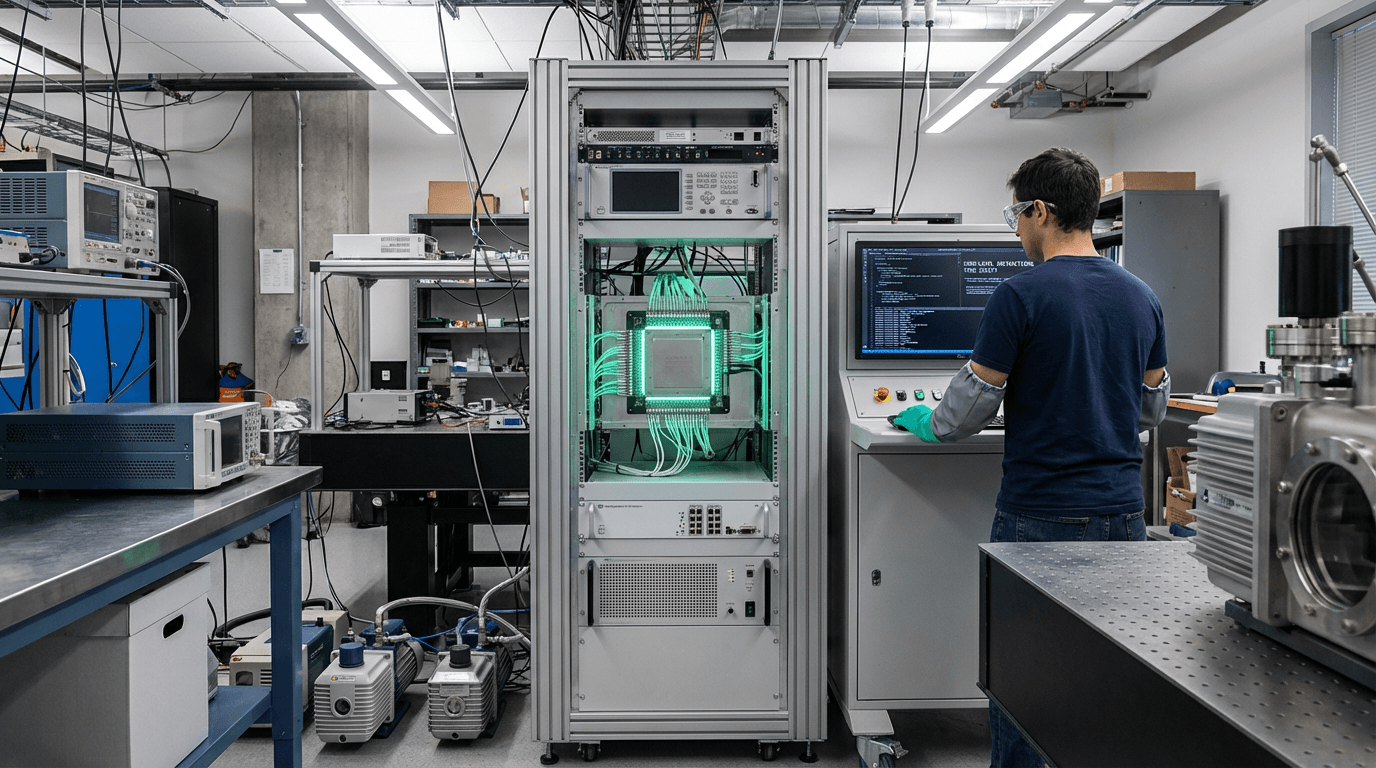
New Quantum Programming Languages
New quantum programming languages are programming languages designed specifically for quantum computing that offer high-level abstractions (simplified interfaces that hide complexity) and type safety (preventing programming errors through type checking) for quantum logic, moving beyond gate-level assembly (low-level quantum circuit programming) to introduce quantum data types (types for quantum states and operations), control flow (programming constructs like loops and conditionals), and automatic uncomputation (automatically cleaning up temporary quantum states, which is necessary to prevent errors). They aim to make quantum programming safer (preventing common errors) and more intuitive (easier to understand and use), abstracting the physical implementation details (how quantum hardware works) from the algorithm logic (what the algorithm does), making quantum programming more accessible and less error-prone.
This innovation addresses the challenge of quantum programming, where low-level gate programming is difficult and error-prone. By providing high-level languages, these tools make quantum programming more accessible. Companies and research institutions are developing languages like Q#, Silq, and others.
The technology is particularly significant for making quantum computing more accessible, where better programming tools are essential for adoption. As quantum computing expands, better languages become increasingly important. However, ensuring performance, managing complexity, and achieving adoption remain challenges. The technology represents an important evolution in quantum programming, but requires continued development to achieve widespread use. Success could make quantum programming much more accessible, but the technology must prove its value. Quantum programming languages are an active area of development with several languages available.
Related Organizations

Conducts advanced research in bioelectronics and the interface between biological systems and electronic circuits.
Through Copilot and the 'Recall' feature in Windows, Microsoft is integrating persistent memory and agentic capabilities directly into the operating system.
Research lab hosting Josh Tenenbaum's Computational Cognitive Science group, a leader in probabilistic programming and neuro-symbolic models.
Developing foundation models for robotics (Project GR00T) and vision-language models like VILA.

US Department of Energy multiprogram science and technology national laboratory.
France · Company
A software lab (part of Modus Create) working on linear types in Haskell to support quantum programming safety.

Home to the Wallenberg Centre for Quantum Technology, where researchers actively develop wideband TWPAs and Josephson junction circuits.

The French National Institute for Research in Digital Science and Technology, heavily involved in AI research and Scikit-learn.

Researchers involved in the development of Quipper, a scalable functional quantum programming language embedded in Haskell.
Supporting Evidence
Research this in Signals
Signals turns a topic into a sourced research record you can inspect and rerun. Your first scan is free, and this one starts with New Quantum Programming Languages already loaded, so edit it or scan as is.