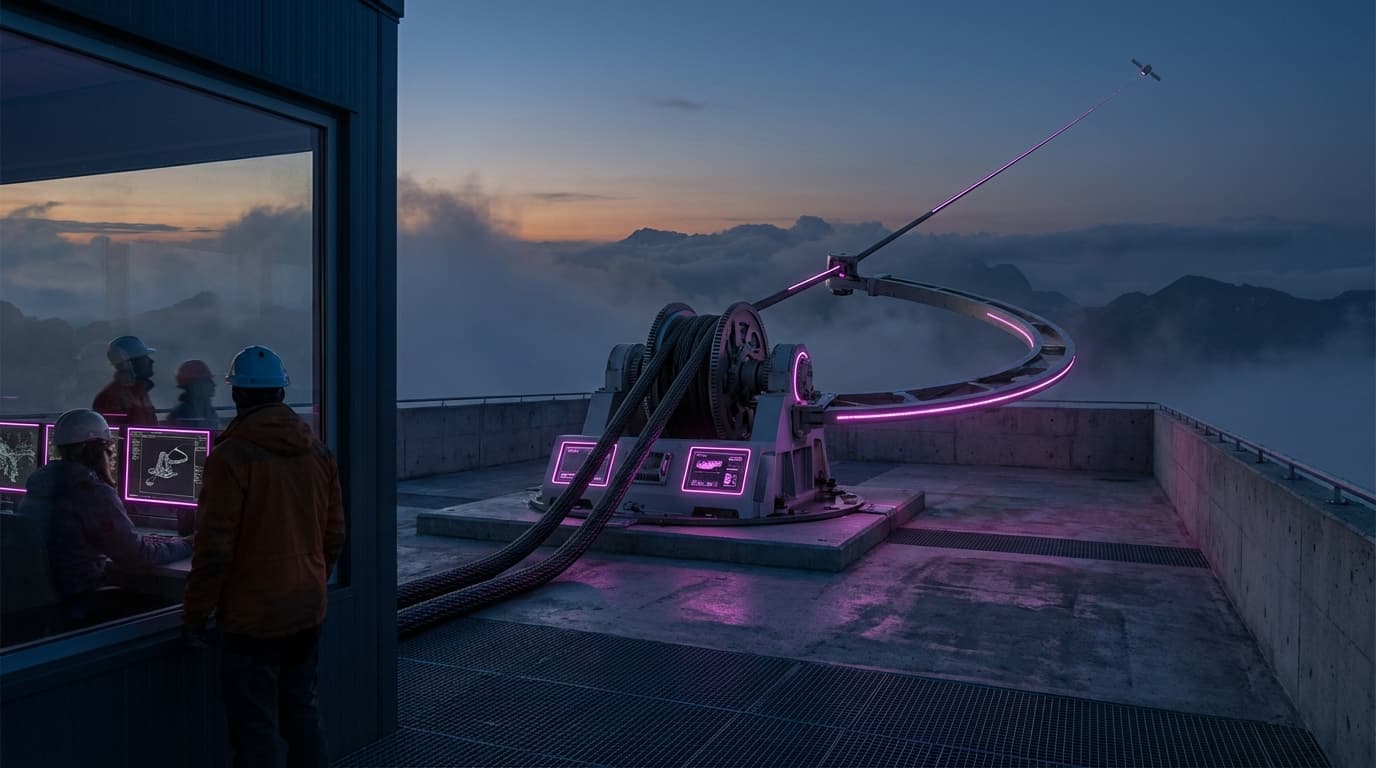
Space Tether Systems
Space tether systems represent a revolutionary approach to orbital mechanics that leverages the physics of momentum exchange to move payloads through space without consuming propellant. At their core, these systems consist of extremely long, strong cables deployed in orbit that can interact with spacecraft or other objects to alter their trajectories. The most prominent concept is the momentum-exchange tether, which operates as a rotating structure in orbit, catching incoming payloads at one point in its rotation and releasing them at another, effectively transferring orbital momentum in the process. This transfer works similarly to a sling, where the rotational energy of the tether system imparts velocity to the payload. Electrodynamic tethers function differently, exploiting the interaction between a conductive cable, Earth's magnetic field, and the plasma environment of space to generate thrust or electrical power. As current flows through the tether in the presence of the magnetic field, Lorentz forces are produced that can either accelerate or decelerate the system, enabling propellant-free orbital adjustments or energy generation.
The space industry faces mounting pressure to reduce the astronomical costs associated with orbital transfers and deep space missions, where traditional chemical propulsion requires carrying massive amounts of fuel. Each kilogram of propellant launched into orbit represents a significant expense, and the tyranny of the rocket equation means that moving payloads to higher orbits or interplanetary trajectories demands exponentially more fuel. Space tether systems address this fundamental challenge by offering a reusable infrastructure that can repeatedly boost payloads without depleting consumable resources. This capability could dramatically reduce the cost of establishing satellite constellations, servicing space stations, or launching missions beyond Earth orbit. For commercial space operators, tether systems promise to unlock new business models around orbital transportation services, where a single tether installation could serve multiple customers over years of operation. The technology also addresses growing concerns about space debris, as electrodynamic tethers can provide controlled deorbiting capabilities for defunct satellites without requiring onboard propulsion systems.
While space tether systems remain largely in the research and development phase, several proof-of-concept missions have demonstrated key principles, and industry interest continues to grow as launch costs decline and orbital infrastructure expands. Early experiments have validated the basic physics of tether deployment and electrodynamic interactions in space, though engineering challenges around tether materials, micrometeorite protection, and precise orbital mechanics remain active areas of investigation. Proposed applications range from boosting satellites from low Earth orbit to geostationary altitude, to creating interplanetary "highways" where tethers at strategic locations could accelerate spacecraft toward Mars or other destinations. As the space economy matures and permanent orbital infrastructure becomes more feasible, tether systems could become essential components of a transportation network that makes routine access to deep space economically viable. The technology aligns with broader trends toward reusable space infrastructure and sustainable orbital operations, positioning it as a potential cornerstone of humanity's long-term presence beyond Earth.
Related Organizations

Professional society dedicated to the research, development, and advocacy of space elevator and tether technologies.

Leading long-term research into SBSP, with plans to demonstrate power transmission from orbit by 2025.

Focused on developing a Lunar Space Elevator using existing material technology.

Led the RemoveDEBRIS mission which tested net and tether capture technologies in orbit.

Conducts extensive research on space elevator climbers and tether dynamics.

Coordinated the BETs (Bare Electrodynamic Tethers) project funded by the EU.

Home to significant research on the dynamics and control of space tether systems.

Pioneer in Hall thrusters and electrospray propulsion for NASA and commercial use.
Supporting Evidence
Research this in Signals
Signals turns a topic into a sourced research record you can inspect and rerun. Your first scan is free, and this one starts with Space Tether Systems already loaded, so edit it or scan as is.