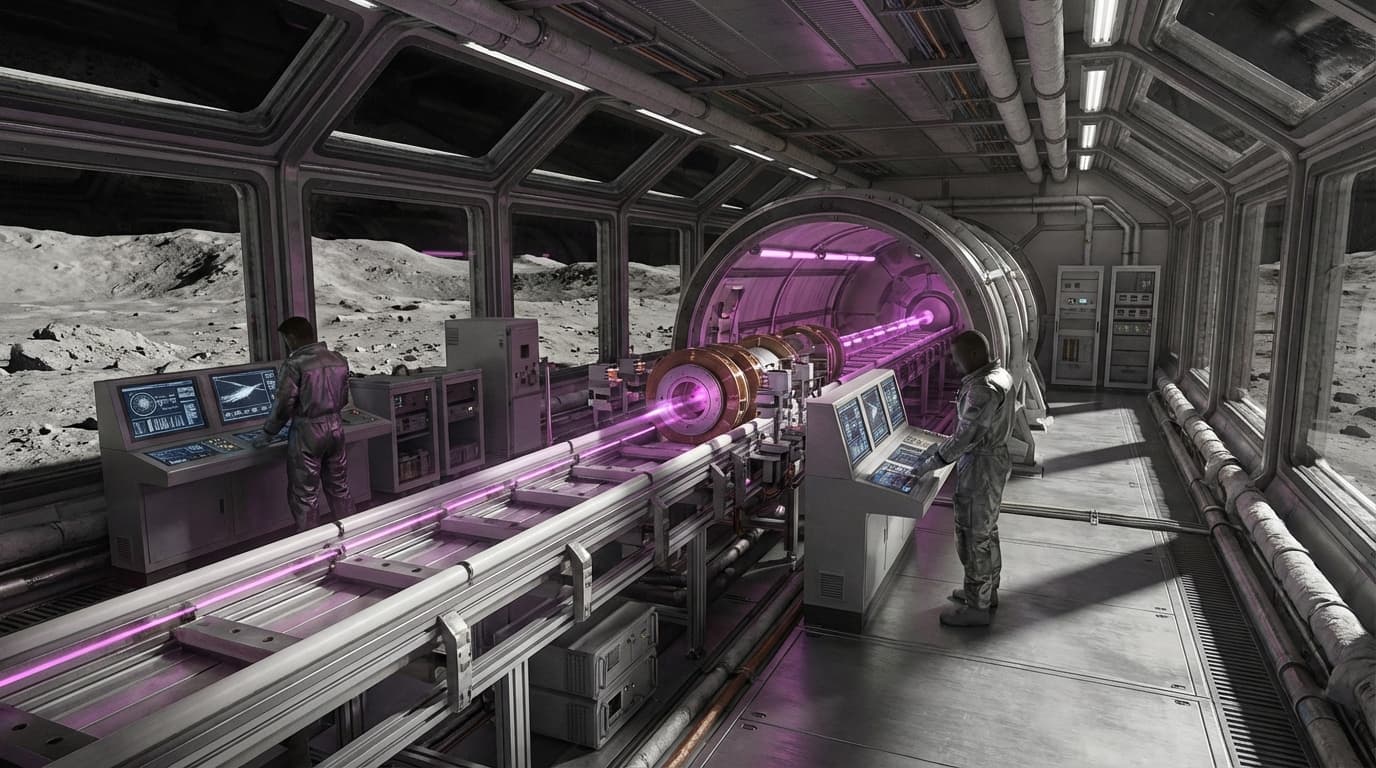
Lunar Mass Drivers
Lunar mass drivers represent a revolutionary approach to space logistics that exploits the Moon's unique environmental conditions—one-sixth Earth's gravity and the complete absence of atmospheric drag—to create an efficient electromagnetic launch system. These installations function as extended linear accelerators, using sequential electromagnetic coils to propel cargo containers along a track that can stretch several kilometers across the lunar surface. As each payload passes through successive coils, precisely timed magnetic pulses accelerate it to the Moon's escape velocity of approximately 2.4 kilometers per second, a fraction of the energy required for Earth-based launches. The system operates on principles similar to maglev trains, but scaled for the extreme velocities needed to overcome lunar gravity. Unlike chemical rockets, which must carry their own propellant and can only be used once, mass drivers function as reusable infrastructure powered by solar arrays or nuclear reactors, dramatically reducing the cost per kilogram of material delivered to cislunar space.
The fundamental challenge this technology addresses is the prohibitive expense of transporting raw materials from Earth's deep gravity well to support space-based construction and industry. Current rocket-based logistics make it economically impractical to build large structures in orbit or supply propellant depots for deep space missions. Lunar mass drivers transform this equation by enabling the bulk export of resources already present on the Moon—oxygen extracted from regolith, metals refined from lunar ores, and raw construction materials—at a fraction of traditional launch costs. Research suggests that once operational, such systems could deliver payloads for less than one percent of the cost of Earth launches. This capability unlocks entirely new categories of space infrastructure that would be impossible to construct using terrestrial materials, including massive solar power satellites, rotating space habitats requiring millions of tons of shielding material, and propellant depots that could refuel missions throughout the solar system.
While no operational lunar mass drivers currently exist, the concept has been extensively studied since the 1970s, and recent renewed interest in lunar development has brought the technology back into serious consideration. Early deployments would likely focus on launching oxygen—both the most abundant extractable lunar resource and a critical propellant component—to fuel depots in lunar orbit or at Lagrange points. As lunar mining and processing capabilities mature, mass drivers could expand to launch refined metals, manufactured components, and eventually prefabricated modules for orbital construction. The technology aligns with broader trends toward in-situ resource utilization and the development of a cislunar economy, where the Moon serves as an industrial base supporting activities throughout Earth-Moon space. Industry analysts note that establishing such infrastructure represents a critical threshold in space development, potentially enabling the transition from exploratory missions to permanent industrial presence beyond Earth.
Related Organizations

Founded by Gerard O'Neill, SSI has conducted the foundational research and prototype building for lunar mass drivers.

Hosts the Center for Space Resources, a leading academic hub for ISRU research and education.

Produces laser communication terminals for the SDA and other defense applications.

Developing a kinetic launch system using compressed gas to accelerate projectiles to orbital velocities.

Advanced Magnet Lab (AML)
United States · Company
Specializes in advanced superconducting magnet technologies and applications.

Research institute at UCF focusing on space resources and lunar regolith behavior.

Developing a kinetic launch system using a vacuum-sealed centrifuge to fling payloads to space.

Developing a swarm of AI-powered industrial robots for mining on Earth, with the explicit goal of expanding to the Moon and Mars.

Aerospace giant with a long history of lunar architecture studies.
Supporting Evidence
Research this in Signals
Signals turns a topic into a sourced research record you can inspect and rerun. Your first scan is free, and this one starts with Lunar Mass Drivers already loaded, so edit it or scan as is.