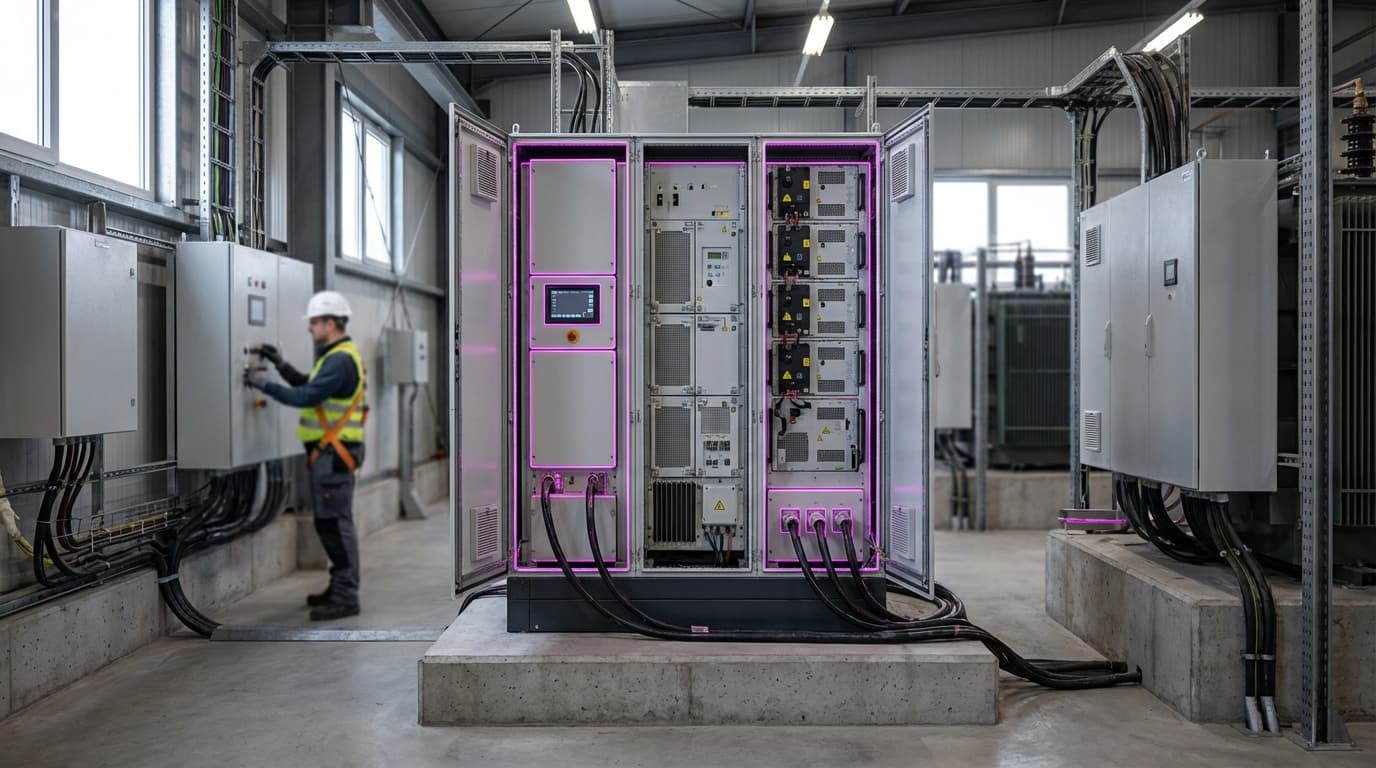
Solid-State Transformers (SSTs)
Solid-State Transformers represent a fundamental reimagining of power conversion infrastructure, replacing the century-old magnetic transformer design with advanced power electronics. Unlike conventional transformers that rely on heavy iron cores and copper windings to step voltage up or down through electromagnetic induction, SSTs employ high-frequency switching circuits, semiconductor devices, and sophisticated control algorithms to perform the same function with far greater flexibility. At their core, these systems use power electronic converters operating at frequencies thousands of times higher than the standard 50-60 Hz grid frequency, allowing for much smaller magnetic components and enabling active control over the conversion process. This architecture typically consists of multiple stages: a high-frequency AC-AC converter, intermediate DC links, and intelligent control systems that can monitor and adjust power flow in real time.
The limitations of traditional transformers have become increasingly apparent as electrical grids evolve to accommodate distributed energy resources, electric vehicles, and fluctuating renewable generation. Conventional transformers are passive devices—they cannot regulate voltage dynamically, reverse power flow efficiently, or provide any intelligence about grid conditions. SSTs address these critical gaps by enabling bidirectional power flow essential for vehicle-to-grid applications and rooftop solar integration, providing active voltage regulation to maintain power quality despite variable renewable generation, and offering a dramatically reduced physical footprint that eases installation constraints in dense urban environments. Industry analysts note that SSTs can also incorporate power quality features such as harmonic filtering and reactive power compensation, functions that would require separate equipment in traditional substations. This consolidation of capabilities into a single intelligent device represents a significant advancement in grid flexibility and efficiency.
Early deployments of solid-state transformers are emerging in microgrids, data centres, and traction systems for electric rail, where their compact size and controllability offer immediate advantages. Research suggests that as semiconductor technology continues to advance—particularly with wide-bandgap materials like silicon carbide and gallium nitride—SSTs will become increasingly cost-competitive with conventional transformers for broader grid applications. Pilot programs in several countries are exploring SST integration at distribution substations, where their ability to manage complex power flows between the transmission grid, local renewable generation, energy storage systems, and consumer loads positions them as critical infrastructure for the transition to decentralised, renewable-heavy power systems. As cities electrify transportation and heating while integrating more distributed energy resources, the intelligent routing and control capabilities of SSTs will become essential to maintaining grid stability and reliability in an increasingly complex energy landscape.
Related Organizations
NSF Engineering Research Center headquartered at NC State University.

A global leader in HVDC technology, specifically HVDC Light (VSC), supplying converter stations for major interconnectors worldwide.

Provides HVDC Plus technology (VSC) and transformers for ultra-high-voltage transmission projects globally.
Global provider of power and thermal management solutions.

Conducts advanced research in bioelectronics and the interface between biological systems and electronic circuits.

The energy portfolio of GE (formerly GE Digital), offering Asset Performance Management (APM) software powered by AI.

Center for Power Electronics Systems at Virginia Tech.

Specialist in power electronics gate drives.

Provides Cooper Power series reclosers and Yukon feeder automation software.
Supporting Evidence
Research this in Signals
Signals turns a topic into a sourced research record you can inspect and rerun. Your first scan is free, and this one starts with Solid-State Transformers (SSTs) already loaded, so edit it or scan as is.