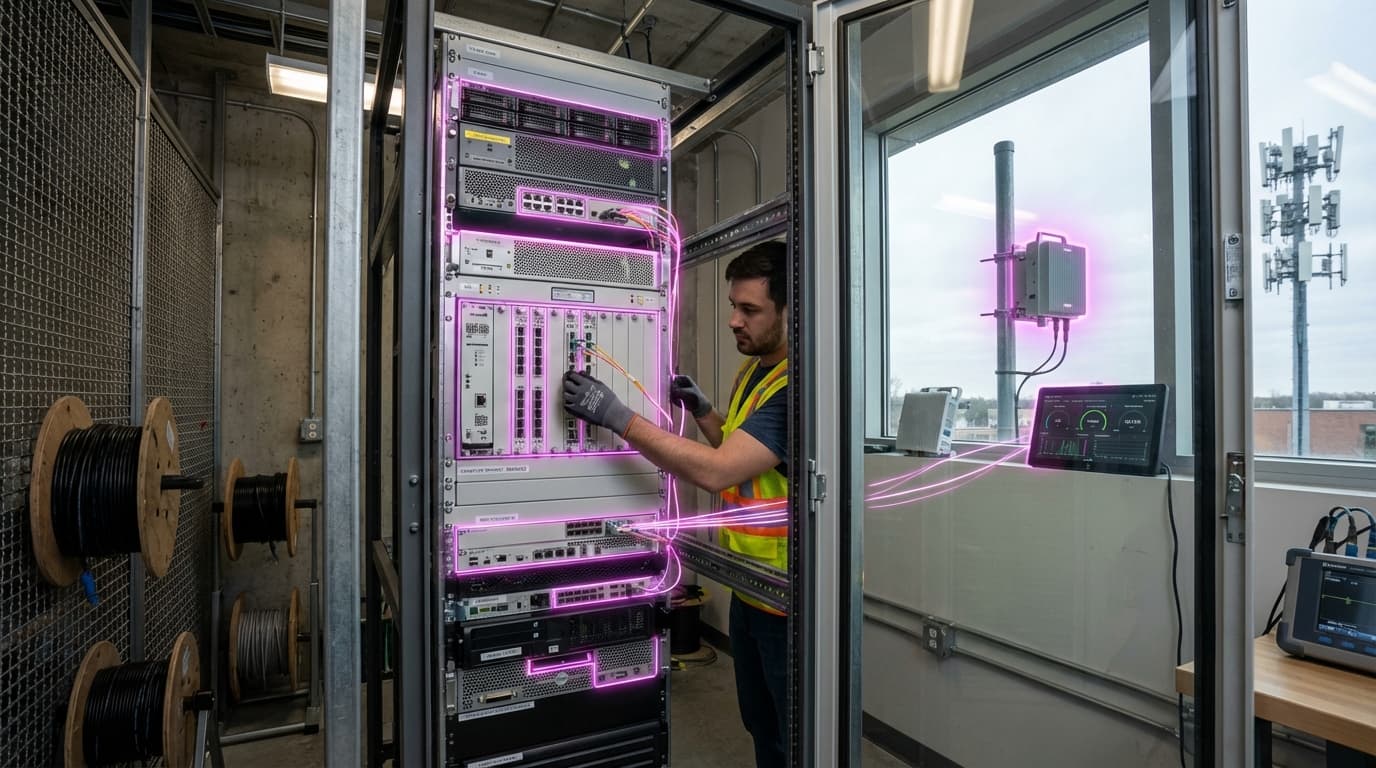
Open RAN & Disaggregated Telecom Infrastructure
Traditional cellular networks have long been dominated by a small number of integrated equipment vendors who provide proprietary, monolithic base station systems. This vertical integration creates vendor lock-in, limits innovation cycles, and results in high capital expenditures for mobile network operators. Open Radio Access Network (Open RAN) represents a fundamental architectural shift that addresses these challenges by disaggregating the radio access network into discrete, interoperable components. The technology separates hardware from software and divides the base station into three main functional units: the radio unit (RU), distributed unit (DU), and centralised unit (CU), each connected through standardised, open interfaces. These interfaces, defined by industry alliances such as the O-RAN Alliance, enable components from different vendors to work together seamlessly. The software layers are designed to run on commercial off-the-shelf hardware rather than specialised equipment, while intelligent controllers manage network resources through programmable interfaces that can be optimised in near real-time.
For telecommunications operators, Open RAN solves several critical industry challenges. The multi-vendor ecosystem it enables drives down equipment costs through increased competition and allows operators to select best-of-breed components for specific network functions rather than accepting bundled solutions. This modularity also accelerates the pace of innovation, as software updates and new features can be deployed independently without replacing entire base station systems. The cloud-native architecture supports more flexible network deployment models, allowing operators to shift radio processing workloads between edge and centralised data centres based on capacity demands and latency requirements. Perhaps most significantly, Open RAN creates opportunities for smaller, specialised vendors to enter the market with innovative solutions for specific network functions, breaking the oligopoly that has characterised telecom infrastructure for decades. This democratisation of the supply chain also addresses geopolitical concerns about network security and resilience by reducing dependence on any single vendor.
Early commercial deployments of Open RAN are already underway in several markets, with operators in Japan, the United States, and Europe launching initial networks that blend open components with traditional infrastructure. Rural and underserved areas have emerged as particularly promising deployment scenarios, where the lower cost structure of Open RAN makes network expansion economically viable in regions that previously lacked business cases for coverage. The technology is also gaining traction in private enterprise networks, where organisations deploy dedicated cellular infrastructure for industrial automation, logistics, and campus connectivity. Industry analysts note that while fully disaggregated networks remain in early stages, the trajectory points toward Open RAN becoming a mainstream architecture as the ecosystem matures and interoperability testing advances. The convergence of Open RAN with edge computing and network slicing capabilities positions this infrastructure approach as foundational to next-generation connectivity, enabling the programmable, software-defined networks required for emerging applications in autonomous systems, smart cities, and industrial IoT.
Related Organizations
Global community of mobile network operators, vendors, and research & academic institutions operating in the Radio Access Network (RAN) industry.

US carrier building the nation's first cloud-native, Open RAN-based 5G broadband network.

Provides cloud-native network software and Open RAN solutions for both public and private 5G networks.

The B2B arm of Rakuten Mobile, selling the Open RAN software stack and operational platform developed for the world's first large-scale Open RAN network.
A global community of companies and organizations working together to accelerate the development and deployment of open, disaggregated, and standards-based technology solutions.

Open RAN software company providing 'All G' (2G/3G/4G/5G) cloud-native solutions.

Launched the Digital Asset Broker (DAB) platform to allow devices to trade securely using blockchain technology.

Offers the Digital Annealer, a quantum-inspired architecture specifically built to solve large-scale combinatorial optimization problems.
Develops Vector Annealing, a quantum-inspired simulated annealing service running on high-performance vector supercomputers.

A semiconductor company designing and marketing open RAN standard-compliant baseband SoCs and software for 5G small cell infrastructure.

Offers the Quantum Engineering Toolkit (QET) and Labber software for instrument control and pulse generation.
Supporting Evidence
Research this in Signals
Signals turns a topic into a sourced research record you can inspect and rerun. Your first scan is free, and this one starts with Open RAN & Disaggregated Telecom Infrastructure already loaded, so edit it or scan as is.