







City-Scale Digital Twins
This page is a narrower case of it.
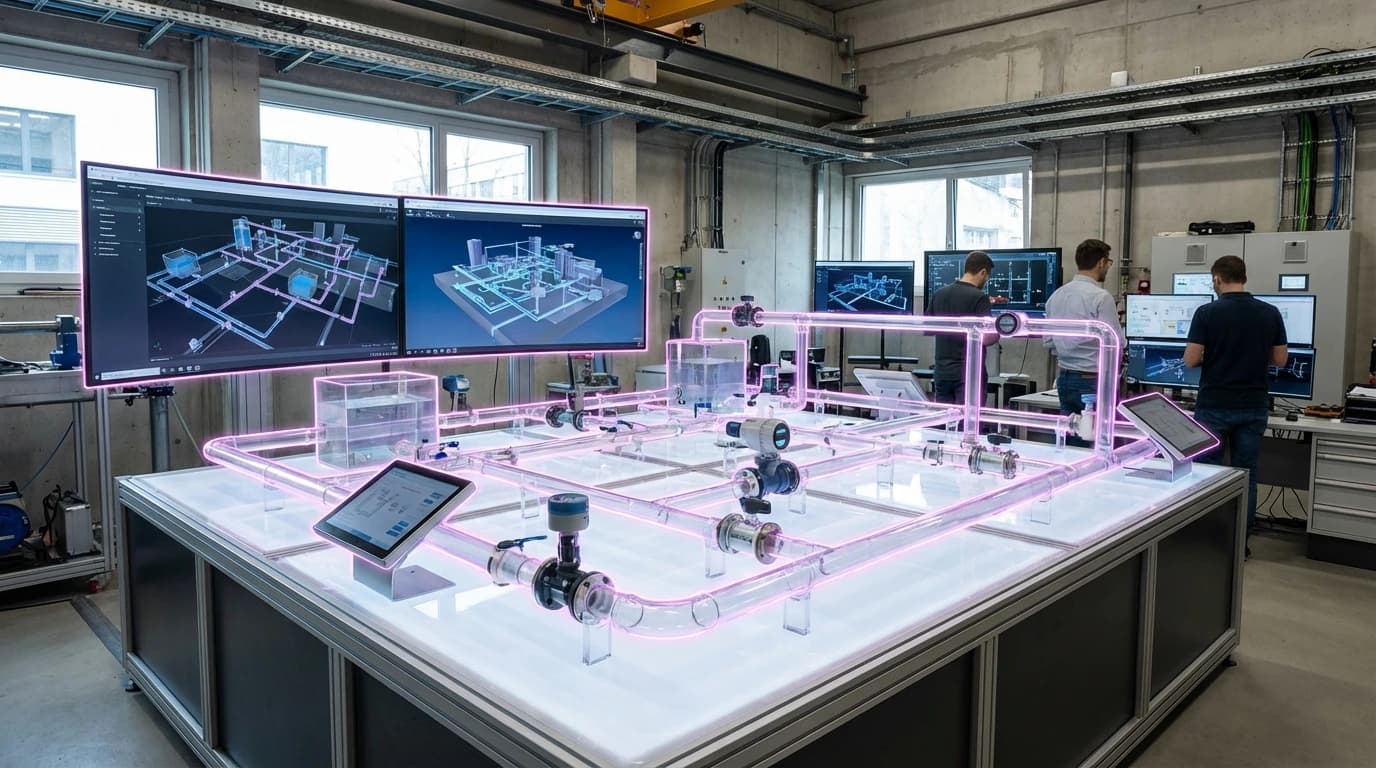
Water utilities worldwide face mounting pressures from aging infrastructure, climate variability, and growing urban populations. Traditional water network management relies heavily on reactive maintenance—responding to pipe bursts, leaks, and pressure failures after they occur. This approach is not only costly but also leads to significant water loss, with some estimates suggesting that up to 30% of treated water is lost through leakage in aging systems. Digital twin water networks represent a fundamental shift in how utilities can monitor, manage, and optimize their infrastructure. These systems create precise virtual replicas of physical water distribution networks by integrating advanced hydraulic modeling software with real-time data streams from Internet of Things (IoT) sensors deployed throughout the infrastructure. These sensors continuously monitor parameters such as flow rates, pressure levels, water quality indicators, and pipe vibrations, feeding this information into sophisticated computational models that mirror the behavior of the actual network. The digital twin processes this data to maintain an up-to-date representation of system performance, enabling operators to visualize conditions across the entire network from a centralized platform.
The transformative power of digital twin technology lies in its ability to shift water utilities from reactive to predictive operational models. By analyzing patterns in sensor data and comparing them against historical performance, these systems can identify anomalies that signal impending failures—such as unusual pressure fluctuations or flow irregularities that precede pipe bursts. This early warning capability allows maintenance teams to address issues before they escalate into costly emergencies or service disruptions. Beyond failure prediction, digital twins enable utilities to run sophisticated "what-if" scenarios, testing how proposed changes—such as new development connections, valve adjustments, or infrastructure upgrades—would affect system performance before implementing them in the physical world. This simulation capability is particularly valuable for optimizing pressure management across the network, as maintaining optimal pressure levels can dramatically reduce both leakage rates and the energy required for pumping operations. The technology also supports more efficient resource allocation by helping utilities prioritize infrastructure investments based on data-driven assessments of risk and system vulnerability.
Several forward-thinking water utilities have begun deploying digital twin systems, with early implementations demonstrating measurable improvements in operational efficiency and water conservation. These deployments typically start with pilot programs covering critical sections of the network before expanding to system-wide coverage. The technology is particularly valuable in regions facing water scarcity, where minimizing losses is essential, and in cities with extensive legacy infrastructure requiring strategic modernization. As climate change introduces greater variability in water availability and demand patterns, digital twins provide utilities with the analytical tools needed to build resilience and adaptability into their operations. The convergence of declining sensor costs, improved computational capabilities, and growing recognition of water as a critical resource is accelerating adoption of this technology. Looking forward, digital twin water networks are expected to become integral components of smart city infrastructure, potentially integrating with other urban systems to support holistic resource management and contribute to broader sustainability goals.
Owner of the Arnold renderer, which integrates AI denoising to optimize high-end VFX workflows for film and TV.

PUB, Singapore's National Water Agency
Singapore · Government Agency
Manages Singapore's water supply and drainage, implementing the 'Active, Beautiful, Clean Waters' (ABC Waters) programme.
Develops the MIKE suite of software, a global standard for water environment simulation and digital twins.
Spun out of Global Omnium, offering the GoAigua platform for smart water digital transformation.
Provides an open, cloud-based water management platform that democratizes digital twin technology.
A renowned research institute bridging science and practice in the water cycle, including wastewater surveillance.
An independent international engineering and project management consultancy.
Published forecasts about this technology, graded against what happened in Hindsight.
City-Scale Digital Twins
This page is a narrower case of it.
Industrial True-to-Reality Simulations and Digital Twins
This page is a narrower case of it.
Signals turns a topic into a sourced research record you can inspect and rerun. Your first scan is free, and this one starts with Digital Twin Water Networks already loaded, so edit it or scan as is.