Autonomous Regolith Construction
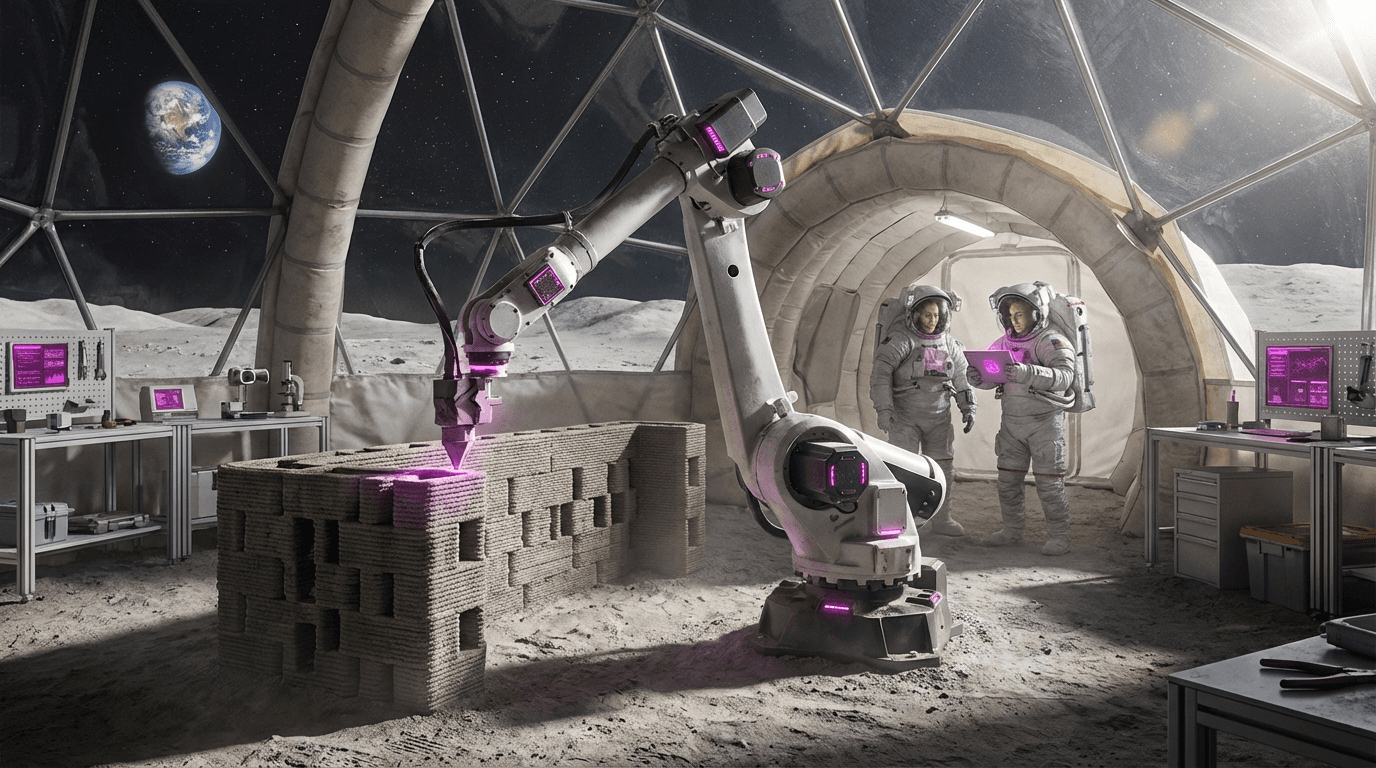
Autonomous regolith construction represents a fundamental shift in how humanity approaches building infrastructure beyond Earth. This technology combines advanced robotics, additive manufacturing, and materials science to transform the loose, rocky soil found on planetary surfaces—known as regolith—into durable construction materials. The process typically involves robotic systems that excavate local regolith, process it through sintering (using concentrated solar energy or microwave radiation to fuse particles together), and deposit the material layer by layer to create structures. Some approaches use binding agents mixed with regolith, while others rely purely on thermal fusion to create solid forms. The key technical innovation lies in the autonomous operation of these systems, which must navigate, excavate, process, and construct with minimal human intervention in extreme environments characterized by temperature fluctuations, radiation exposure, and low gravity. These machines integrate computer vision for terrain mapping, precision robotic arms for material placement, and adaptive algorithms that adjust construction parameters based on local regolith composition and environmental conditions.
The primary challenge this technology addresses is the prohibitive cost and physical limitations of launching construction materials from Earth. Current space launch costs make it economically unfeasible to transport the thousands of tons of building materials needed for permanent lunar or Martian settlements. By utilizing in-situ resources, autonomous regolith construction reduces payload mass by potentially 90% or more, fundamentally changing the economics of space infrastructure development. This capability solves critical problems for sustained off-world presence: creating radiation shielding to protect astronauts from cosmic rays and solar particle events, building landing pads that prevent regolith dispersal during spacecraft operations, establishing roads for rover mobility, and constructing the structural shells of habitats. The technology also enables rapid deployment of infrastructure ahead of human arrival, allowing robotic systems to prepare sites during the months-long transit periods between Earth and Mars, or to continuously expand facilities on the Moon between crewed missions.
Research institutions and space agencies have conducted extensive ground testing of regolith construction systems using simulated lunar and Martian soil. Early demonstrations have shown that sintered regolith can achieve compressive strengths comparable to concrete, making it suitable for load-bearing structures. Several space agencies are developing prototype systems intended for deployment in the coming decade as part of lunar base initiatives, with Mars applications following as interplanetary missions mature. The technology aligns with broader trends toward autonomous construction on Earth and the growing emphasis on sustainable, locally-sourced building practices. As commercial space activities expand and the vision of permanent off-world settlements moves from science fiction toward engineering reality, autonomous regolith construction stands as an enabling technology that could determine whether humanity establishes temporary outposts or truly sustainable cities beyond Earth. The scalability of this approach—where each robotic system can theoretically construct structures far larger than itself—suggests a future where off-world infrastructure grows exponentially once initial systems are deployed.
Related Organizations

NASA's lead center for the In-Space Manufacturing (ISM) project, focusing on on-demand fabrication and repair.

Architecture and technology firm that won NASA's 3D Printed Habitat Challenge with 'MARSHA', a vertical Martian habitat design.

Leads the EAGLE-1 mission and the SAGA program to build a European quantum communication infrastructure in space.

Construction technology company using 3D printing robotics, software, and advanced materials.

Hosts the Center for Space Resources, a leading academic hub for ISRU research and education.

Provides in-space 3D printing and bioprinting capabilities, having acquired Made In Space and Techshot.

Honeybee Robotics
United States · Company
Develops advanced robotic systems for planetary exploration, specifically drilling and sampling tools essential for extracting subsurface ice and regolith.

Uses 'Cellular Fabrication' (C-Fab) to 3D print freeform polymer matrices that are filled with insulation and concrete.

Global architecture firm collaborating with ESA and NASA on lunar habitation concepts involving 3D printing with regolith.
Supporting Evidence
Research this in Signals
Signals turns a topic into a sourced research record you can inspect and rerun. Your first scan is free, and this one starts with Autonomous Regolith Construction already loaded, so edit it or scan as is.