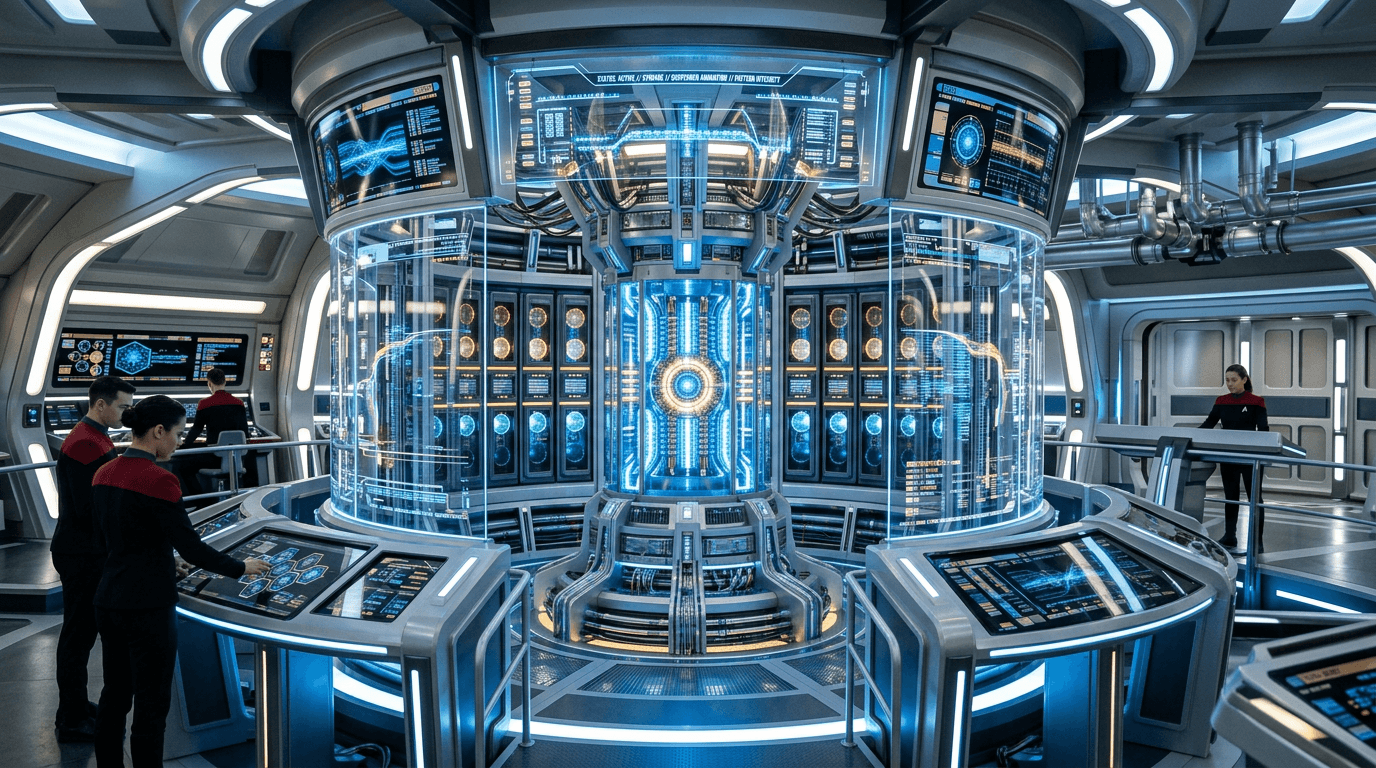
Transporter Pattern Buffer (Extended)
The Transporter Pattern Buffer (Extended) represents a speculative extension of the matter-stream storage concept familiar from science fiction transporters, particularly those depicted in Star Trek. In standard transporter theory, a pattern buffer temporarily holds the digitised quantum state of matter during dematerialisation and rematerialisation—a process measured in seconds. Extended pattern buffering pushes this concept into hours, days, or theoretically longer durations by employing cyclic redundancy phasing and continuous pattern integrity verification. The imagined mechanism involves maintaining the matter stream in a kind of suspended quantum state, where the information describing every particle's position, momentum, and quantum properties remains frozen in a computational substrate. This would require extraordinary energy stability, error-correction algorithms operating at quantum scales, and isolation from decoherence effects that normally collapse quantum superpositions within fractions of a second.
In narrative contexts, extended pattern buffering serves as a plot device for suspended animation, emergency rescue scenarios, or even accidental preservation of characters across time. It appears in speculative discussions about future medical stasis, digital consciousness preservation, and extreme-duration space travel. The concept connects tangentially to real-world research in quantum information storage, cryopreservation, and digital data integrity—though none of these fields approach the wholesale conversion and storage of macroscopic matter as quantum information. Current quantum memory systems can preserve entangled states for milliseconds under laboratory conditions, while cryonics attempts to preserve biological structure through freezing, not information encoding. The transporter buffer concept assumes breakthroughs not only in quantum computing and error correction but also in our fundamental understanding of consciousness, identity, and the information-theoretic nature of matter itself.
The primary constraint separating this from plausible science is the Heisenberg uncertainty principle and quantum decoherence, which make perfect measurement and indefinite storage of quantum states fundamentally problematic. Even if matter could be scanned and encoded, the no-cloning theorem in quantum mechanics suggests perfect duplication is impossible, raising questions about whether reconstitution truly preserves identity or creates a copy. Power requirements would be astronomical—maintaining quantum coherence across trillions of particles would likely demand energy inputs comparable to small power plants, with any fluctuation risking catastrophic pattern degradation. The concept also sidesteps unresolved questions about whether consciousness could survive as stored information, or whether the process constitutes death and reconstruction. For extended pattern buffering to move from fiction toward plausibility, we would need revolutionary advances in room-temperature quantum computing, energy storage density improvements of many orders of magnitude, and perhaps entirely new physics governing information and matter. Until then, it remains a powerful narrative device for exploring themes of identity, mortality, and the boundaries between life and information.
Research this in Signals
Signals turns a topic into a sourced research record you can inspect and rerun. Your first scan is free, and this one starts with Transporter Pattern Buffer (Extended) already loaded, so edit it or scan as is.