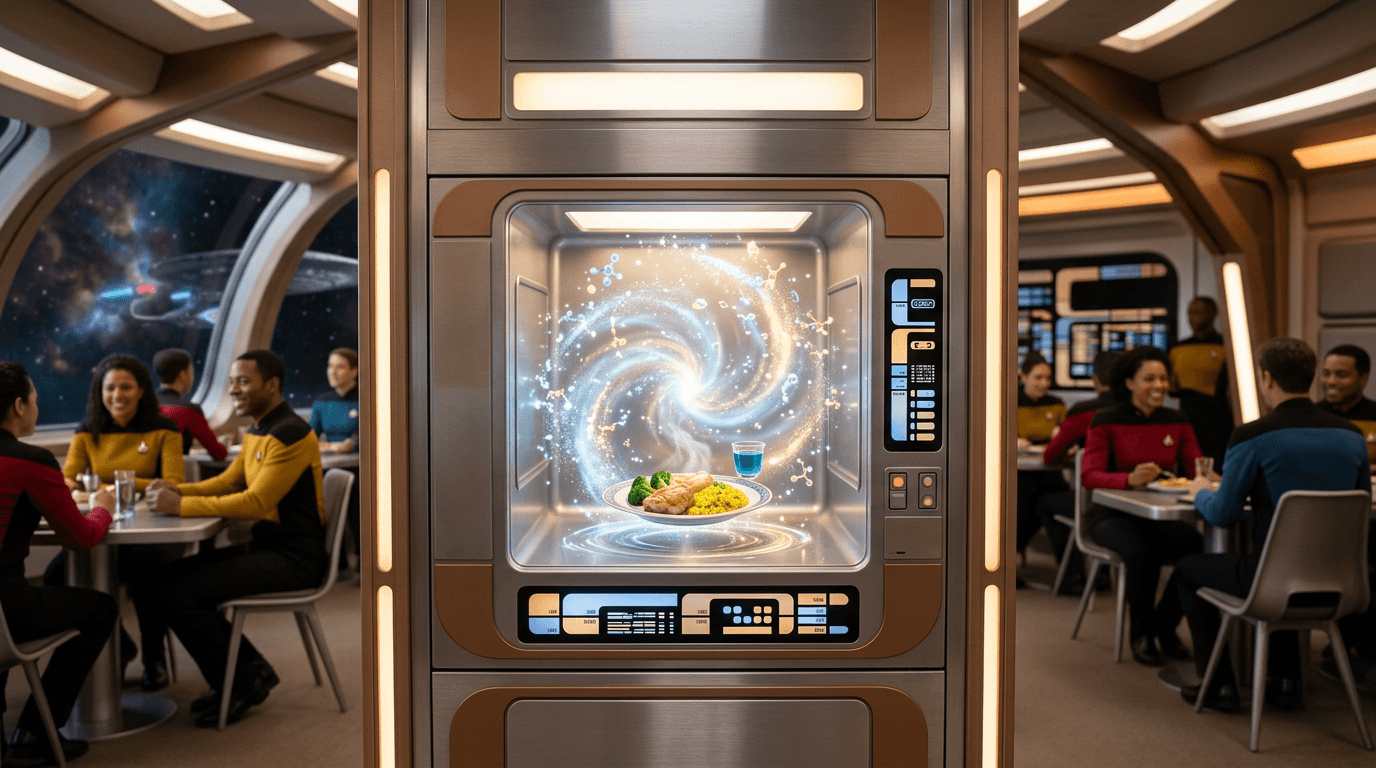
Replicator
The replicator represents one of science fiction's most transformative concepts for material production, imagined as a device capable of synthesizing physical objects and food from base matter by rearranging atoms and molecules according to stored digital patterns. In fictional universes where this technology appears, replicators typically function through principles borrowed from transporter technology—scanning an object at the quantum level to create a detailed molecular blueprint, then using energy-to-matter conversion or matter reorganization to reconstruct that pattern from raw feedstock. The system maintains vast databases of molecular templates, from simple utensils to complex meals, allowing users to request items through voice commands or interface controls. This technology fundamentally reimagines manufacturing and logistics by eliminating traditional supply chains, though most fictional depictions impose limitations such as inability to replicate living organisms, certain complex materials, or items requiring precise quantum states.
Within narrative contexts, replicators serve as crucial world-building elements that enable long-duration space exploration, post-scarcity economics, and radical transformations in how societies relate to material goods and food production. The technology appears prominently in scenarios exploring resource abundance, where the ability to create nearly anything on demand reshapes social structures, eliminates certain forms of labor, and raises questions about value, craftsmanship, and authenticity. In military and exploration settings, replicators solve the practical challenge of resupply during extended missions, allowing vessels to operate independently for years while maintaining crew comfort and operational readiness. The recurring narrative detail that replicated food tastes subtly different from "real" food often serves as a metaphor for tensions between efficiency and authenticity, suggesting that even in technologically advanced futures, human preferences for the natural and handcrafted persist.
From a scientific plausibility standpoint, replicator technology requires multiple breakthroughs that remain firmly in the realm of speculation. Current physics offers no practical pathway for the precise atomic-level manipulation and energy-to-matter conversion at the scales depicted in fiction—such processes would require energy expenditures far beyond current capabilities and control mechanisms that don't exist in known science. While 3D printing and additive manufacturing demonstrate rudimentary object synthesis from base materials, these technologies work at vastly larger scales and cannot approach molecular-level precision or create the chemical complexity of food. The concept assumes mastery over quantum states, perfect molecular assembly, and energy conversion efficiencies that may be fundamentally impossible given thermodynamic constraints. For replicator technology to approach plausibility, civilization would need revolutionary advances in nanotechnology, quantum manipulation, energy generation, and our understanding of matter itself—developments that, if achievable at all, likely remain centuries distant and may require revisions to fundamental physics.
Research this in Signals
Signals turns a topic into a sourced research record you can inspect and rerun. Your first scan is free, and this one starts with Replicator already loaded, so edit it or scan as is.