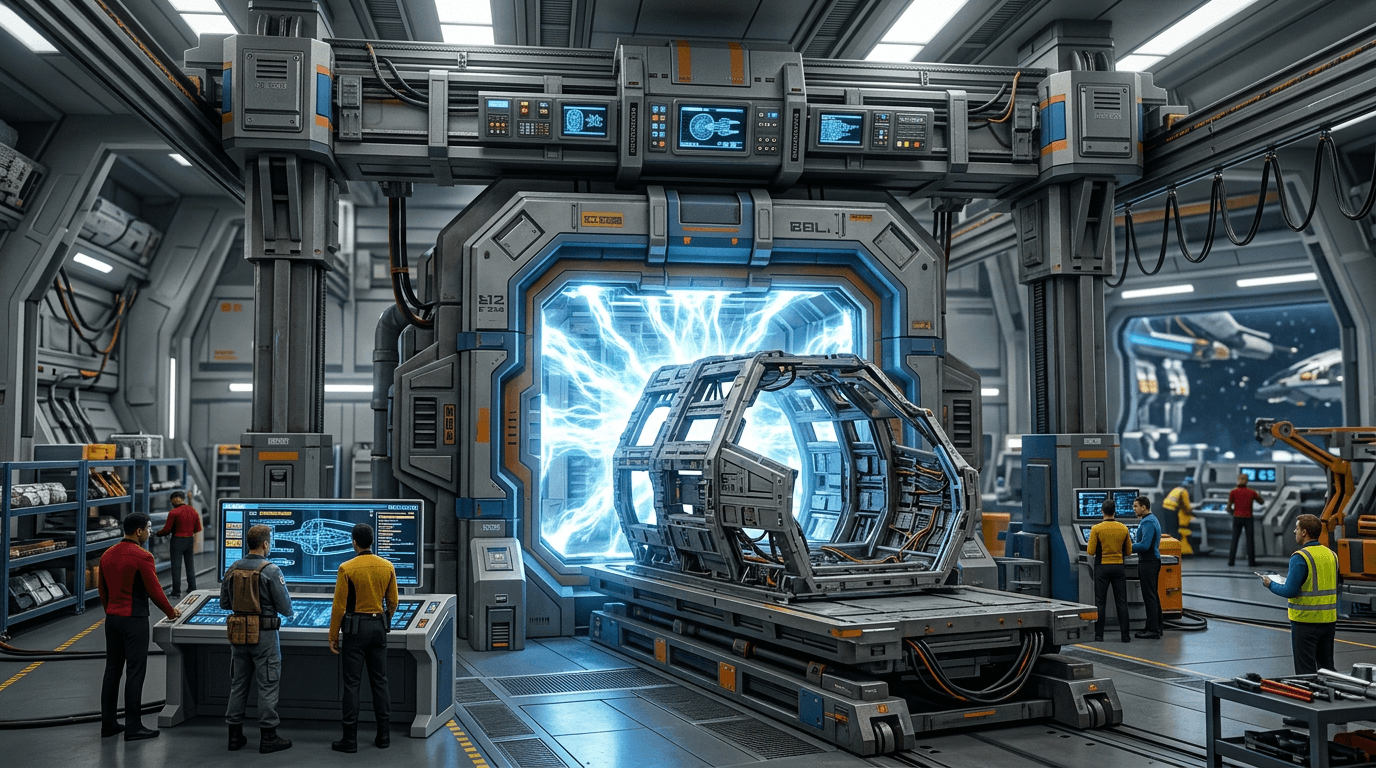
Industrial Replicator
Industrial replicators represent a speculative extension of additive manufacturing and molecular assembly concepts, envisioned as systems capable of synthesizing complex objects—from structural beams to complete machinery—directly from feedstock materials or energy inputs. Unlike contemporary 3D printers that build objects layer by layer from specific polymers or metals, the fictional industrial replicator would theoretically rearrange matter at the molecular or atomic level to produce finished goods on demand. This concept draws from real-world research in programmable matter, advanced nanofabrication, and energy-to-matter conversion theories explored in particle physics, though no current technology approaches the scale or versatility depicted in science fiction narratives. The imagined mechanism typically involves either precise atomic manipulation through advanced nanotechnology or direct matter-energy conversion processes that remain firmly in the realm of theoretical physics.
Within speculative scenarios and science fiction frameworks, industrial replicators serve as narrative solutions to logistical bottlenecks that constrain human expansion beyond Earth or rapid response to catastrophic events. In colonial settlement narratives, these devices eliminate the need to transport massive quantities of building materials across interplanetary distances, allowing small crews to establish infrastructure using locally sourced raw materials or recycled waste. Disaster response scenarios similarly envision replicators producing emergency shelters, medical equipment, and replacement parts without relying on fragile supply chains. This concept resonates with contemporary research directions in distributed manufacturing, where advanced fabrication systems could reduce dependency on centralized production facilities. The strategic appeal lies in radical supply chain compression—transforming logistics from a matter of transportation into one of information transmission, where designs rather than physical goods move across distances.
The plausibility of industrial replicators depends on breakthroughs that currently appear distant or impossible under known physics. Molecular assembly at scale would require unprecedented control over atomic bonding, energy management systems far beyond current capabilities, and solutions to thermodynamic constraints that make matter rearrangement extraordinarily energy-intensive. Real-world additive manufacturing continues advancing in speed, material diversity, and structural complexity, but remains constrained by the need for specific feedstocks, limited material properties in printed objects, and production rates measured in hours or days rather than minutes. For industrial replicators to transition from fiction to plausibility, fundamental advances would be needed in room-temperature atomic manipulation, compact fusion or antimatter energy sources, and computational systems capable of managing quadrillions of simultaneous molecular interactions. The concept serves primarily as a thought experiment highlighting the transformative potential of manufacturing technologies while underscoring the vast gap between current capabilities and the frictionless material abundance depicted in speculative narratives.
Research this in Signals
Signals turns a topic into a sourced research record you can inspect and rerun. Your first scan is free, and this one starts with Industrial Replicator already loaded, so edit it or scan as is.