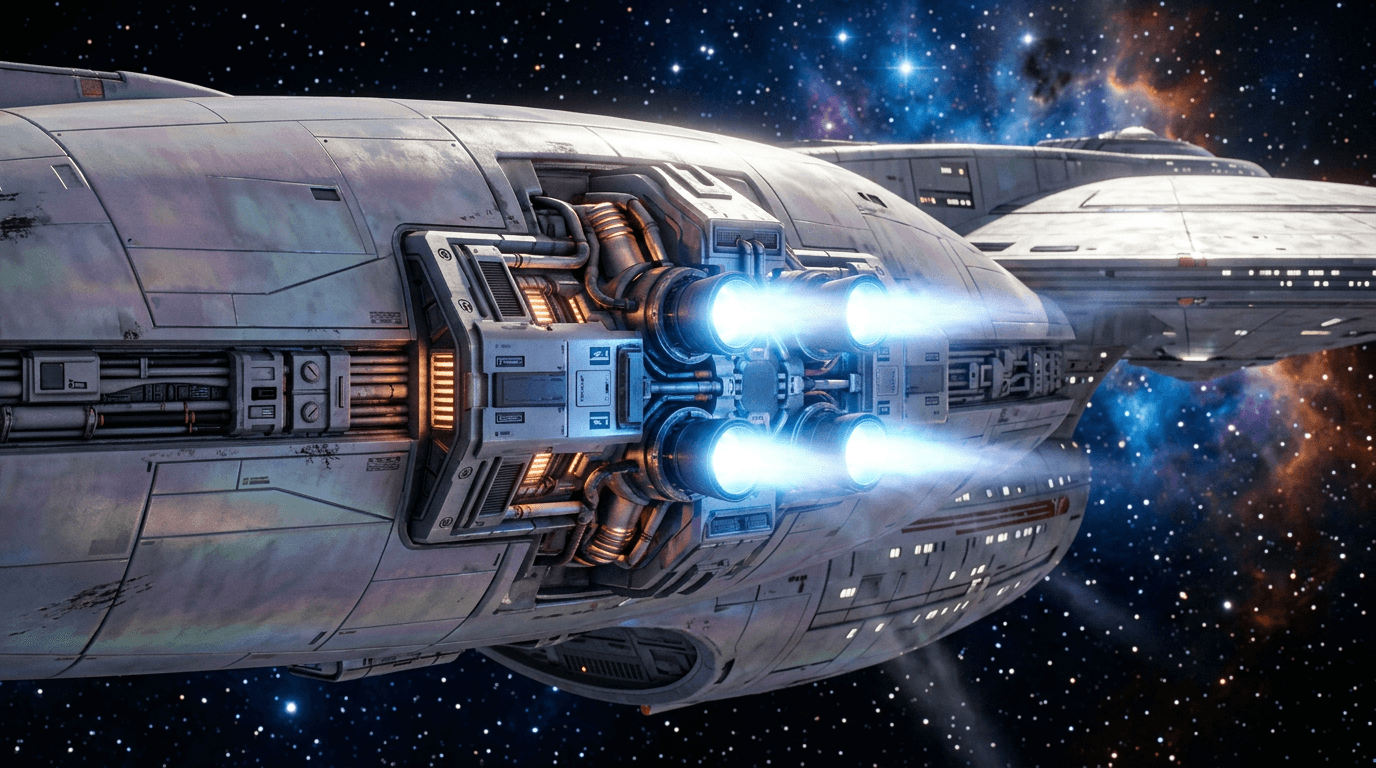
RCS Thrusters
Reaction Control System (RCS) thrusters represent a foundational technology in spacecraft maneuvering, providing precise attitude control and low-velocity translation without engaging primary propulsion systems. These small, strategically positioned thrusters generate controlled bursts of thrust by expelling propellant—typically through chemical combustion, compressed gas, or in more speculative frameworks, ionized plasma. Unlike main engines designed for sustained acceleration, RCS thrusters deliver short impulses that allow spacecraft to rotate around their axes, make fine positional adjustments, or maintain orientation relative to other objects. In real-world applications, every spacecraft from the Apollo Command Module to the International Space Station relies on reaction control systems for docking operations, orbital corrections, and attitude stabilization. The fundamental physics governing these systems—Newton's third law of motion—remains consistent whether the propellant is hydrazine or a fictional exotic fuel, making RCS thrusters one of the more scientifically grounded elements in speculative spacecraft design.
Within science fiction narratives, particularly those depicting large starships, RCS thrusters serve a critical operational role that distinguishes routine maneuvering from dramatic main-engine burns. They enable the delicate ballet of docking procedures, allow vessels to maintain precise station-keeping in formation or orbit, and provide the fine control necessary when operating near space stations, planetary surfaces, or other vessels. The integration of RCS systems with fictional technologies like inertial dampeners addresses a genuine challenge: even small thruster firings would subject crew and cargo to jarring accelerations without some form of compensation. This narrative pairing acknowledges that precision maneuvering requires not just the ability to apply force, but to do so without compromising crew safety or operational effectiveness. The distributed placement of thrusters around a hull—often depicted as glowing ports or visible exhaust plumes—also serves visual storytelling purposes, making spacecraft orientation changes comprehensible to audiences.
The core principles underlying RCS technology are well-established and currently deployed across all spacefaring programs, though the scale and sophistication vary considerably from fiction. Contemporary chemical RCS systems face constraints including propellant mass, thrust efficiency, and operational lifespan—challenges that become more pronounced for long-duration missions or massive vessels. Research into electric propulsion alternatives, such as ion thrusters and Hall-effect systems, offers improved efficiency but typically at lower thrust levels, creating trade-offs between fuel economy and responsiveness. For truly large spacecraft of the kind depicted in science fiction, the propellant requirements for conventional RCS would be substantial, potentially necessitating either frequent resupply or fundamentally different thruster technologies. Advanced concepts under investigation, including electromagnetic or field-effect systems that might manipulate spacecraft orientation without expelling mass, could eventually provide the capabilities fiction often assumes, though such technologies remain theoretical and would require breakthroughs in our understanding of physics and engineering.
Research this in Signals
Signals turns a topic into a sourced research record you can inspect and rerun. Your first scan is free, and this one starts with RCS Thrusters already loaded, so edit it or scan as is.