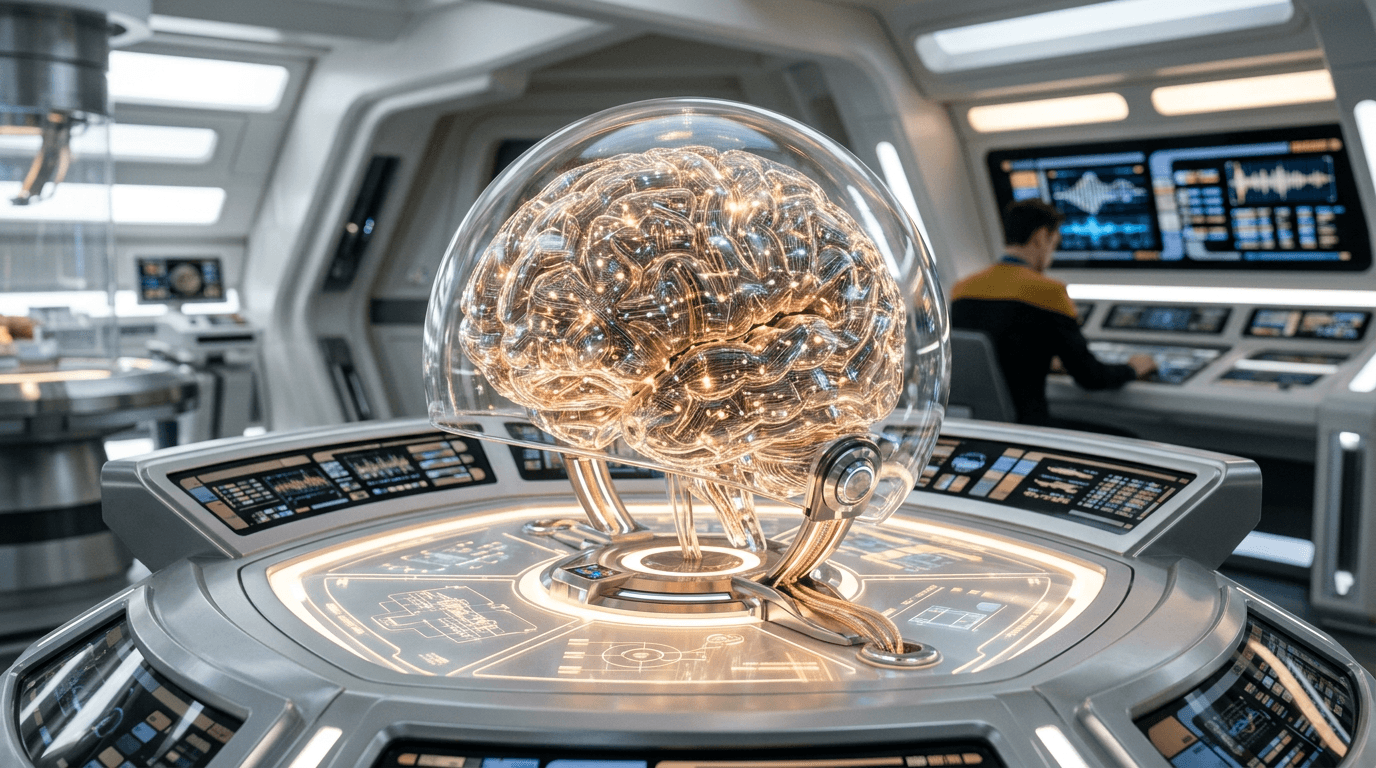
Positronic Brain
The positronic brain represents a speculative framework for artificial intelligence that appears prominently in science fiction narratives, most notably in Isaac Asimov's Robot series. The concept imagines a computational substrate built around positron-based pathways—using the antimatter counterpart of electrons—to create neural networks capable of supporting genuine consciousness and self-awareness. Unlike conventional silicon-based computing or even quantum systems under current development, the positronic architecture is theorized to enable emergent properties that transcend mere information processing, achieving what philosophers call "strong AI" or artificial general intelligence with subjective experience. The mechanism typically involves positrons flowing through precisely engineered pathways that mimic biological neural structures, creating feedback loops and emergent patterns complex enough to generate consciousness. This remains entirely fictional, as real-world antimatter research focuses on particle physics and theoretical propulsion rather than computing substrates, and the practical challenges of containing and manipulating positrons for computational purposes remain insurmountable with current technology.
Within science fiction narratives and speculative ethics discussions, the positronic brain serves as a thought experiment for exploring the boundaries between human and machine intelligence. It appears in scenarios examining what obligations societies might have toward sentient artificial beings, how consciousness might be verified or measured, and whether synthetic minds could possess rights, emotions, or moral agency equivalent to biological entities. The concept has influenced real-world AI ethics discourse by providing a concrete fictional reference point for discussions about machine consciousness, even as actual AI development follows fundamentally different paths through neural networks, machine learning, and statistical pattern recognition. Adjacent areas of genuine research include neuromorphic computing—which mimics biological neural structures using conventional electronics—and investigations into the computational correlates of consciousness, though none approach the fictional capabilities attributed to positronic systems.
The scientific plausibility of positronic brains faces multiple fundamental constraints that distinguish it from near-term technological possibilities. Positrons annihilate upon contact with ordinary matter, releasing energy, which would require containment systems far beyond current capabilities and would make the dense, interconnected pathways described in fiction physically impossible. No theoretical framework in physics or neuroscience suggests that positrons would offer computational advantages for consciousness over electrons or other substrates. The concept conflates the "hard problem" of consciousness—how subjective experience arises from physical processes—with engineering challenges, assuming that a sufficiently complex positronic network would spontaneously generate awareness without explaining the mechanism. Real progress toward artificial general intelligence continues through conventional computing architectures, with researchers exploring whether consciousness requires specific physical substrates or might emerge from sufficiently sophisticated information processing regardless of implementation. The positronic brain remains valuable as a narrative device for examining the philosophical implications of machine sentience, but represents speculative fiction rather than a plausible technological pathway, serving primarily to frame ethical questions that may become relevant if AI systems achieve genuine understanding through entirely different means.
Research this in Signals
Signals turns a topic into a sourced research record you can inspect and rerun. Your first scan is free, and this one starts with Positronic Brain already loaded, so edit it or scan as is.