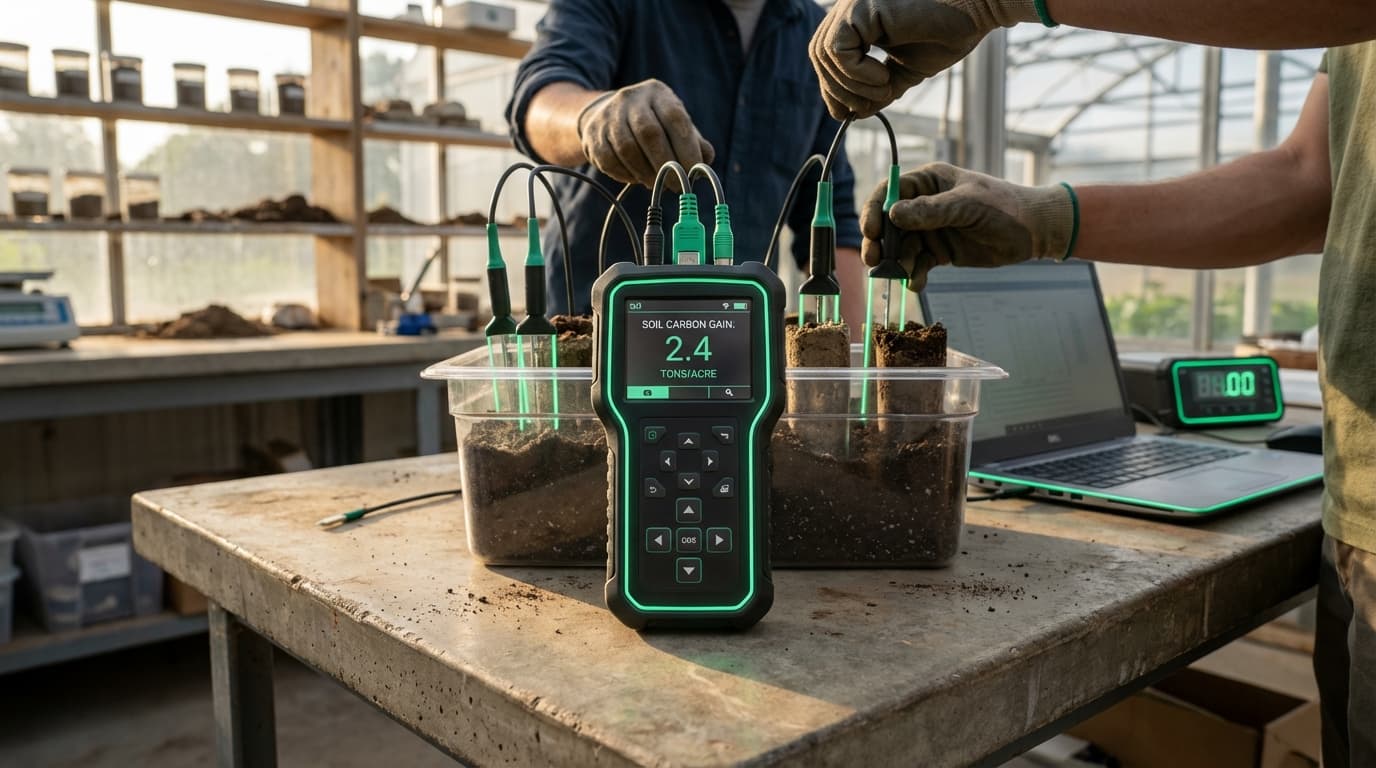
Carbon Farming Calculators
Carbon farming calculators are web and mobile platforms that let producers model soil carbon sequestration from cover cropping, agroforestry, biochar, or adaptive grazing. Users input field boundaries, practice changes, and soil tests; the software runs biogeochemical models and outputs MRV-ready reports aligned with Verra, Gold Standard, or USDA protocols.
Growers, carbon developers, and ag lenders rely on these calculators to estimate revenue from carbon credits, de-risk regenerative transitions, and satisfy reporting requirements for sustainability-linked loans. Tools from companies like Regrow, Nori, and Agreena integrate satellite imagery and machine learning to improve baseline accuracy and automate audit documentation.
Future releases will tie into payments for ecosystem services, actuarial risk scoring, and smart contracts that issue credits upon verified outcomes. Challenges include reconciling model outputs with field sampling, managing evolving methodologies, and ensuring equitable access for smallholder farmers. Partnerships with extension services and standardized APIs will be key to mainstreaming carbon MRV.
Related Organizations

Developers of COMET-Farm, the official USDA-backed tool for estimating carbon sequestration and GHG emissions.

A not-for-profit member organization that owns and manages the Cool Farm Tool, a widely used calculator for on-farm greenhouse gas emissions.

Develops MRV (Measurement, Reporting, and Verification) software for agriculture, modeling soil carbon sequestration and GHG emissions at the field level.

Europe's leading soil carbon platform, issuing certificates to farmers for regenerative transitions.

Open Technology Ecosystem for Agricultural Management; a community building open-source interoperability for ag data.

Develops handheld hardware and software for in-situ soil carbon measurement to lower the cost of verification.

Uses satellites and AI to measure soil carbon globally, enabling carbon credits for developing nations.

Farm management software that includes a carbon program to calculate and verify credits for farmers in CEE and Africa.

Formerly Cloud Agronomics, they use hyperspectral imaging to verify soil carbon change for the offset market.
Operates a certified carbon payment program for farmers, using a proprietary calculator to assess operational shifts.
Supporting Evidence
Research this in Signals
Signals turns a topic into a sourced research record you can inspect and rerun. Your first scan is free, and this one starts with Carbon Farming Calculators already loaded, so edit it or scan as is.