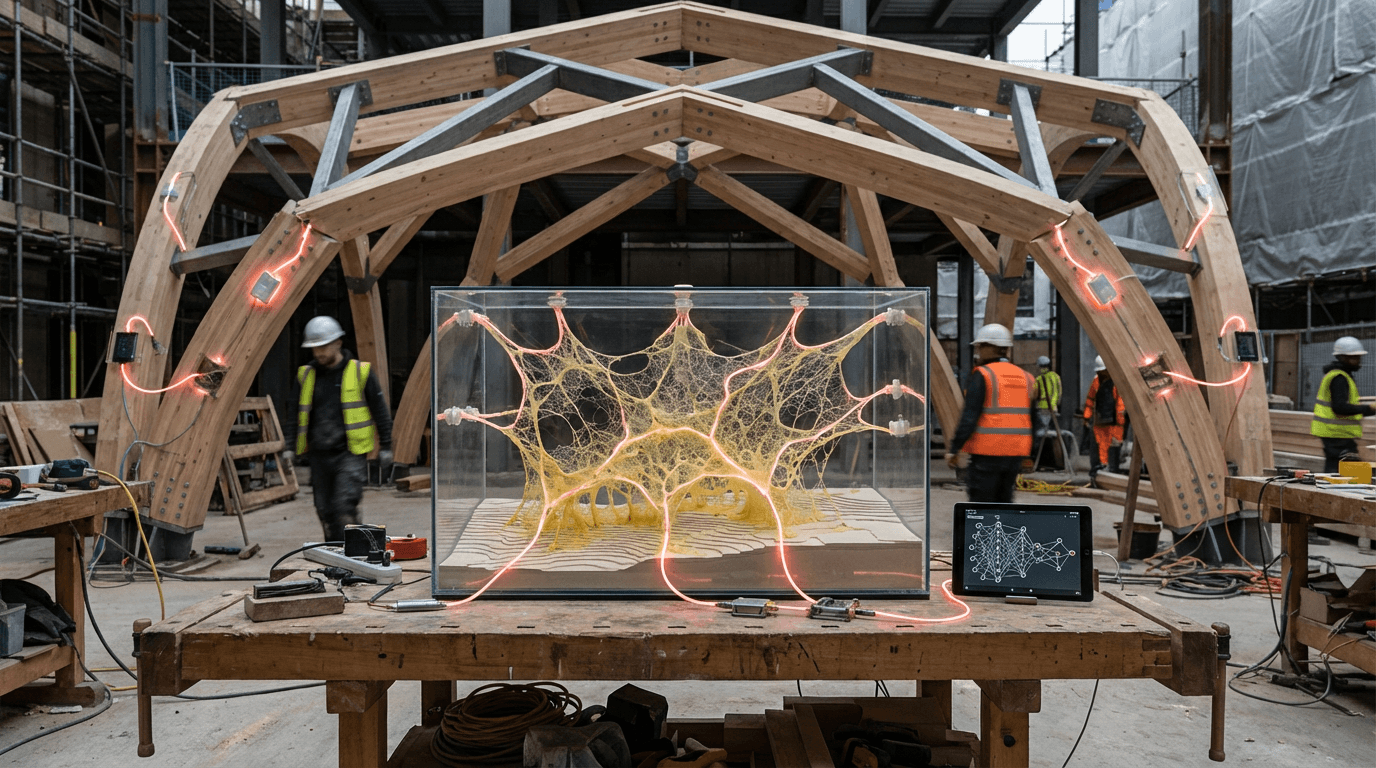
Bio-Algorithmic Design (Physarum Computing)
Bio-algorithmic design represents a radical departure from conventional computational approaches by harnessing the natural problem-solving capabilities of living organisms, particularly the slime mold Physarum polycephalum. This single-celled organism has demonstrated a remarkable ability to solve complex network optimization problems through its natural foraging behavior. When placed in an environment with multiple food sources, the slime mold extends tendrils in all directions, gradually retracting inefficient paths while reinforcing the most effective routes. This biological process creates networks that are both highly efficient and resilient, balancing the competing demands of minimizing total path length while maintaining redundancy for fault tolerance. Researchers have successfully translated these organic growth patterns into computational algorithms that can tackle routing, structural distribution, and resource allocation challenges that would require enormous processing power using traditional optimization methods.
In the construction and infrastructure sectors, this approach addresses fundamental challenges in designing efficient yet robust systems. Traditional computational methods for network optimization often struggle with the sheer complexity of real-world constraints—multiple objectives, dynamic conditions, and the need for adaptive resilience. Bio-algorithmic design offers a fundamentally different strategy, one that mirrors how natural systems have evolved to solve similar problems over millions of years. Early research has demonstrated the potential of Physarum-inspired algorithms in optimizing transportation networks, with studies showing that the organism's growth patterns can recreate the efficiency of existing rail systems while suggesting improvements for redundancy and disaster resilience. This approach has particular relevance for designing utility networks, structural load distribution in buildings, and even construction site logistics, where the balance between efficiency and adaptability is crucial.
Current applications of bio-algorithmic design remain largely in research and pilot phases, though the technology is gaining traction in specialized engineering contexts. Some architectural firms and infrastructure planners have begun incorporating Physarum-based algorithms into early-stage design processes, particularly for projects requiring complex network layouts such as district heating systems, drainage networks, and pedestrian circulation patterns. The approach shows particular promise in contexts where conventional optimization might overlook emergent properties or fail to account for future adaptability. As computational biology advances and the integration between biological observation and digital modeling becomes more sophisticated, bio-algorithmic design is positioned to become a standard tool in the infrastructure planning toolkit. This convergence of biology and computation represents a broader trend toward biomimetic solutions in construction, where nature's time-tested strategies inform human engineering challenges, potentially leading to infrastructure that is not only more efficient but also more adaptable to changing urban conditions and climate pressures.
Related Organizations

A research lab led by Prof. Adam Adamatzky, pioneering the field of fungal computing and fungal electronics.
Architecture and design firm known for 'PhotoSynthetica', a bio-digital cladding system that uses algae to purify air.

Research into spintronics and probabilistic computing which overlaps with reversible logic principles.
Bio-ID (The Bartlett, UCL)
United Kingdom · University
Bio-Integrated Design program at UCL.

Leading research institute for biomimetic and computational design.
Research center developing projects like 'Hydroceramic', a passive cooling material that mimics biological transpiration.

Home of the Affective Computing research group led by Rosalind Picard.

An Autodesk Studio that designed the 'Hy-Fi' tower at MoMA PS1, the first large-scale structure made of mycelium bricks.

A research center at the Royal Danish Academy focusing on the intersection of architecture and computation, including bio-hybrid systems.

A premier bio-inspired engineering lab developing soft robotics and adaptive materials.
Supporting Evidence
Research this in Signals
Signals turns a topic into a sourced research record you can inspect and rerun. Your first scan is free, and this one starts with Bio-Algorithmic Design (Physarum Computing) already loaded, so edit it or scan as is.