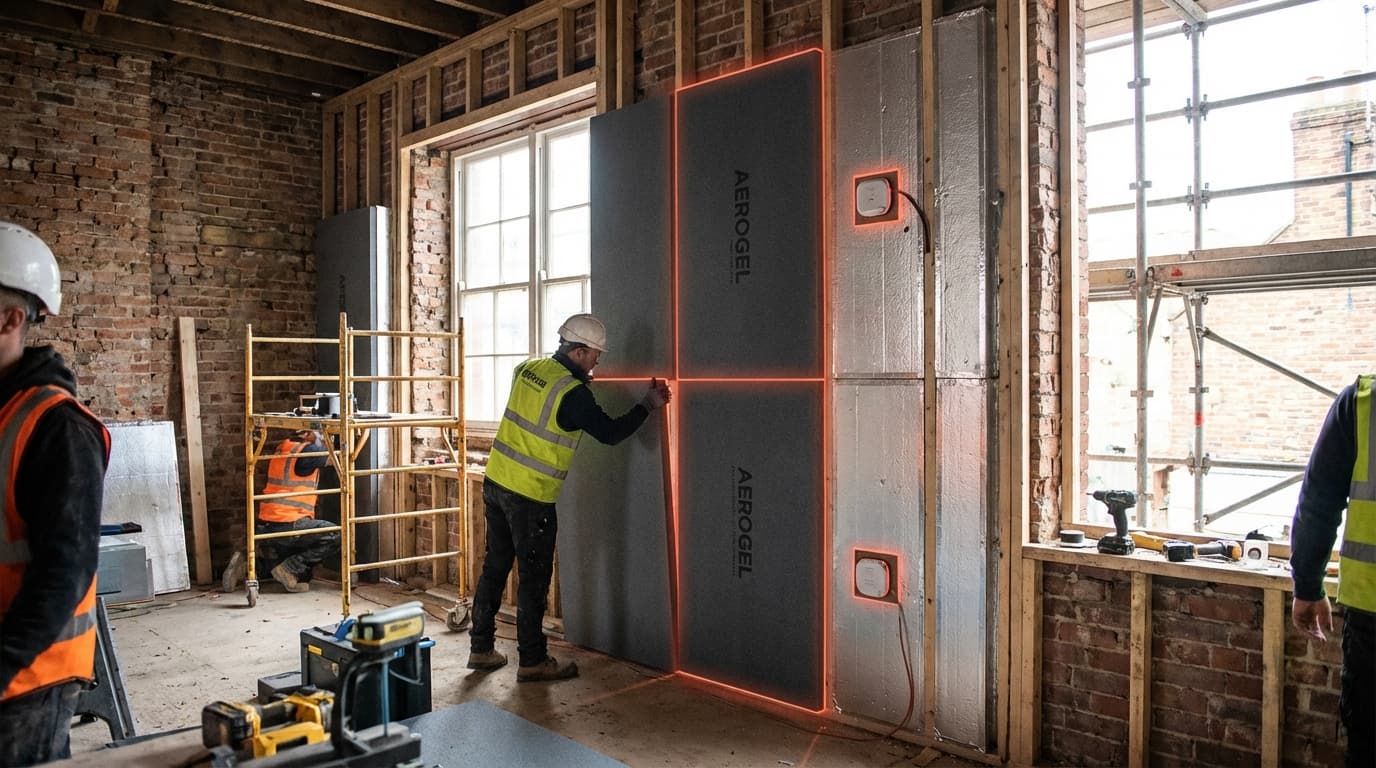
Aerogel & Vacuum Insulation Panels
Aerogel and vacuum insulation panels represent a breakthrough in thermal performance for building envelopes, addressing the fundamental challenge of achieving superior insulation in applications where space is at a premium. Aerogels are highly porous materials—often silica-based, though organic variants are emerging—with up to 99% air content trapped within a nanoscale structure, earning them the distinction of being among the lightest solid materials known. Vacuum insulation panels, by contrast, consist of a rigid core material enclosed in a gas-tight envelope from which air has been evacuated, eliminating convective and conductive heat transfer. Both technologies deliver thermal resistance values (R-values) that can exceed conventional fiberglass or foam insulation by factors of three to five per inch of thickness, making them particularly valuable where building codes demand high performance but physical constraints limit wall or roof depth.
The construction industry faces mounting pressure to improve energy efficiency in existing buildings, which constitute the vast majority of the built environment and often feature thin walls, historic facades, or tight urban footprints that resist conventional deep-energy retrofits. Traditional insulation upgrades typically require significant interior space sacrifice or exterior cladding modifications, both of which can be cost-prohibitive or architecturally unacceptable. Aerogel and vacuum panels solve this problem by enabling dramatic thermal performance improvements within minimal thickness—often just one to two inches—allowing building owners to meet modern energy standards without compromising usable floor area or altering protected exteriors. This capability is equally critical in extreme climates, where Arctic cold or desert heat impose severe thermal loads, and in dense urban environments where every square foot of interior space carries substantial economic value. The technology also supports modular and prefabricated construction approaches, where thin, high-performance envelopes reduce shipping volumes and installation complexity.
Early commercial deployments have focused on high-value applications including cold chain logistics, industrial facilities, and premium residential projects, though costs remain higher than conventional insulation. Aerogel blankets have found particular traction in industrial settings and heritage building retrofits, where their flexibility and thinness allow installation around complex geometries and within historic wall assemblies. Vacuum panels, while offering superior performance, require careful handling to prevent puncture and loss of vacuum, limiting their use to controlled factory assembly or specialized installation teams. Research efforts continue to address durability concerns, reduce manufacturing costs, and develop hybrid systems that combine aerogel's flexibility with vacuum panels' peak performance. As building codes tighten and urban densification accelerates, these ultra-high-performance insulation technologies are positioned to transition from niche applications to mainstream solutions, particularly in markets where space constraints and energy performance requirements converge to justify their premium positioning.
Related Organizations

A leading manufacturer of aerogel insulation products (Pyrogel, Cryogel, Spaceloft) for building and industrial infrastructure.

Empa
Switzerland · Research Lab
Swiss Federal Laboratories for Materials Science and Technology, researching self-healing elastomers.

Manufacturer of high-performance insulation and building envelope solutions.

Specializes in developing and manufacturing vacuum insulation panels (VIPs) for space-constrained thermal insulation.

Armacell
Luxembourg · Company
Produces ArmaGel, a silica aerogel blanket for thermal and acoustic insulation.

Produces aerogel particles (Lumira and Enova) used as additives in plasters, boards, and daylighting systems.

Innovator in manufacturing processes to lower the cost of silica aerogel powder and blankets.

Manufactures Quartzene, a nanoporous aerogel material used as an additive for insulation coatings and plasters.

Chemical giant producing Elastopave, a polyurethane binder system for stable, water-permeable stone surfaces.

Panasonic Housing Solutions
Japan · Company
Produces Vacuum Insulation Panels (VIPs) for use in appliances and high-efficiency housing components.
Supporting Evidence
Research this in Signals
Signals turns a topic into a sourced research record you can inspect and rerun. Your first scan is free, and this one starts with Aerogel & Vacuum Insulation Panels already loaded, so edit it or scan as is.