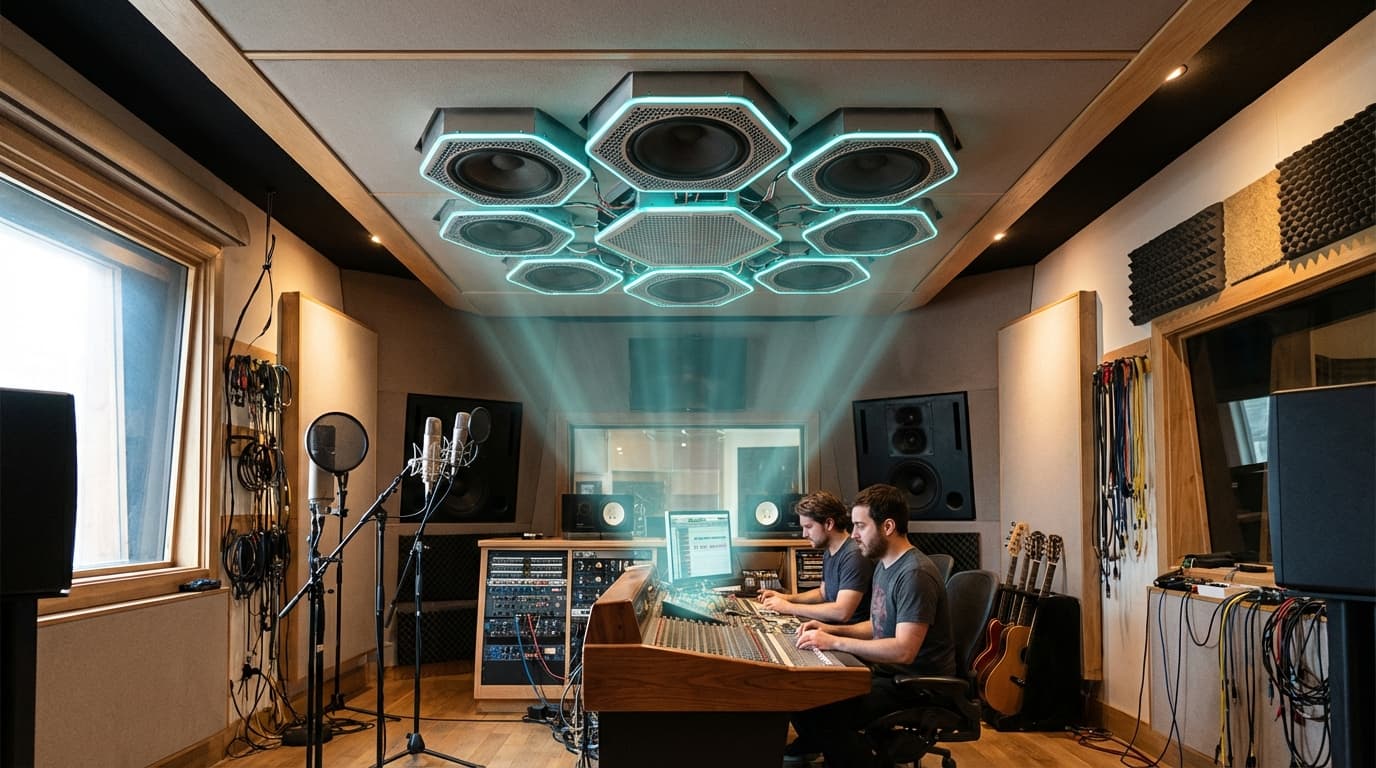
Acoustic Holography Speakers
Acoustic holography speakers arrange hundreds of ultrasonic transducers and apply phase delays so interference patterns sculpt audible sound fields in mid-air. By dynamically steering the beams, the system can paint discrete audio zones, sweep sonic shapes across a room, or wrap visitors in spiraling effects without traditional loudspeakers. Some installations combine beamforming with head tracking so the sweet spot follows a moving listener, while others integrate with smell or light cues for full multisensory control.
Museums and themed attractions use acoustic holography to stage overlapping stories in the same gallery without bleed, while automotive OEMs add it to cabins so each passenger hears personalized media or translation feeds. Broadcasters experiment with “audio AR” sets where analysts stand inside invisible sound cones, and immersive retail builds whisper channels that trigger only when customers approach specific products. Because the arrays can also generate mid-air haptics at higher amplitudes, choreographers pair them with volumetric displays for synesthetic performances.
Deployments (TRL 5–6) still require calibration expertise and safety modeling to ensure prolonged exposure stays within guidelines. Standards bodies like AES are drafting measurement practices, and companies such as Holoplot, Tactile Labs, and Ultraleap are productizing turnkey content toolchains. As costs fall and content suites expose spatial-audio scripting that targets acoustic holography, expect the tech to power intimate storytelling zones in museums, transit hubs, premium retail, and mixed reality stages.
Related Organizations

Manufacturer of 3D audio beamforming systems, famously deployed at The Sphere in Las Vegas to target sound to specific seats.

The world leader in mid-air haptics and hand tracking, formed from the merger of Ultrahaptics and Leap Motion.

Develops 3D audio beamforming technology that tracks the listener's head to deliver binaural sound without headphones.
United Kingdom · University
A leading research center at the University of Southampton specializing in sound zones and array signal processing.

Creators of 'invisible headphones' technology that beams ultrasound pockets of sound directly to a user's ears.

German audio company offering 'Soundscape', a system for object-based audio reproduction and acoustic emulation.

A brand of Neurotechnology that manufactures high-precision directional ultrasonic speakers.
Creator of L-ISA, an immersive hyperreal sound technology that uses object-based mixing and spatial audio processing.

Professional audio manufacturer known for the Constellation acoustic system which electronically alters room acoustics.
Supporting Evidence
Research this in Signals
Signals turns a topic into a sourced research record you can inspect and rerun. Your first scan is free, and this one starts with Acoustic Holography Speakers already loaded, so edit it or scan as is.