UV Safety Governance (UV‑C / Far‑UV‑C)
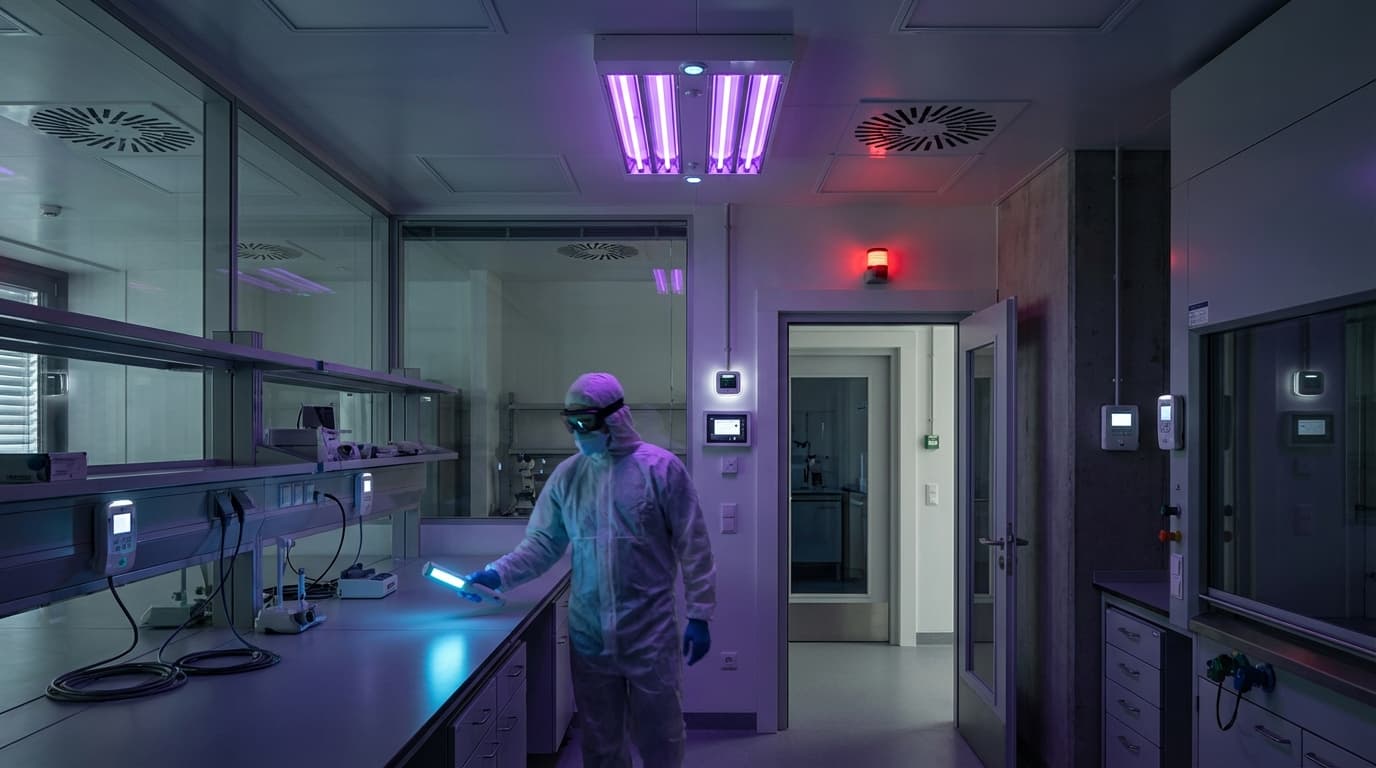
Ultraviolet germicidal irradiation has emerged as a powerful tool for pathogen control in built environments, but its effectiveness comes with inherent biological risks that demand rigorous governance frameworks. UV-C light (200–280 nm) and its narrower-spectrum cousin far-UV-C (207–222 nm) work by damaging the DNA and RNA of microorganisms, rendering them unable to replicate. While conventional UV-C lamps have long been used in unoccupied spaces due to their documented harm to human skin and eyes, far-UV-C technologies promise safer continuous disinfection by targeting wavelengths that research suggests cannot penetrate the outer layers of human tissue. However, the deployment of any germicidal UV system requires careful attention to exposure thresholds, spectral output verification, and fail-safe engineering. Key technical mechanisms include real-time dosimetry to ensure pathogen inactivation without exceeding safe human exposure limits, optical shielding to prevent stray radiation, and automated interlocks that deactivate lamps when occupancy sensors detect human presence in restricted zones.
The challenge facing facility managers, public health officials, and building operators is balancing the urgent need for enhanced indoor air quality—accelerated by pandemic concerns—with the imperative to protect occupants from photobiological hazards. Inadequate governance can lead to overexposure incidents, eroding public trust and inviting regulatory backlash that may stifle beneficial applications. Existing occupational safety standards, such as those from the American Conference of Governmental Industrial Hygienists and the International Commission on Non-Ionizing Radiation Protection, provide exposure limits, but these guidelines were developed primarily for conventional UV-C and are still evolving for far-UV-C technologies. This creates a gap where manufacturers and deployers must navigate incomplete evidence, varying international standards, and the temptation to make premature safety claims. Effective governance frameworks address this uncertainty by mandating third-party validation of spectral output, requiring transparent labeling that communicates both benefits and risks, establishing maintenance protocols to prevent lamp degradation that could shift wavelengths into hazardous ranges, and ensuring that installation teams receive proper training in photobiological safety.
Early adopters in healthcare settings, transit hubs, and commercial buildings are beginning to implement UV safety governance protocols, often guided by industry consortia and emerging best-practice guidelines. These deployments typically combine engineering controls—such as ceiling-mounted far-UV-C fixtures with downward-facing optics—with administrative measures like usage logs, periodic spectral audits, and incident reporting systems. As the evidence base for far-UV-C safety matures through ongoing clinical and field studies, governance structures must remain adaptive, updating exposure limits and operational procedures in response to new findings. The trajectory of UV safety governance will likely mirror other emerging building technologies, moving from voluntary industry standards toward more formalized regulatory frameworks as adoption scales. Transparent communication about both the disinfection efficacy and the safety boundaries of these systems will be essential to maintaining public confidence and ensuring that germicidal lighting fulfills its promise as a component of healthier indoor environments without compromising occupant well-being.
Related Organizations

Sets the Threshold Limit Values (TLVs) for chemical and physical agents, including recently revised limits for UV exposure.

The research hub (led by Dr. David Brenner) that pioneered the safety and efficacy studies of Far-UV-C (222nm) light.

Manufacturer of the 'Care222' filtered Far-UV-C excimer lamp module, the core component in most safe-for-occupied-space UV systems.

A global nonprofit dedicated to the advancement of ultraviolet technologies for public health and the environment.

Offers the AWS Truepower suite, a leading platform for renewable energy project design and operational forecasting.

A developer of microplasma UV technology, focusing on Far-UV-C 222nm solutions for disinfection.
US federal agency that sets standards for technology, including facial recognition vendor tests (FRVT).
Known for projectors, they launched the 'CounterAct' line of commercial UV disinfection fixtures using Care222 technology.