Orbital Angular Momentum (OAM) Multiplexing
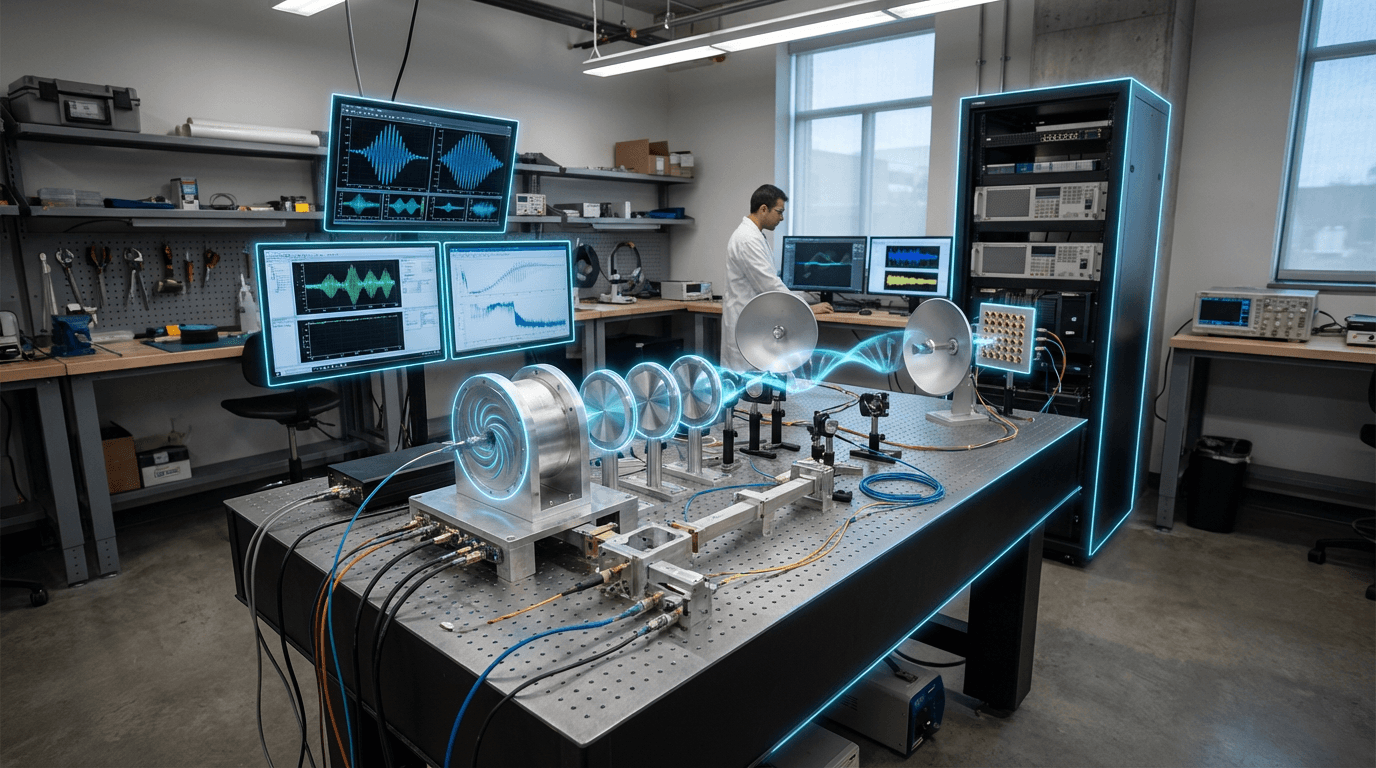
Orbital Angular Momentum (OAM) multiplexing represents a fundamental shift in how electromagnetic waves can carry information through space. Unlike conventional radio transmission that relies on amplitude, frequency, or polarisation to encode data, OAM exploits a previously underutilised property of electromagnetic waves: their ability to carry angular momentum in a helical pattern around the axis of propagation. This is achieved by manipulating the phase front of radio waves to create a corkscrew-like structure, where different "twists" or helical modes remain mathematically orthogonal to one another. Each distinct OAM mode, characterised by a unique topological charge, can theoretically carry an independent data stream on the same frequency band simultaneously. The technology employs specialised antenna arrays or phase plates that precisely control the wavefront, generating these twisted beams with remarkable accuracy. Because these helical modes do not interfere with one another when properly aligned, they offer a pathway to multiplying channel capacity without requiring additional spectrum—a property that has captured significant attention in telecommunications research.
The telecommunications industry faces an increasingly urgent challenge: spectrum scarcity. As demand for wireless data continues to grow exponentially, traditional approaches to increasing capacity—such as acquiring new frequency bands or deploying more cell towers—are becoming prohibitively expensive and logistically complex. OAM multiplexing addresses this fundamental limitation by enabling multiple independent data streams to coexist within the same frequency allocation, potentially increasing spectral efficiency by orders of magnitude. This capability is particularly valuable for high-capacity point-to-point links, such as backhaul connections between cell towers, satellite-to-ground communications, and data centre interconnects. Early research suggests that OAM could complement existing technologies like Multiple-Input Multiple-Output (MIMO) systems rather than replace them, creating hybrid architectures that leverage both spatial multiplexing and orbital angular momentum. The technology also promises benefits for free-space optical communications, where twisted light beams could enhance data transmission through the atmosphere while reducing susceptibility to certain types of interference.
Laboratory demonstrations and controlled field trials have validated the basic principles of OAM multiplexing, with research teams successfully transmitting multiple independent data streams using different helical modes. However, practical deployment faces several technical hurdles that researchers are actively working to overcome. The alignment requirements between transmitting and receiving antennas are extremely stringent, as even slight misalignment can cause mode coupling and signal degradation. Atmospheric turbulence and multipath propagation in real-world environments can also distort the helical wavefronts, limiting effective range and reliability. Despite these challenges, the technology shows particular promise for controlled environments such as indoor wireless networks, short-range outdoor links, and space-based communications where atmospheric effects are minimal. As antenna design techniques advance and signal processing algorithms become more sophisticated, OAM multiplexing is positioned to play an increasingly important role in next-generation wireless infrastructure. The technology aligns with broader industry trends toward exploiting every available dimension of electromagnetic waves to meet the insatiable demand for wireless capacity, potentially becoming a critical component of future 6G networks and beyond.
Research this in Signals
Signals turns a topic into a sourced research record you can inspect and rerun. Your first scan is free, and this one starts with Orbital Angular Momentum (OAM) Multiplexing already loaded, so edit it or scan as is.