Indigenous Spatial Protocols
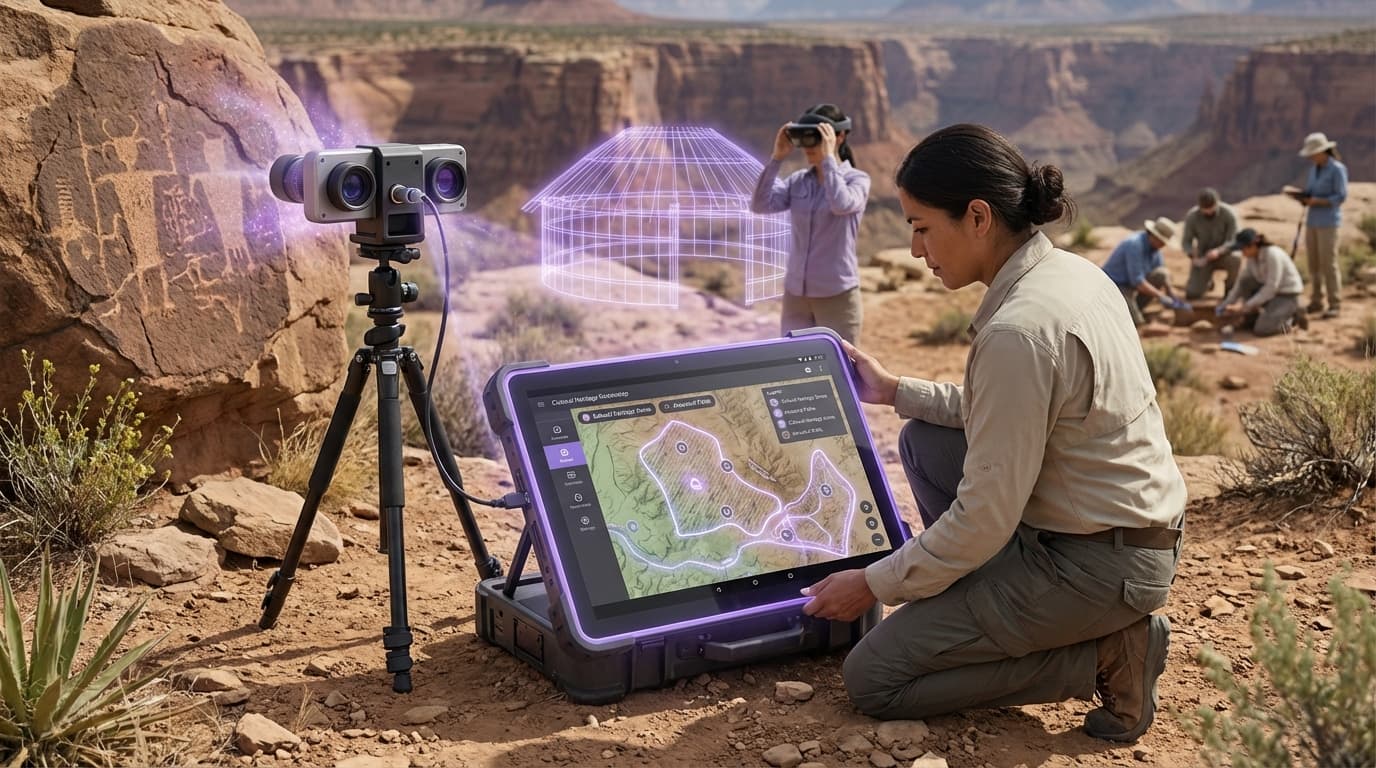
Indigenous Spatial Protocols represent a critical framework for addressing the fundamental tension between rapidly expanding spatial computing technologies and the sovereignty rights of indigenous communities over their cultural heritage and sacred lands. As augmented reality, virtual reality, and digital mapping systems proliferate globally, they often operate under Western assumptions about data ownership, public accessibility, and the neutrality of geographic information. These technologies frequently treat all physical space as equally available for digital capture, overlay, and commodification—an approach that directly conflicts with indigenous worldviews where certain places, stories, and knowledge systems are protected, restricted, or sacred. The protocols work by establishing community-led governance structures that determine whether and how indigenous territories, cultural sites, and traditional knowledge can be digitally represented, accessed, or monetized. This includes technical mechanisms such as geofencing to prevent AR content from appearing at sacred sites, metadata standards that encode access restrictions based on cultural protocols, and consent frameworks that ensure indigenous communities maintain authority over their own spatial narratives rather than having them extracted and repackaged by external developers or mapping corporations.
The absence of such protocols has created significant challenges across multiple sectors. Tourism operators have inadvertently directed visitors to restricted ceremonial sites through AR wayfinding applications. Gaming companies have placed virtual characters and objectives at locations of deep cultural significance without consultation. Mapping platforms have published detailed imagery and coordinates of sacred sites, exposing them to vandalism and inappropriate visitation. Cultural institutions have digitized indigenous artifacts and stories without permission, stripping them of their proper context and custodianship. These incidents reflect a broader pattern of digital colonialism, where spatial technologies replicate historical patterns of extraction and erasure. Indigenous Spatial Protocols address these problems by shifting control back to communities themselves, enabling them to set boundaries around what can be seen, shared, and commercialized. This creates new models for ethical spatial computing that recognize indigenous data sovereignty—the principle that communities have inherent rights to govern the collection, ownership, and application of data about their people, territories, and resources.
Early implementations of these protocols are emerging through collaborations between indigenous organizations, technology developers, and research institutions. Some mapping platforms now allow communities to request removal or restriction of certain geographic data, while pilot projects are exploring blockchain-based systems for encoding cultural permissions directly into spatial datasets. Indigenous-led technology initiatives are developing alternative mapping tools that respect traditional knowledge systems and incorporate indigenous languages, place names, and cosmologies. These efforts connect to broader movements around data sovereignty, digital self-determination, and decolonial technology design. As spatial computing becomes increasingly embedded in everyday life—from navigation systems to urban planning tools to immersive entertainment—the importance of Indigenous Spatial Protocols will only intensify. They represent not merely a technical specification but a fundamental reimagining of who controls digital space, whose knowledge systems are valued, and how technology can support rather than undermine cultural continuity and indigenous rights in an increasingly digitized world.
Related Organizations

An Aboriginally determined research-creation network based at Concordia University, focused on ensuring indigenous presence in the web, online games, and virtual environments.

Develops Traditional Knowledge (TK) Labels and Biocultural (BC) Labels, which are digital markers used to define attribution, access, and usage rights for indigenous data in digital systems.

An international network promoting Indigenous Data Sovereignty and Governance, known for creating the CARE Principles for Indigenous Data Governance.

An open-source content management system built with indigenous communities to manage and share digital cultural heritage.

An indigenous-led nonprofit that creates a digital map of indigenous territories, treaties, and languages, providing an API for other platforms to acknowledge traditional lands.

Partners with marginalized communities to build technology (like Mapeo) that defends their rights and environment.

United States · Research Lab
A working group founded to articulate Indigenous perspectives on the development and deployment of artificial intelligence and related technologies.

An indigenous-owned technology company specializing in Augmented Reality (AR) and digital skills training to preserve and project cultural stories onto country.

A research institute at the University of Waikato focused on Māori development, heavily involved in the 'Tikanga in Technology' (Indigenous protocols in tech) research.
An indigenous-owned digital agency that builds custom software and web experiences centered on indigenous data sovereignty and social impact.

Indigenous-led organization in BC, Canada, advancing digital equity and Indigenous innovation.

Partners with indigenous colleagues to protect the rainforest, utilizing ethnographic mapping and technology to secure land tenure.
Supporting Evidence
Research this in Signals
Signals turns a topic into a sourced research record you can inspect and rerun. Your first scan is free, and this one starts with Indigenous Spatial Protocols already loaded, so edit it or scan as is.