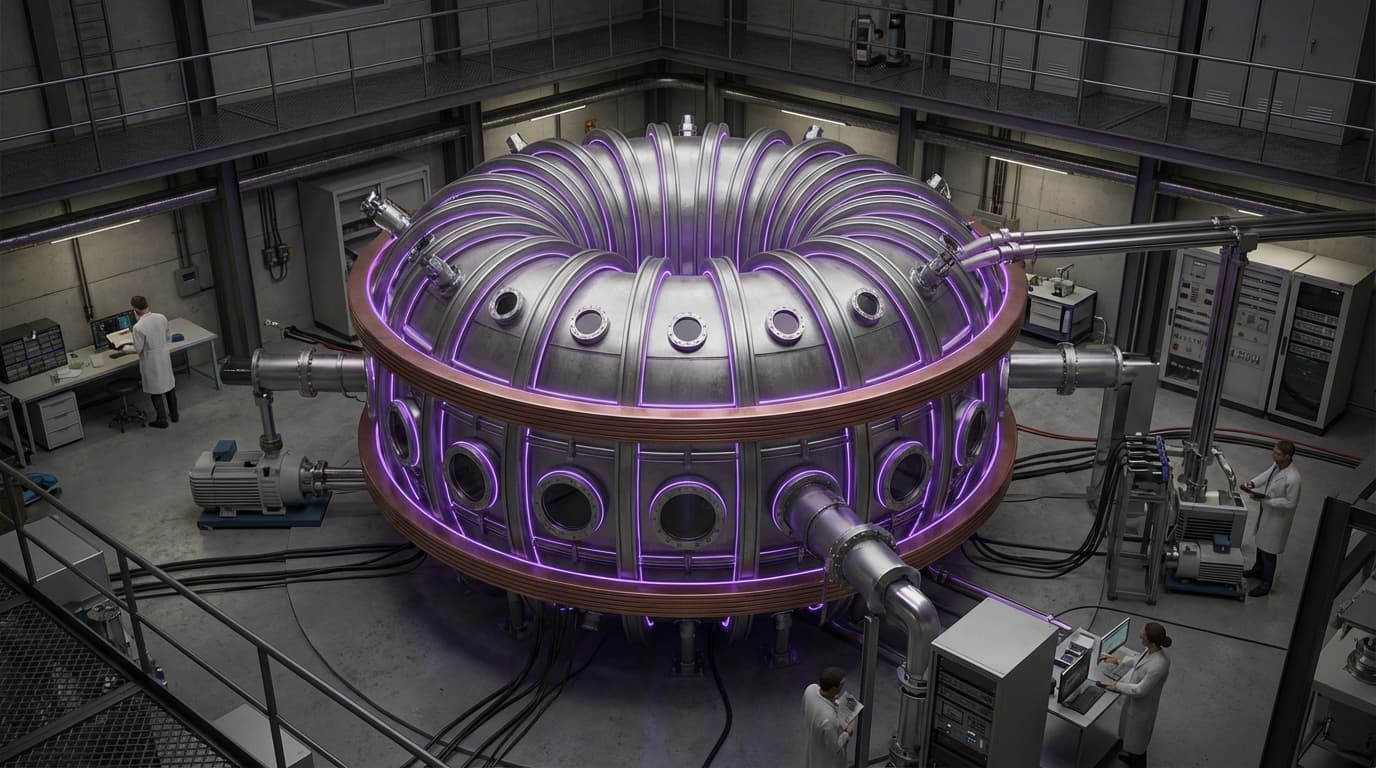
Nuclear Fusion Reactor
Nuclear fusion reactors aim to replicate the process that powers stars, fusing light atomic nuclei—typically isotopes of hydrogen—to release enormous amounts of energy. The most common approach uses a tokamak design: a torus-shaped vacuum chamber where hydrogen plasma is heated to millions of degrees and confined by powerful magnetic fields. When conditions are right, atomic nuclei overcome their mutual repulsion and fuse, releasing energy that can be captured to generate electricity. Unlike nuclear fission, fusion produces minimal radioactive waste and cannot create runaway chain reactions.
The technology promises virtually unlimited, carbon-free energy using abundant fuel sources (deuterium from seawater and tritium bred from lithium). Major projects like ITER (International Thermonuclear Experimental Reactor) are building large-scale fusion reactors to demonstrate net energy gain, while private companies are pursuing alternative approaches including compact tokamaks, stellarators, and inertial confinement fusion. Companies like Commonwealth Fusion Systems, TAE Technologies, and Helion Energy are developing commercial fusion systems with various technical approaches.
At TRL 4, fusion reactors have achieved fusion reactions but not yet demonstrated net energy production (more energy out than in). The technology faces enormous challenges including achieving and maintaining the extreme conditions required for fusion, developing materials that can withstand neutron bombardment, managing plasma instabilities, and reducing costs to make fusion economically viable. However, recent advances in superconducting magnets, plasma control, and alternative fusion approaches have renewed optimism. If these challenges can be overcome, fusion could provide a transformative energy source that addresses climate change while meeting growing global energy demand, potentially becoming the foundation of a carbon-free energy system.
Related Organizations

International megaproject building the world's largest tokamak to prove the feasibility of fusion as a large-scale energy source.

Federal research facility focusing on national security and nuclear science.

A fusion energy company building magnets using High-Temperature Superconductors (HTS).

Developing a magneto-inertial fusion device to produce electricity directly from the fusion reaction.

Developing Magnetized Target Fusion (MTF) technology, currently building a demonstration plant in the UK.

Pursuing aneutronic fusion (hydrogen-boron) using a field-reversed configuration (FRC).

A fusion company developing spherical tokamaks using high-temperature superconducting (HTS) magnets.

Developing sheared-flow stabilized Z-pinch fusion technology, eliminating the need for magnets.

Specializes in high-tech components for fusion reactors, such as gyrotrons and breeding blankets.

Pursuing laser-driven inertial confinement fusion using advanced short-pulse lasers.
Supporting Evidence
Research this in Signals
Signals turns a topic into a sourced research record you can inspect and rerun. Your first scan is free, and this one starts with Nuclear Fusion Reactor already loaded, so edit it or scan as is.