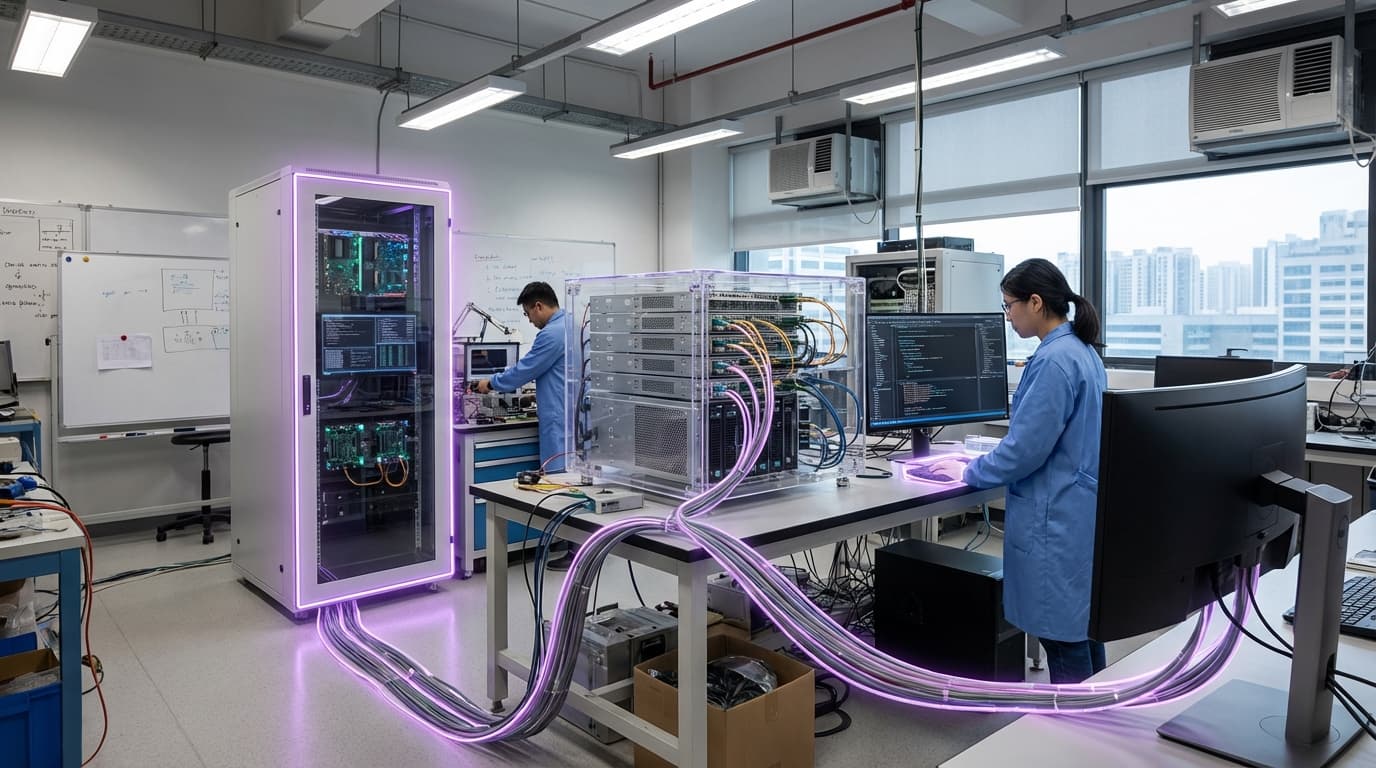
Homomorphic Encryption
Homomorphic encryption enables computation on encrypted data without decrypting it first, allowing sensitive information to be processed in the cloud or by third parties while remaining completely private. The technology uses mathematical operations that work directly on encrypted values, producing encrypted results that, when decrypted, match the results of the same operations performed on unencrypted data. This means data can be analyzed, searched, or computed upon while remaining encrypted throughout the entire process.
The technology addresses critical privacy challenges in cloud computing, data analytics, and collaborative research where sensitive data must be processed by untrusted parties. Applications include secure cloud computing where users can run computations on encrypted data, privacy-preserving machine learning where models can be trained on encrypted datasets, and secure multi-party computation where multiple parties can jointly analyze data without revealing their individual inputs. Companies like Microsoft, IBM, and various cryptography startups are developing homomorphic encryption solutions, with some already available for specific use cases.
At TRL 5, homomorphic encryption is commercially available for limited applications, though performance remains a challenge compared to unencrypted computation. The technology faces significant challenges including computational overhead (operations on encrypted data are orders of magnitude slower), limited operation support in some schemes, key management complexity, and the need for specialized expertise to implement correctly. However, as computational efficiency improves and privacy regulations become stricter, homomorphic encryption becomes increasingly valuable. The technology could enable new models of secure cloud computing and data collaboration, allowing organizations to leverage external computing resources and collaborate on sensitive data while maintaining complete privacy, potentially transforming how sensitive data is processed and shared.
Related Organizations

Provides a platform for secure data collaboration using Homomorphic Encryption.

Long-standing leader in neuro-symbolic AI, combining neural networks with logical reasoning for enterprise applications.

Through Copilot and the 'Recall' feature in Windows, Microsoft is integrating persistent memory and agentic capabilities directly into the operating system.

Open-source cryptography company building state-of-the-art Fully Homomorphic Encryption (FHE) tools and libraries.

Developing specialized hardware (accelerators) designed to handle the massive computational load of Fully Homomorphic Encryption.

Pioneered the use of Homomorphic Encryption for 'Data in Use' security, allowing secure search over encrypted data.

Secret Computing company using Multi-Party Computation and FHE for privacy-preserving analytics.

European deep tech startup providing a platform for encryption-in-use based on FHE and MPC.

Develops silicon spin qubits using advanced 300mm wafer manufacturing processes.

Developing optical computing hardware to accelerate FHE operations.
Supporting Evidence
Research this in Signals
Signals turns a topic into a sourced research record you can inspect and rerun. Your first scan is free, and this one starts with Homomorphic Encryption already loaded, so edit it or scan as is.