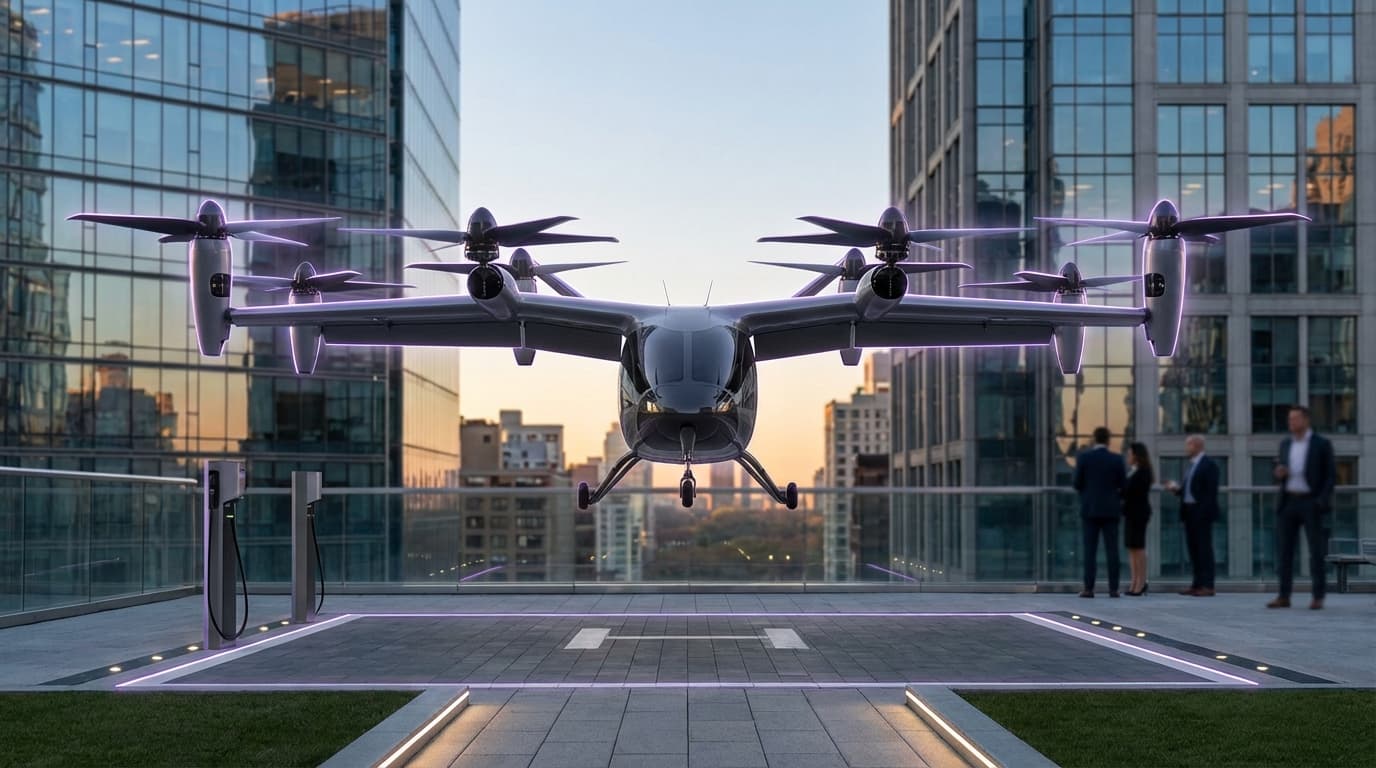
eVTOL Systems
Electric Vertical Take-Off and Landing (eVTOL) aircraft use electric motors and advanced flight control systems to enable vertical takeoff and landing like helicopters, but with the efficiency and quiet operation of electric propulsion. Various designs are being developed including multicopters with multiple rotors, tilt-rotor systems that transition between vertical and horizontal flight, and hybrid configurations. These aircraft are designed for short-range urban and regional transportation, offering point-to-point travel that bypasses ground traffic. Electric propulsion provides quieter operation, lower emissions, and potentially lower operating costs compared to helicopters.
The technology addresses the challenge of urban mobility in congested cities, offering a new transportation mode that can reduce travel times and provide access to areas poorly served by ground transportation. eVTOLs could enable air taxis, emergency medical transport, cargo delivery, and personal aerial mobility. The quiet electric operation makes them more suitable for urban environments than helicopters, while vertical takeoff and landing eliminates the need for long runways. Applications include urban air mobility services, emergency response, cargo delivery, and regional transportation. Companies like Joby Aviation, Archer, Lilium, and various aerospace firms are developing eVTOL aircraft.
At TRL 5, eVTOL systems have demonstrated flight capabilities, though certification, infrastructure, and commercial deployment remain in development. The technology faces significant challenges including battery energy density limiting range and payload, regulatory certification for passenger-carrying aircraft, developing air traffic management for dense urban airspace, building vertiport infrastructure, ensuring safety and reliability, and gaining public acceptance. However, as battery technology improves and regulatory frameworks develop, eVTOL systems become increasingly viable. The technology could transform urban transportation by enabling three-dimensional mobility, potentially reducing travel times dramatically, providing new transportation options, and creating new forms of aerial mobility, though it requires solving complex technical, regulatory, and infrastructure challenges to achieve widespread adoption.
Related Organizations

Manufacturer of the 'Midnight' eVTOL aircraft, focused on urban air mobility networks.

An autonomous aerial vehicle technology platform company, the first to receive a type certificate for an eVTOL in China.

Developing an all-electric vertical takeoff and landing aircraft for commercial passenger service.

Developing the ALIA-250 aircraft and an extensive charging network for electric aviation.

Eve Air Mobility
Brazil · Company
A spinoff from Embraer developing an eVTOL and urban air traffic management software.

German aircraft manufacturer specializing in multicopter designs like the VoloCity for inner-city flights.

A wholly-owned subsidiary of Boeing developing self-flying (autonomous) eVTOL air taxis.

Partner in the EuroQCI initiative, working on the space segment of the European quantum communication infrastructure.

A global high-tech startup developing autonomous eVTOLs, known for the 'Prosperity I' aircraft.

The Advanced Air Mobility division of Hyundai Motor Group, developing an eVTOL vehicle for 2028 entry.

British aerospace manufacturer developing the VX4 eVTOL aircraft.
Supporting Evidence
Research this in Signals
Signals turns a topic into a sourced research record you can inspect and rerun. Your first scan is free, and this one starts with eVTOL Systems already loaded, so edit it or scan as is.