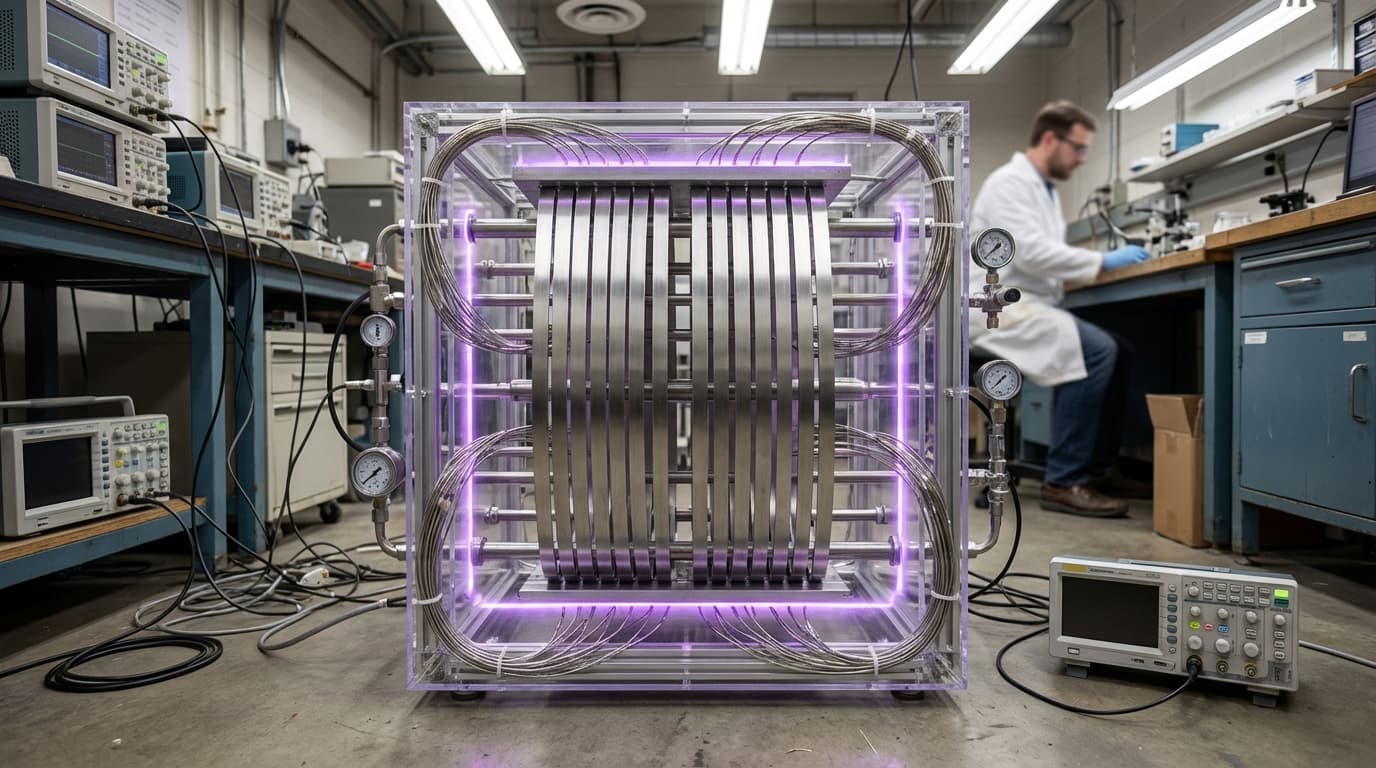
Elastocalorics
Elastocaloric cooling represents a solid-state refrigeration technology that uses the elastocaloric effect, where certain materials absorb or release heat when subjected to mechanical stress. When these materials—typically shape-memory alloys like nickel-titanium—are stretched or compressed, their crystal structure changes, causing a temperature change that can be harnessed for cooling. Unlike traditional vapor-compression refrigeration that uses greenhouse gas refrigerants, elastocaloric systems use only solid materials, eliminating direct emissions and reducing environmental impact.
The technology offers several advantages: no harmful refrigerants, potentially higher efficiency than conventional systems, and the ability to operate without moving parts in the working fluid. Elastocaloric cooling could replace traditional air conditioning and refrigeration systems, particularly important as cooling demand grows globally and regulations phase out hydrofluorocarbon refrigerants. Research institutions and companies are developing elastocaloric systems, with some prototypes demonstrating proof-of-concept for various cooling applications.
At TRL 5, elastocaloric cooling is in active research and development, with laboratory demonstrations showing promising performance. The technology faces challenges including material fatigue from repeated stress cycles, efficiency optimization, system integration complexity, and scaling to practical cooling capacities. However, as the world seeks alternatives to harmful refrigerants and more efficient cooling systems, elastocaloric technology offers a promising pathway. If durability and efficiency challenges can be overcome, the technology could transform the cooling industry, providing environmentally friendly and potentially more efficient alternatives to conventional refrigeration systems.
Related Organizations

Researchers involved in the development of Quipper, a scalable functional quantum programming language embedded in Haskell.

US Department of Energy lab leading the CaloriCool consortium.
Germany · University
Hosts a specialized research group on intelligent material systems focusing on elastocaloric cooling cycles.
Ireland · Startup
Develops thermal management engines using shape memory alloys (SMAs).
Germany · Research Lab
German research institute working on caloric systems for heating and cooling.
Denmark · University
DTU Energy conducts significant research into caloric materials and magnetic/elastocaloric refrigeration.
Memry Corporation
United States · Company
Manufacturer of Nitinol (nickel-titanium) components and shape memory alloys.
Supporting Evidence
Research this in Signals
Signals turns a topic into a sourced research record you can inspect and rerun. Your first scan is free, and this one starts with Elastocalorics already loaded, so edit it or scan as is.