Carbon-Cement Supercapacitor
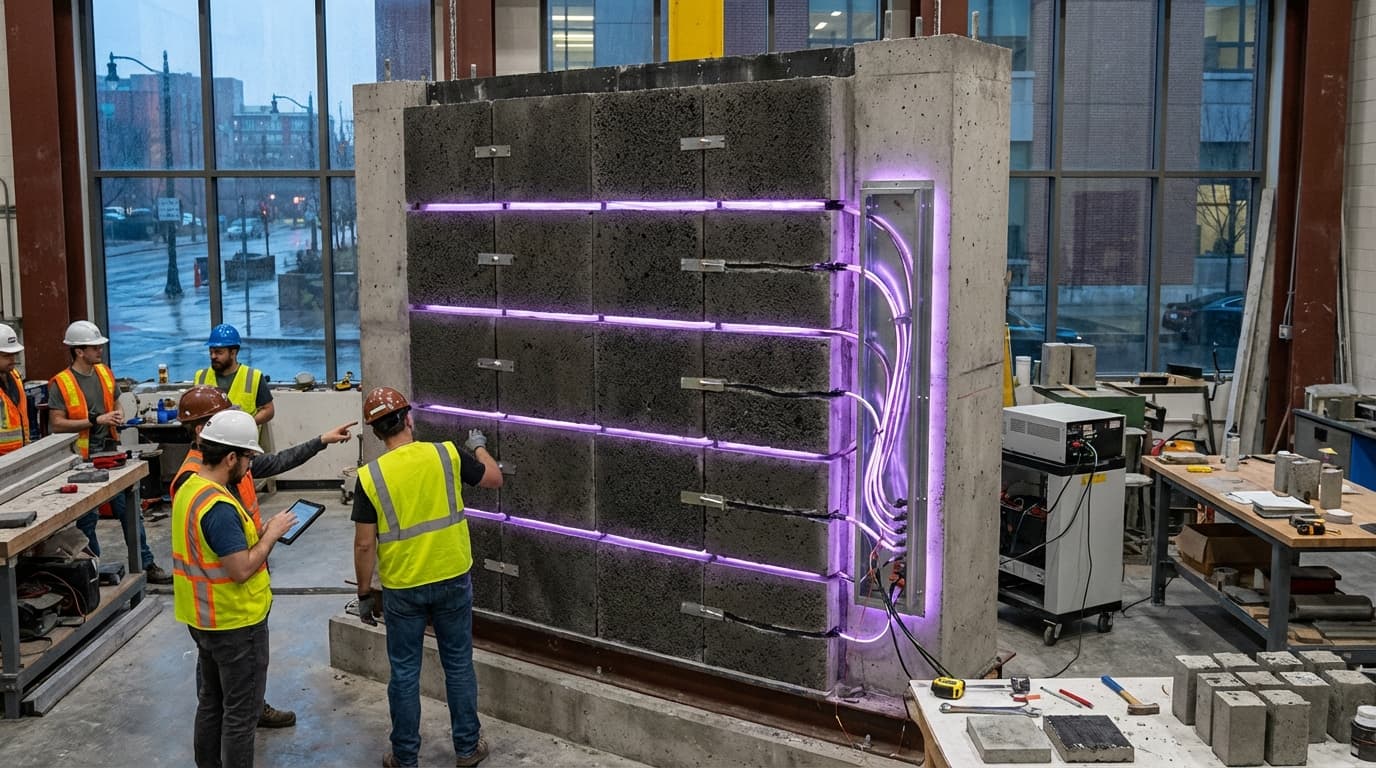
Carbon-cement supercapacitors embed energy storage functionality directly into concrete by mixing carbon black—a conductive form of carbon—into cement paste, creating a material that can store and discharge electrical energy. The carbon black forms a conductive network throughout the concrete, while the cement provides the structure and electrolyte medium. When electrodes are embedded in the material, it functions as a supercapacitor that can rapidly charge and discharge, storing energy in the electrical double layer at the carbon-electrolyte interface. This creates infrastructure that serves dual purposes: structural support and energy storage.
The technology addresses the challenge of storing renewable energy at scale while utilizing existing infrastructure investments. By embedding storage into buildings, roads, and other concrete structures, the technology can provide distributed energy storage without requiring separate battery installations or land use. The material can store energy from solar panels on buildings, provide backup power, and help balance grid demand. Applications include building foundations that store solar energy, roads that store energy from embedded solar cells or vehicle charging, and infrastructure that provides grid services. Research institutions are developing and testing carbon-cement supercapacitor systems.
At TRL 4, carbon-cement supercapacitors have been demonstrated in laboratory settings, though scaling to practical applications and ensuring structural integrity remain challenges. The technology faces obstacles including balancing energy storage capacity with structural strength, ensuring long-term durability and performance, managing heat generation during charging/discharging, and achieving cost-effectiveness compared to separate storage systems. However, as the technology matures and renewable energy adoption increases, embedded storage becomes increasingly valuable. The technology could transform how we think about infrastructure, making every concrete structure a potential energy storage device, enabling distributed storage at massive scale, and reducing the need for separate battery installations, potentially creating a built environment that actively supports renewable energy integration while serving its primary structural functions.
Related Organizations
United States · University
World-renowned research university.

Home to the Wallenberg Centre for Quantum Technology, where researchers actively develop wideband TWPAs and Josephson junction circuits.

The Centre for Cold Matter develops portable quantum accelerometers for navigation without satellite support.

A premier bio-inspired engineering lab developing soft robotics and adaptive materials.
United Kingdom · University
Public collegiate research university in Lancaster, England.

Global leader in innovative and sustainable building solutions.

One of the world's largest building materials companies.

Supporting Evidence
Research this in Signals
Signals turns a topic into a sourced research record you can inspect and rerun. Your first scan is free, and this one starts with Carbon-Cement Supercapacitor already loaded, so edit it or scan as is.