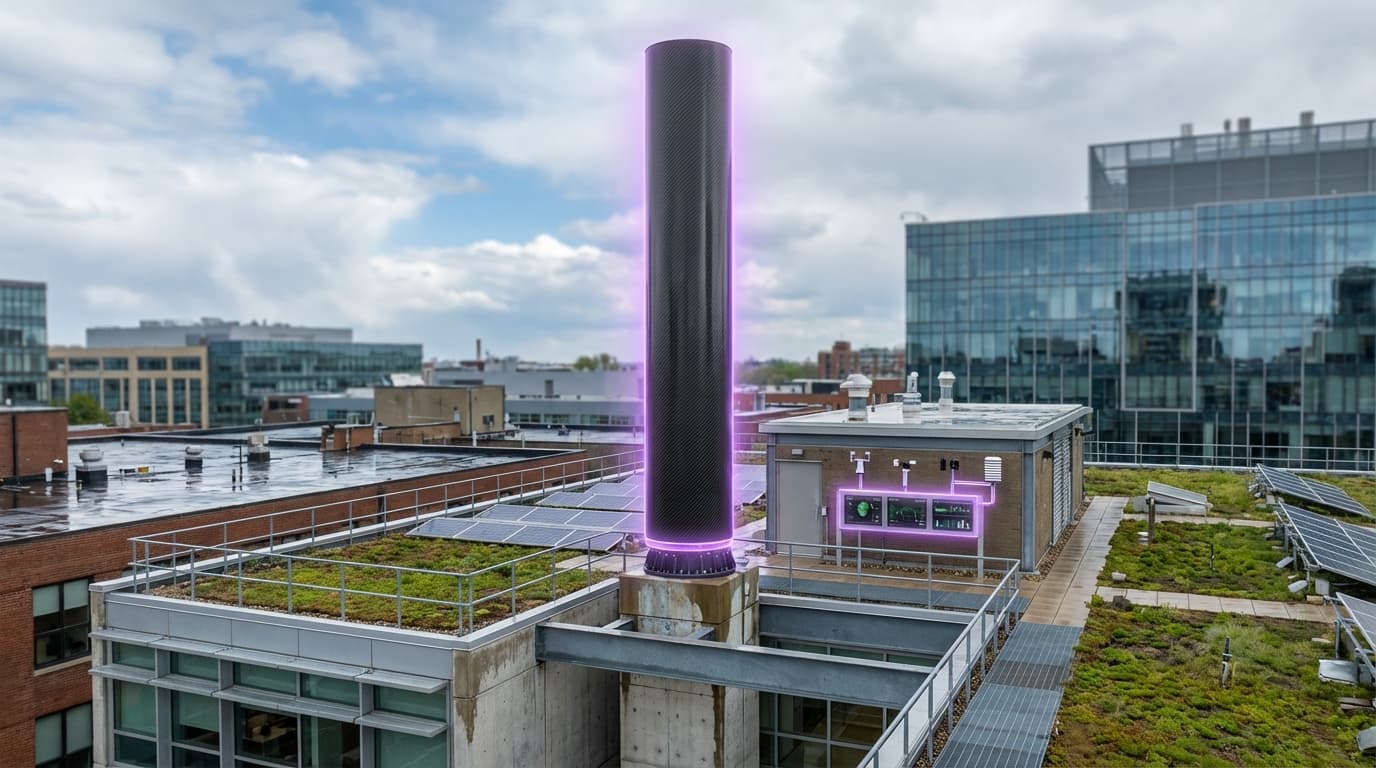
Bladeless Wind Turbine
Bladeless wind turbines generate electricity through vortex-induced vibration (VIV), where wind flowing around a fixed structure creates alternating vortices that cause the structure to oscillate. This oscillation drives a generator through various mechanisms including linear generators, piezoelectric materials, or electromagnetic induction. Unlike traditional turbines with rotating blades, bladeless designs use a simple vertical or horizontal structure that sways in the wind, eliminating the complex gearboxes, blades, and yaw mechanisms of conventional systems.
The technology addresses several limitations of traditional wind turbines: noise from rotating blades, visual impact and aesthetic concerns, wildlife collisions with blades, maintenance complexity, and the difficulty of installation in urban or constrained spaces. Bladeless turbines are quieter, have a smaller visual footprint, pose no risk to birds or bats, require less maintenance, and can be installed in locations where traditional turbines are impractical. Applications include rooftop installations for buildings, integration into urban infrastructure, distributed generation in residential areas, and deployment in sensitive environments where traditional turbines are problematic. Companies like Vortex Bladeless and various research institutions are developing bladeless turbine designs.
At TRL 6, bladeless wind turbines are being demonstrated in pilot installations, though efficiency and power output remain lower than traditional turbines. The technology faces challenges including lower energy conversion efficiency compared to blade-based systems, scaling to larger power outputs, optimizing vibration frequencies for different wind conditions, and proving long-term durability. However, as the technology improves and urban renewable energy becomes more important, bladeless turbines become increasingly viable. The technology could enable wind energy generation in urban environments where traditional turbines are impractical, reduce environmental impacts of wind power, and make distributed wind generation more accessible, potentially expanding the locations where wind energy can be harvested while addressing concerns about traditional wind turbines.
Related Organizations
Spain · Startup
Pioneers of vortex-induced vibration wind generators that oscillate rather than rotate.
Aeromine Technologies
United States · Startup
Develops static, motionless wind harvesting units for rooftops that use aerodynamics to amplify airflow into an internal turbine.
Tunisia · Startup
Creators of the 'Saphonian', a zero-blade wind converter that uses a sail-shaped body to capture kinetic energy.
United Kingdom · Startup
Develops honeycomb-shaped wind panels that use oscillating aerofoils to capture wind energy.
United States · Startup
Developing the PowerPod, a portable wind turbine designed for urban environments with no external moving parts.
Spain · University
Spanish technical university conducting aerodynamic research.

Maintains the efficiency charts for solar cells and conducts foundational research on perovskite stability.
Supporting Evidence
Research this in Signals
Signals turns a topic into a sourced research record you can inspect and rerun. Your first scan is free, and this one starts with Bladeless Wind Turbine already loaded, so edit it or scan as is.