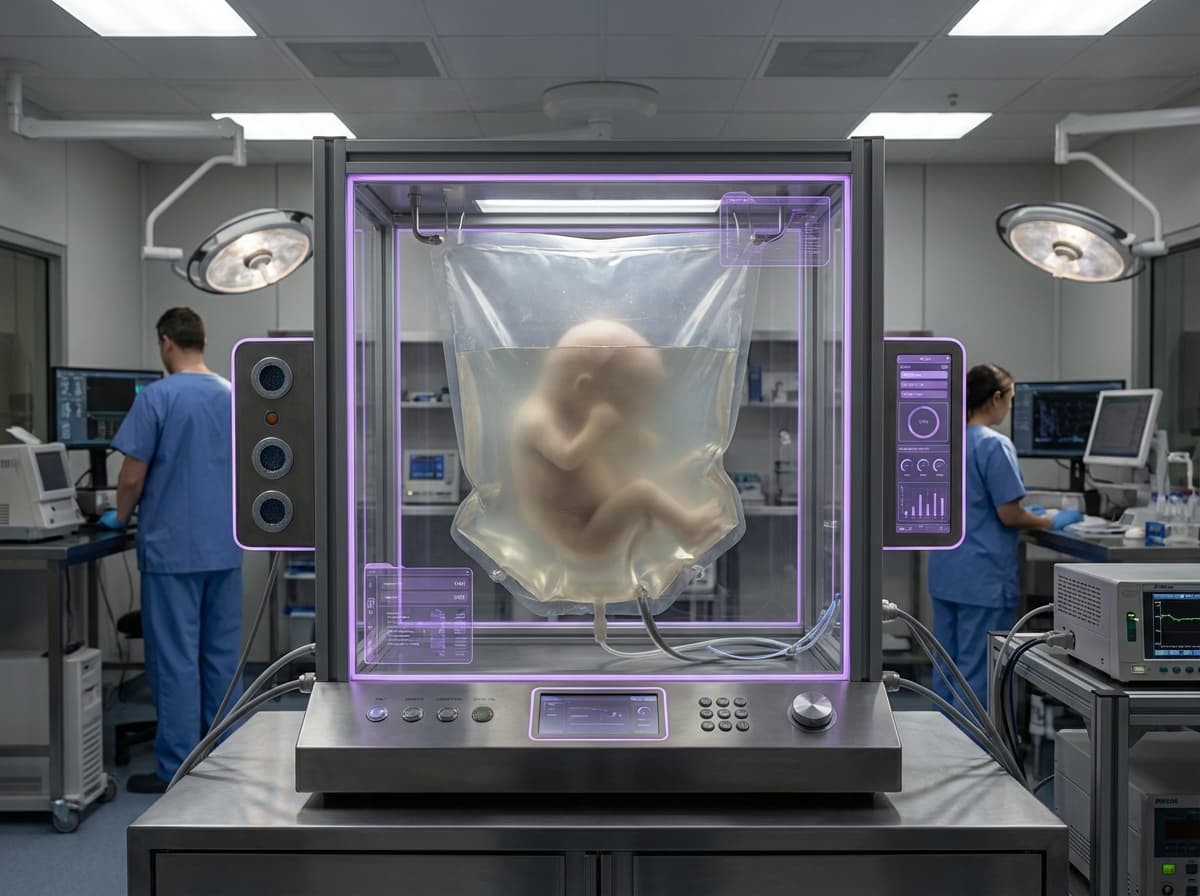
Artificial Womb
Artificial wombs, also known as ectogenesis systems, are devices designed to support the growth and development of embryos or fetuses outside the human body. These systems aim to replicate the functions of the natural uterus, including providing appropriate temperature, nutrients, oxygen, waste removal, and protection. Current research focuses on systems for extremely premature infants (ectogestation) that could extend viability earlier than current neonatal intensive care allows, though the ultimate goal is full ectogenesis from conception to birth.
The technology could address critical challenges in reproductive medicine and neonatal care: improving outcomes for extremely premature infants, enabling pregnancy for people with uterine conditions, and potentially providing alternatives to traditional pregnancy. Current systems being developed use fluid-filled environments, artificial placentas that exchange gases and nutrients, and monitoring systems to track development. Research institutions and companies are developing various approaches, with some systems successfully supporting animal fetuses for limited periods.
At TRL 3, artificial womb technology is in early research, with some systems demonstrating proof-of-concept for supporting premature animal fetuses. The technology faces enormous challenges including replicating the complex biochemical environment of the uterus, ensuring proper development of all organ systems, managing the transition from artificial to natural systems, and addressing profound ethical and social questions. However, as understanding of fetal development improves and technology advances, artificial wombs could eventually become viable. The technology raises fundamental questions about reproduction, parenthood, and the nature of pregnancy, and would require careful ethical and regulatory consideration. If developed successfully, it could transform reproductive medicine and neonatal care, though it would also represent one of the most significant technological interventions in human biology.
Related Organizations

Developed the 'Biobag' system (EXTEND), demonstrating successful support of premature lamb fetuses in an artificial womb environment.

A spin-out company working to commercialize the EXTEND artificial womb technology developed at CHOP for extreme premature infants.

Leads the Perinatal Life Support (PLS) consortium, developing an artificial womb system using simulation mannequins.

The regulatory body convening advisory committees to discuss the safety, efficacy, and ethics of artificial womb technology (EXTEND).

Renowned for research into fractional quantum Hall effect and topological states of matter.
Israel · Startup
A biotech startup leveraging Weizmann Institute research to grow synthetic human embryos for organ harvesting and therapeutic purposes.

Researchers here developed the EVE therapy platform, an ex-vivo uterine environment for treating preterm infants.

An independent body that examines ethical issues in biology and medicine, actively publishing on the ethics of artificial wombs.

Research into spintronics and probabilistic computing which overlaps with reversible logic principles.
Supporting Evidence
Research this in Signals
Signals turns a topic into a sourced research record you can inspect and rerun. Your first scan is free, and this one starts with Artificial Womb already loaded, so edit it or scan as is.