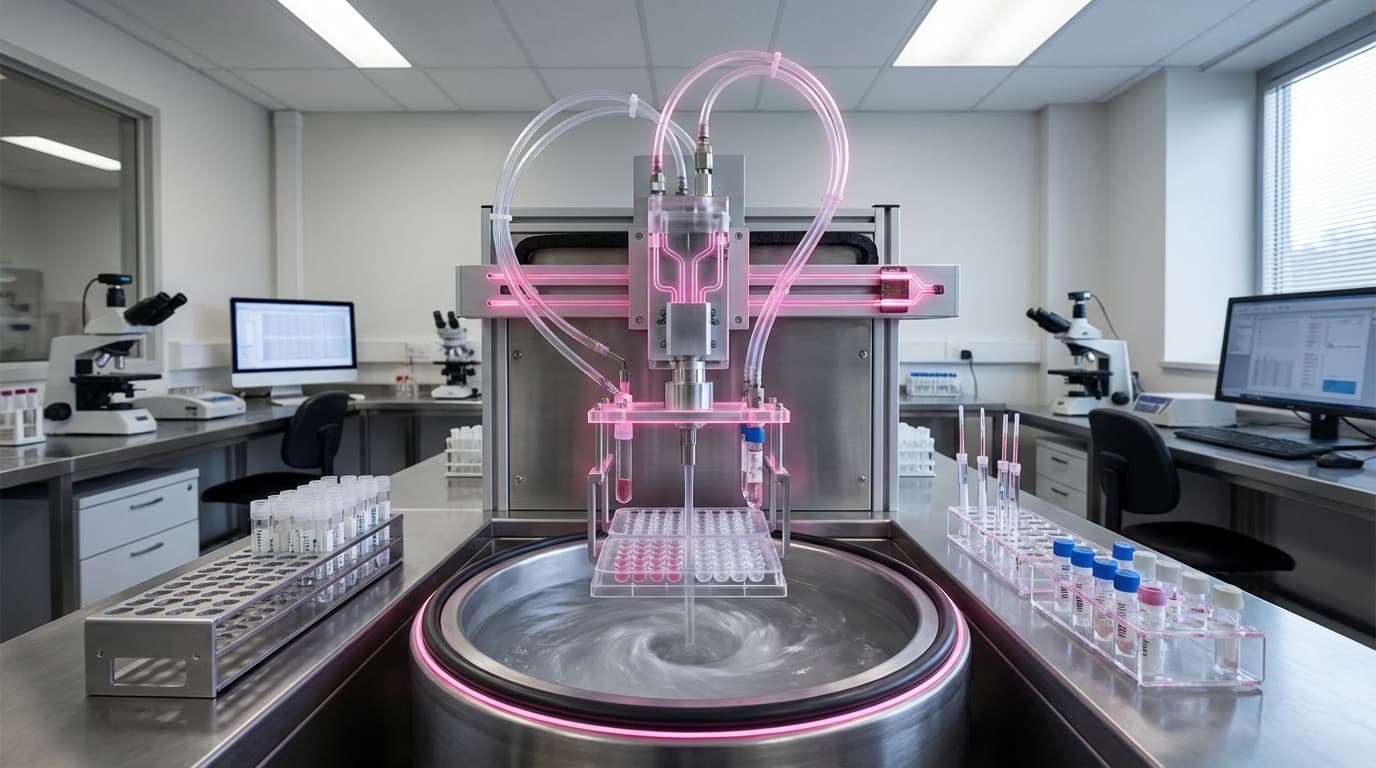
Cryopreservation Automation
Cryopreservation automation systems use robotic platforms to automate the complex process of preserving biological materials at ultra-low temperatures, including precisely controlling cooling curves, dosing cryoprotectant agents, and managing storage logistics for gametes (sperm and eggs), tissues, and engineered cells. These Israeli-led platforms standardize the vitrification process (rapid freezing that prevents ice crystal formation), improving cell viability after thawing, reducing the workload on technicians, and enabling scalable global biobanking operations that can preserve biological materials reliably and consistently.
This innovation addresses the variability and labor-intensive nature of manual cryopreservation, where inconsistent techniques can reduce viability and the process requires significant expertise. By automating the process, these systems ensure consistent, optimal preservation conditions, improving outcomes and enabling biobanking at scale. Companies and research institutions, particularly in Israel, are developing these automated systems.
The technology is particularly valuable for fertility preservation, tissue banking, and cell therapy manufacturing, where reliable cryopreservation is essential. As biobanking expands and cell therapies become more common, automated cryopreservation becomes increasingly important. However, ensuring reliability, managing system complexity, and integrating with existing workflows remain challenges. The technology represents an important evolution in biobanking capabilities, but requires continued development to achieve the reliability and integration needed for widespread use. Success could enable more reliable biobanking and support the growth of cell-based therapies and fertility services, but the technology must prove itself in operational environments to achieve widespread adoption.
Related Organizations

United States · Company
A leading provider of life sciences solutions worldwide.
Hamilton Company
United States · Company
A global enterprise specializing in the development, manufacturing and customization of precision measurement devices and automated liquid handling workstations.
United States · Company
A provider of temperature-controlled supply chain solutions for the life sciences industry.
United Kingdom · Company
A global supplier of innovative and efficient products for drug discovery and structural biology.
Supporting Evidence
Research this in Signals
Signals turns a topic into a sourced research record you can inspect and rerun. Your first scan is free, and this one starts with Cryopreservation Automation already loaded, so edit it or scan as is.