






Smart Ports
Smart Ports and Automated Terminals
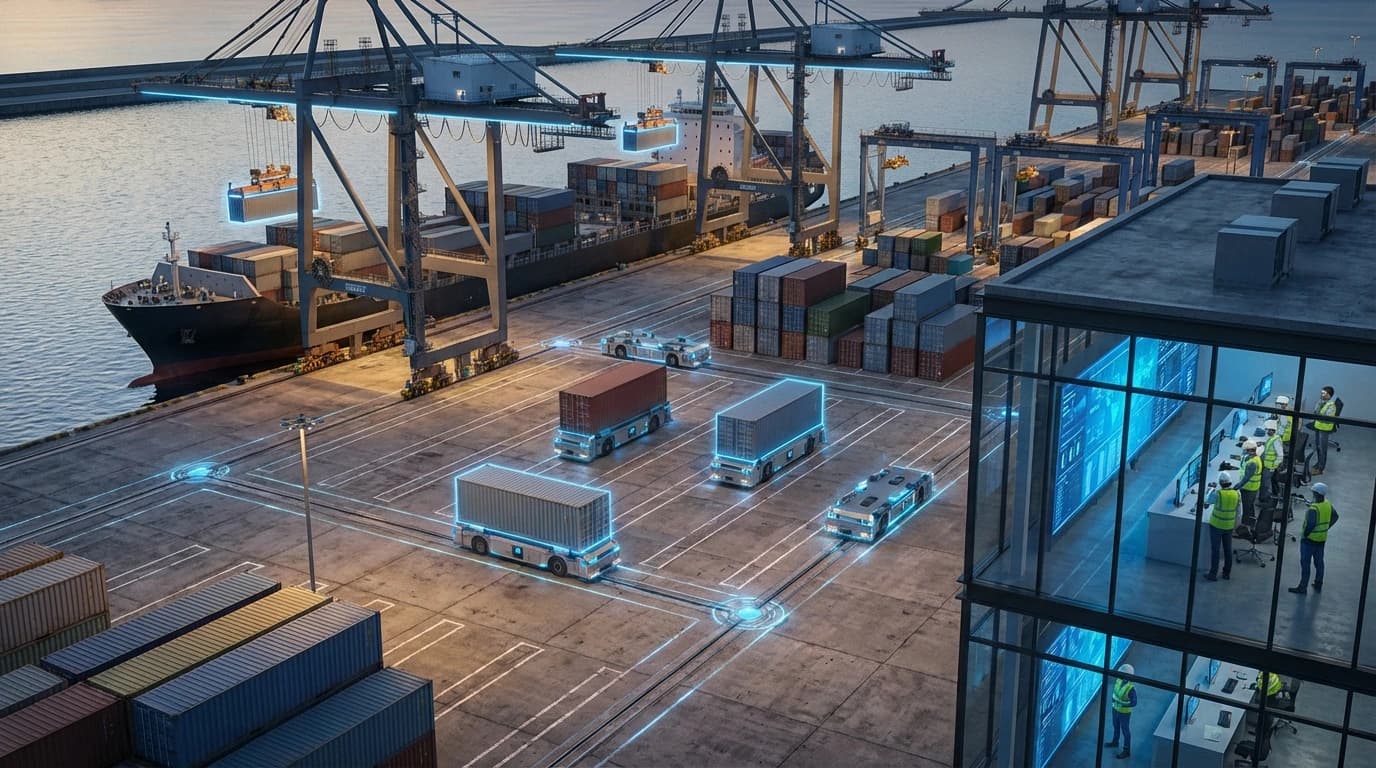
Fully automated container terminals with AI-orchestrated cranes, AGVs, and predictive berth allocation.
Modern seaports face mounting pressure to handle exponentially growing container volumes while reducing operational costs, emissions, and vessel turnaround times. Traditional terminals rely heavily on manual labor and sequential processes that create bottlenecks during peak periods, leading to costly delays and inefficient use of valuable waterfront real estate. Smart ports address these challenges through comprehensive automation and artificial intelligence, transforming container terminals into highly orchestrated systems where cranes, vehicles, and gate operations function as integrated components of a digital ecosystem. The technology stack typically includes automated stacking cranes that operate on fixed rails, autonomous guided vehicles or automated guided carts that transport containers between quayside and yard, and AI-powered terminal operating systems that coordinate every movement in real time. These systems leverage sensors, computer vision, and machine learning algorithms to optimize container placement, predict equipment maintenance needs, and dynamically adjust workflows based on vessel schedules and cargo priorities.
The shift toward smart port infrastructure fundamentally changes the economics and capabilities of global trade gateways. By eliminating the variability inherent in human-operated equipment, automated terminals achieve significantly higher throughput rates and can operate continuously without shift changes or fatigue-related slowdowns. Research suggests that fully automated terminals can reduce vessel berthing time by up to forty percent compared to conventional operations, directly translating into lower costs for shipping lines and faster delivery times for cargo owners. The integration with shipping companies' digital systems enables predictive berth allocation, where terminals receive advance cargo manifests and vessel arrival data, allowing them to pre-plan container stacking positions and equipment deployment before ships even arrive. This level of coordination extends to landside operations, where automated gate systems use optical character recognition and RFID technology to process truck entries and exits in minutes rather than the lengthy manual inspections typical of traditional facilities. The environmental benefits are equally compelling, as electric automated equipment produces zero direct emissions and optimized routing reduces unnecessary vehicle movements across the terminal yard.
Several major port operators have deployed fully automated terminals in recent years, with facilities in Rotterdam, Singapore, and Shanghai serving as prominent examples of this technological transformation. These installations demonstrate that automation can coexist with existing port infrastructure, as many operators pursue hybrid approaches that gradually introduce automated equipment alongside conventional operations. The technology is particularly well-suited to greenfield port developments, where terminal layouts can be designed from the ground up to maximize the efficiency of automated systems. Beyond the physical automation, smart ports are becoming critical nodes in broader supply chain visibility networks, sharing real-time data with freight forwarders, customs authorities, and logistics providers to create end-to-end transparency. As global trade patterns evolve and pressure mounts to decarbonize maritime logistics, the adoption of smart port technologies is expected to accelerate, with industry analysts noting that automation will likely become the standard for new terminal construction rather than a premium option. This trajectory positions smart ports not merely as operational improvements but as essential infrastructure for maintaining competitiveness in an increasingly digital and time-sensitive global economy.
TRL
8/9Deployed
Impact
5/5
Investment
5/5
Category
Applications
Related Organizations
Manufacturer of cargo handling solutions, specializing in automated stacking cranes and straddle carriers for smart ports.
Developer
Operator of Europe's largest port, pioneering the 'Digital Twin' of the port and fully automated container terminals (Maasvlakte 2).
Deployer
Global port operator developing the Tuas Port in Singapore, set to be the world's largest fully automated terminal.
Deployer
Provides full-stack AI solutions for container logistics, including the autonomous Q-Truck.
Developer
Shanghai Zhenhua Heavy Industries is the world's largest manufacturer of port machinery, heavily investing in automated quay cranes.
Developer
Software platform for smart ports and shipping, focusing on AI-driven berth planning and situational awareness.
Developer
Global manufacturer of lifting equipment, offering automated RTGs (Rubber Tired Gantries) and port automation software.
Developer
Provider of the N4 Terminal Operating System (TOS), the standard software for managing automated terminal operations.
Developer
IT specialist providing terminal operating systems (OPUS Terminal) that support fully automated terminal operations.
Developer
What was expected
Published forecasts about this technology, graded against what happened in Hindsight.
The Race for Smart Ports
Supporting Evidence
Evidence data is not available for this technology yet.
Research this in Signals
Scan Smart Ports and Automated Terminals for yourself.
Signals turns a topic into a sourced research record you can inspect and rerun. Your first scan is free, and this one starts with Smart Ports and Automated Terminals already loaded, so edit it or scan as is.