Community Maker Labs
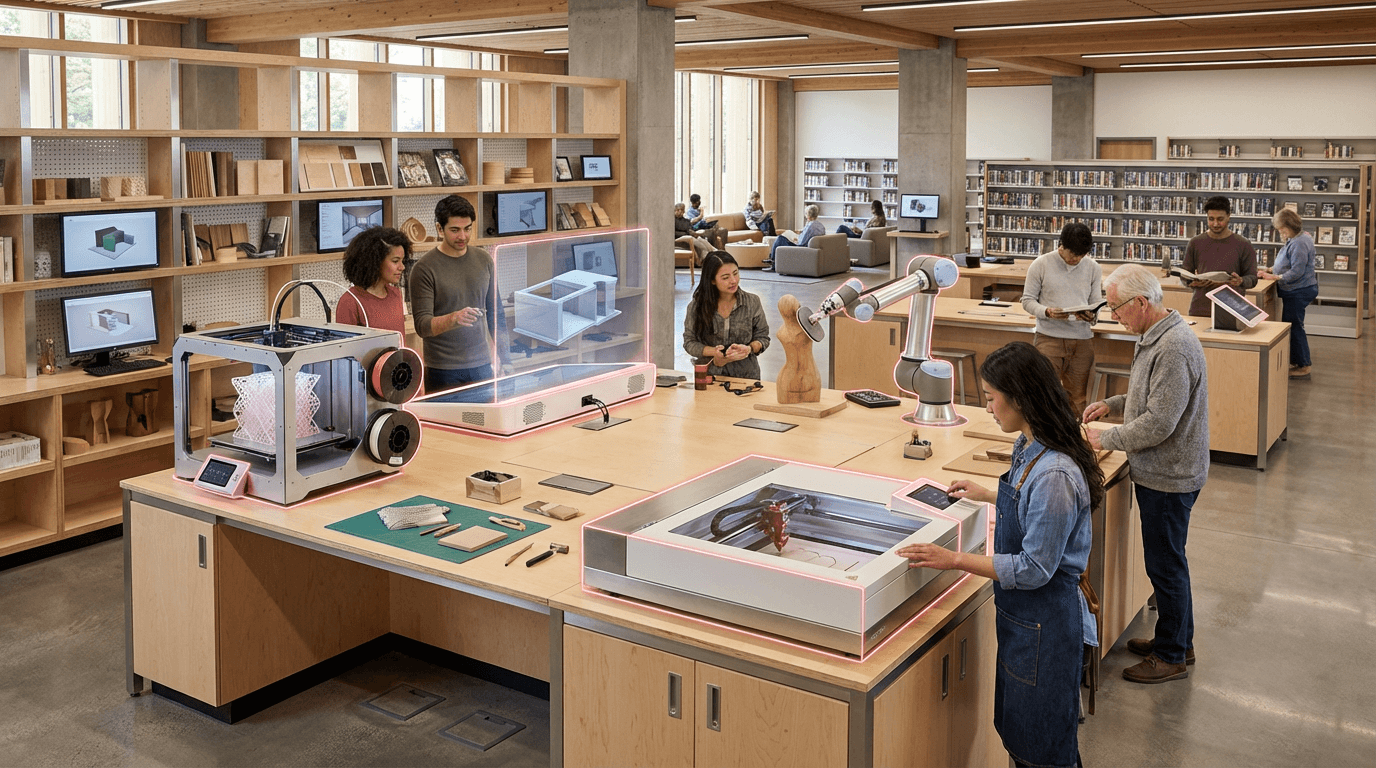
Community Maker Labs represent a fundamental reimagining of the traditional library as a passive repository of information, transforming it into an active site of production and experimentation. These facilities integrate digital fabrication equipment—such as 3D printers, laser cutters, CNC routers, and vinyl cutters—with computational resources including coding workstations, electronics prototyping kits, and data visualization tools. The technical infrastructure typically combines cloud-based design software accessible through library networks with physical manufacturing equipment that can translate digital models into tangible objects. Many installations also incorporate specialized workspaces for textile arts, electronics assembly, and media production, creating hybrid environments where patrons can move fluidly between digital design and physical creation. The integration of library data resources with fabrication tools enables a unique form of knowledge work: users can access digitized collections, historical datasets, or community archives and transform these informational assets into new creative outputs, whether physical artifacts, interactive installations, or open-source software projects.
The emergence of Community Maker Labs addresses a critical gap in equitable access to production technologies that have traditionally been confined to universities, research institutions, and well-funded private enterprises. As manufacturing and design tools become increasingly digitized and software-dependent, the barrier to entry is no longer just the cost of equipment but also access to training, collaborative networks, and experimentation space. Libraries, with their established mission of democratizing access to knowledge and their trusted position within communities, are uniquely positioned to lower these barriers. These spaces enable economic opportunity by allowing entrepreneurs to prototype products without significant capital investment, support workforce development by providing hands-on experience with industry-standard tools, and foster innovation at the community level by bringing together diverse skill sets and perspectives. For marginalized communities historically excluded from technical education and maker culture, library-based fabrication labs offer a crucial on-ramp to digital literacy and technical competency without the gatekeeping mechanisms of commercial makerspaces or academic institutions.
Early implementations of Community Maker Labs have demonstrated significant community impact across diverse contexts, from urban library systems in major metropolitan areas to rural library branches serving geographically isolated populations. Patrons have used these facilities to create everything from assistive devices customized for individuals with disabilities to small-batch manufacturing for local businesses, from student robotics projects to community art installations that incorporate historical photographs from library archives. The model has proven particularly effective in supporting STEAM education, with libraries partnering with schools to provide students access to fabrication technologies that their institutions cannot afford independently. Research suggests that these spaces function not merely as tool libraries but as sites of informal learning and community building, where knowledge transfer occurs peer-to-peer and across generational divides. As libraries continue to evolve their role in the digital age, Community Maker Labs represent a compelling vision of cultural institutions as platforms for creation rather than mere consumption, positioning libraries at the intersection of information access, technical education, and civic innovation. The trajectory points toward increasingly sophisticated integration of emerging technologies—from bioprinting to AI-assisted design tools—while maintaining the core commitment to open access and community empowerment that distinguishes library-based maker spaces from their commercial counterparts.
Related Organizations

A US non-profit organization that emerged from MIT's Center for Bits & Atoms to support the international Fab Lab network.

An open-source hardware and software company that designs single-board microcontrollers and microcontroller kits.

A flagship modern library in Finland known for its 'Urban Workshop' maker space.

An interdisciplinary initiative at MIT that originated the concept of the Fab Lab.

Open-source hardware manufacturer known for the i3 MK series and Prusa MINI, highly popular in university makerspaces and STEM labs.

A UK charity that works to put the power of computing and digital making into the hands of people all over the world.
A national nonprofit supporting the full range of maker organizations in the US.

One of the largest public library systems in the US, offering extensive TechConnect and maker programs.

Manufacturer of the MakerBot Sketch and Method series, widely considered the standard for managed classroom 3D printing ecosystems.

A leading manufacturer of CO2 and fiber laser engraving and cutting systems.

Leading 3D printing manufacturer focusing on SLA and SLS technology.
Supporting Evidence
Research this in Signals
Signals turns a topic into a sourced research record you can inspect and rerun. Your first scan is free, and this one starts with Community Maker Labs already loaded, so edit it or scan as is.