Envisioning is an emerging technology research institute and advisory.

LinkedInInstagramGitHub

2011 — 2026

research
  • Reports
  • Newsletter
  • Methodology
  • Origins
  • Vocab
services
  • Research Sessions
  • Signals Workspace
  • Bespoke Projects
  • Use Cases
  • Signal Scanfree
  • Readinessfree
impact
  • ANBIMAFuture of Brazilian Capital Markets
  • IEEECharting the Energy Transition
  • Horizon 2045Future of Human and Planetary Security
  • WKOTechnology Scanning for Austria
audiences
  • Innovation
  • Strategy
  • Consultants
  • Foresight
  • Associations
  • Governments
resources
  • Pricing
  • Partners
  • How We Work
  • Data Visualization
  • Multi-Model Method
  • FAQ
  • Security & Privacy
about
  • Manifesto
  • Community
  • Events
  • Support
  • Contact
  • Login
ResearchServicesPricingPartnersAbout
  1. Home
  2. Research
  3. Fabric
  4. Generative Pattern-Cutting AI

Generative Pattern-Cutting AI

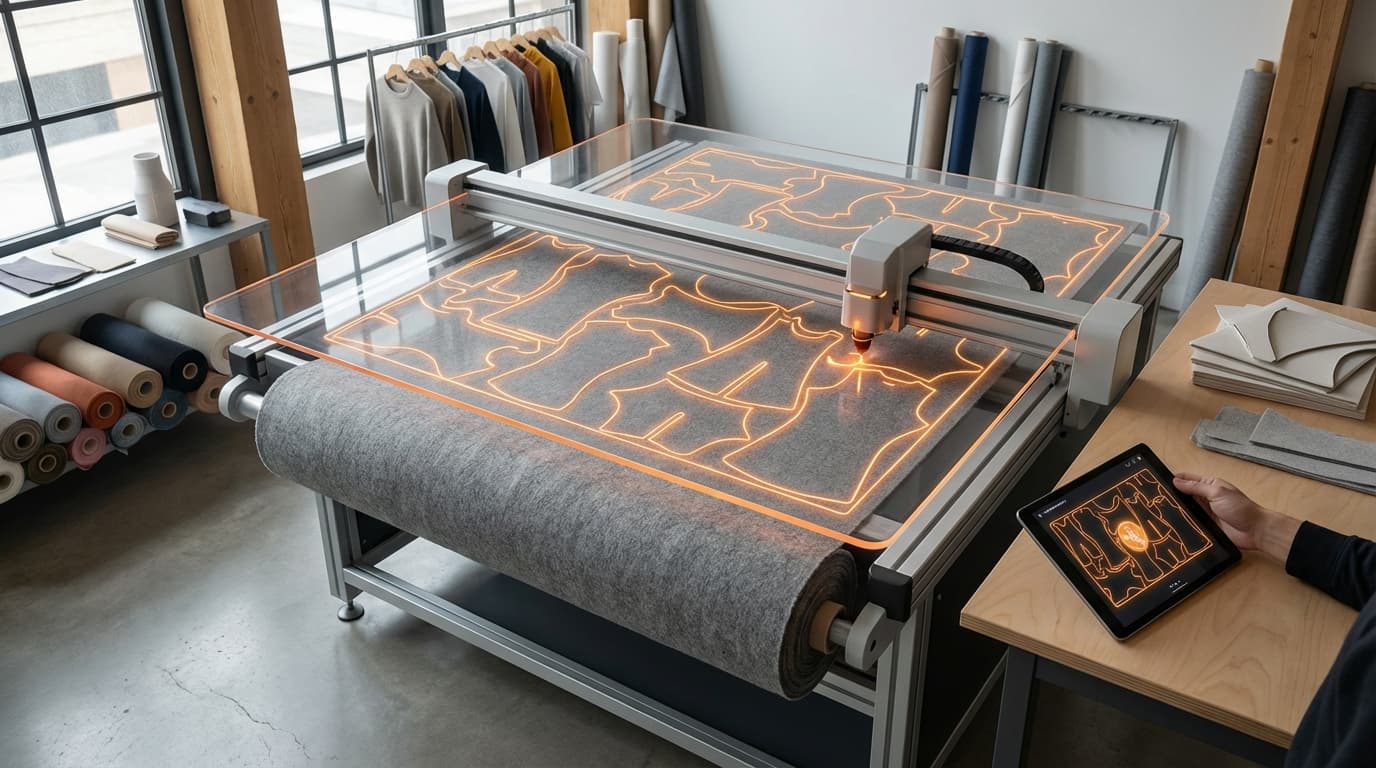
AI-driven pattern layout that minimizes fabric waste during garment cutting
Back to FabricView interactive version

Generative pattern-cutting systems translate design briefs, body scans, or drape references into optimized cutting plans that minimize offcuts. These AI-powered tools use computational geometry and machine learning to co-design garment topology and fabric usage simultaneously, analyzing thousands of pattern variations to find optimal layouts that maximize material efficiency.

This innovation addresses one of the fashion industry's most significant waste streams: pre-consumer fabric waste from inefficient cutting patterns. Traditional pattern cutting can waste 15-20% of fabric, but generative systems can achieve near-zero waste by designing garments and cutting layouts together. Companies like Unmade, Optitex, and Browzwear are integrating these capabilities into their design and manufacturing software, enabling digital-native brands to produce sustainable, made-to-order garments at scale.

The technology is particularly transformative for brands pursuing circular economy models and on-demand manufacturing. By eliminating fabric waste at the design stage, generative pattern-cutting AI enables more sustainable production while reducing material costs and enabling rapid iteration of designs without physical prototyping.

TRL
6/9Demonstrated
Impact
4/5
Investment
3/5
Category
Software

Related Organizations

Gemini CAD Systems logo
Gemini CAD Systems

Romania · Company

95%

Developers of advanced nesting algorithms and CAD software for flexible materials, now part of Lectra.

Developer
Lectra logo
Lectra

France · Company

95%

Industrial giant offering Modaris and Retviews, automating pattern making and nesting for mass production.

Developer
Browzwear logo
Browzwear

Singapore · Company

90%

Provides VStitcher and Lotta, enabling 3D design that automatically translates to 2D production patterns.

Developer
CLO Virtual Fashion logo
CLO Virtual Fashion

South Korea · Company

90%

Developers of CLO3D and Marvelous Designer, the industry-standard software for creating realistic 3D cloth simulation.

Developer
ExactFlat logo
ExactFlat

Canada · Company

90%

Software that converts 3D CAD models into 2D flat patterns for fabrics and composites.

Developer
Unspun logo
Unspun

United States · Startup

90%

Robotics and apparel company developing 3D weaving technology (Vega) to produce custom jeans on-demand.

Developer
Assyst GmbH logo
Assyst GmbH

Germany · Company

85%

German fashion tech company offering the 'Automarker' cloud service for nesting optimization.

Developer
EFI Optitex logo
EFI Optitex

United States · Company

85%

Provider of integrated 2D/3D CAD software for the fashion and textile industry.

Developer
Tukatech logo
Tukatech

United States · Company

85%

Offers TUKA3D and automatic pattern making software tailored for the garment industry.

Developer

Supporting Evidence

Evidence data is not available for this technology yet.

Connections

Software
Software
Generative Garment Pattern Engines

ML systems that generate clothing patterns from body scans, design sketches, or brand aesthetics

TRL
6/9
Impact
4/5
Investment
3/5
Software
Software
Zero-Waste Pattern Nesting Algorithms

Software that arranges garment patterns on fabric to eliminate cutting waste

TRL
8/9
Impact
4/5
Investment
3/5
Ethics Security
Ethics Security
AI-Driven Fabric Waste Reduction

Machine learning systems that optimize fabric cutting patterns and inventory to minimize textile waste

TRL
7/9
Impact
4/5
Investment
3/5
Software
Software
CAD/CAM Patternmaking and Marker Systems

Digital pattern drafting, grading, and cutting layout software for apparel manufacturing

TRL
9/9
Impact
5/5
Investment
4/5
Ethics Security
Ethics Security
Image-Based Predictive Analytics to Reduce Overproduction

AI analyzes social imagery to forecast fashion demand and prevent overproduction waste

TRL
8/9
Impact
4/5
Investment
4/5
Software
Software
Mass Customization Manufacturing Platforms

Production systems that combine body data with flexible manufacturing to create made-to-measure garments at scale

TRL
6/9
Impact
4/5
Investment
4/5

Book a research session

Bring this signal into a focused decision sprint with analyst-led framing and synthesis.
Research Sessions