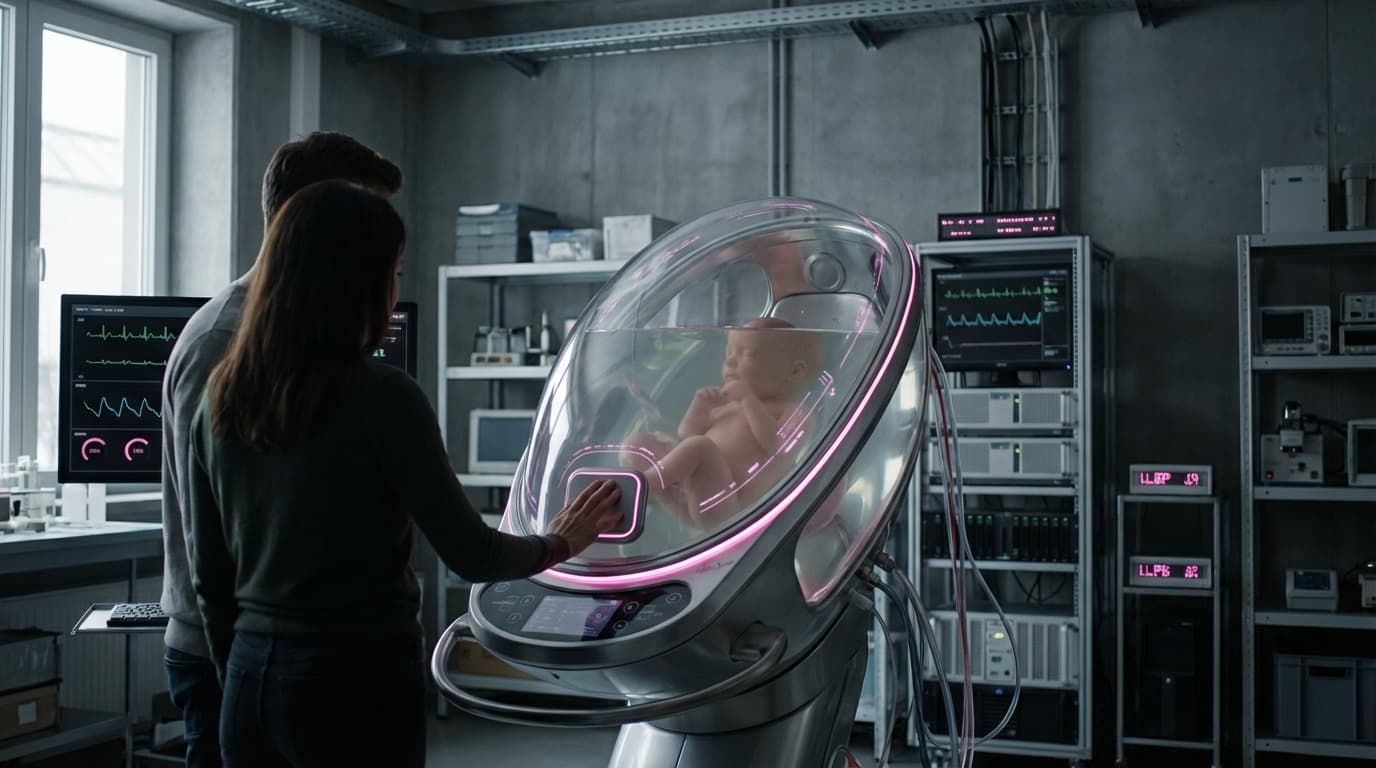
Artificial Womb Bonding Pods
Artificial womb bonding pods represent a critical interface layer for ectogenesis technology, addressing one of the most profound challenges of external gestation: maintaining the emotional and physiological connection between parent and developing fetus. These systems integrate haptic feedback mechanisms, real-time biometric monitoring, and multi-sensory communication channels to replicate and enhance the bonding experiences traditionally mediated by pregnancy. The technology typically employs pressure-sensitive surfaces that translate fetal movements into tactile sensations for parents, audio systems that transmit parental voices and heartbeats into the artificial womb environment, and visual displays that provide detailed developmental information. Advanced implementations incorporate skin-to-surface contact points where parents can place their hands to "feel" the fetus through sophisticated vibration and temperature feedback systems, while microphone arrays allow parents to sing, speak, or play music directly into the gestational chamber. Some experimental designs even explore chemical signaling systems that could simulate hormonal exchanges, though these remain largely theoretical.
The fundamental challenge these pods address is the potential disruption of prenatal attachment that ectogenesis might create. Traditional pregnancy involves constant physical proximity, hormonal changes that prepare parents psychologically for caregiving, and sensory experiences like feeling kicks or hearing heartbeats that foster emotional bonds. Without intervention, artificial womb technology risks creating a clinical, detached experience of fetal development that could impact parent-child relationships and parental mental health. Research in developmental psychology suggests that prenatal bonding significantly influences postnatal caregiving behaviors and infant attachment patterns. Bonding pods aim to preserve these critical developmental processes while offering advantages that natural pregnancy cannot provide, such as allowing both parents equal access to bonding experiences regardless of who carries the pregnancy, enabling bonding for individuals using surrogacy or adoption, and providing detailed developmental data that can enhance parental understanding and engagement. The technology also addresses practical concerns for medical ectogenesis applications, where pregnancy complications necessitate external gestation but parents still desire connection with their developing child.
Early prototypes of bonding pod systems are emerging in research hospitals exploring ectogenesis for extreme prematurity cases, where elements of the technology help parents connect with infants in advanced neonatal intensive care units. These preliminary applications indicate that multi-sensory bonding interfaces can reduce parental anxiety and improve engagement with medical care teams. As ectogenesis technology advances from animal trials toward potential human applications, bonding pods are being designed as integral components rather than afterthoughts, reflecting growing recognition that successful artificial womb technology must address psychological and social dimensions alongside physiological ones. The trajectory of this technology intersects with broader trends in reproductive autonomy, gender equity in parenting, and the medicalization of pregnancy, suggesting that bonding pods may become standard features in future reproductive care facilities. Industry observers note that the development of these interfaces may ultimately benefit all parents by creating new tools for prenatal connection that could be adapted for traditional pregnancies as well.
Related Organizations

Developed the 'Biobag' system (EXTEND), demonstrating successful support of premature lamb fetuses in an artificial womb environment.

Researchers here developed a cotton fabric coated with a polymer (PNIPAM) that collects water from fog and releases it when warm.

Research into spintronics and probabilistic computing which overlaps with reversible logic principles.

An independent body that examines ethical issues in biology and medicine, actively publishing on the ethics of artificial wombs.

Renowned for research into fractional quantum Hall effect and topological states of matter.

International leader in the fields of medical and safety technology.

A nonpartisan, nonprofit bioethics research institute.
Supporting Evidence
Research this in Signals
Signals turns a topic into a sourced research record you can inspect and rerun. Your first scan is free, and this one starts with Artificial Womb Bonding Pods already loaded, so edit it or scan as is.