Envisioning is an emerging technology research institute and advisory.

LinkedInInstagramGitHub

2011 — 2026

research
  • Reports
  • Newsletter
  • Methodology
  • Origins
  • Vocab
services
  • Research Sessions
  • Signals Workspace
  • Bespoke Projects
  • Use Cases
  • Signal Scanfree
  • Readinessfree
impact
  • ANBIMAFuture of Brazilian Capital Markets
  • IEEECharting the Energy Transition
  • Horizon 2045Future of Human and Planetary Security
  • WKOTechnology Scanning for Austria
audiences
  • Innovation
  • Strategy
  • Consultants
  • Foresight
  • Associations
  • Governments
resources
  • Pricing
  • Partners
  • How We Work
  • Data Visualization
  • Multi-Model Method
  • FAQ
  • Security & Privacy
about
  • Manifesto
  • Community
  • Events
  • Support
  • Contact
  • Login
ResearchServicesPricingPartnersAbout
  1. Home
  2. Research
  3. Cities
  4. Aerial Urban Gondola

Aerial Urban Gondola

Cable-suspended transit system that moves passengers above street-level traffic
Back to CitiesView interactive version

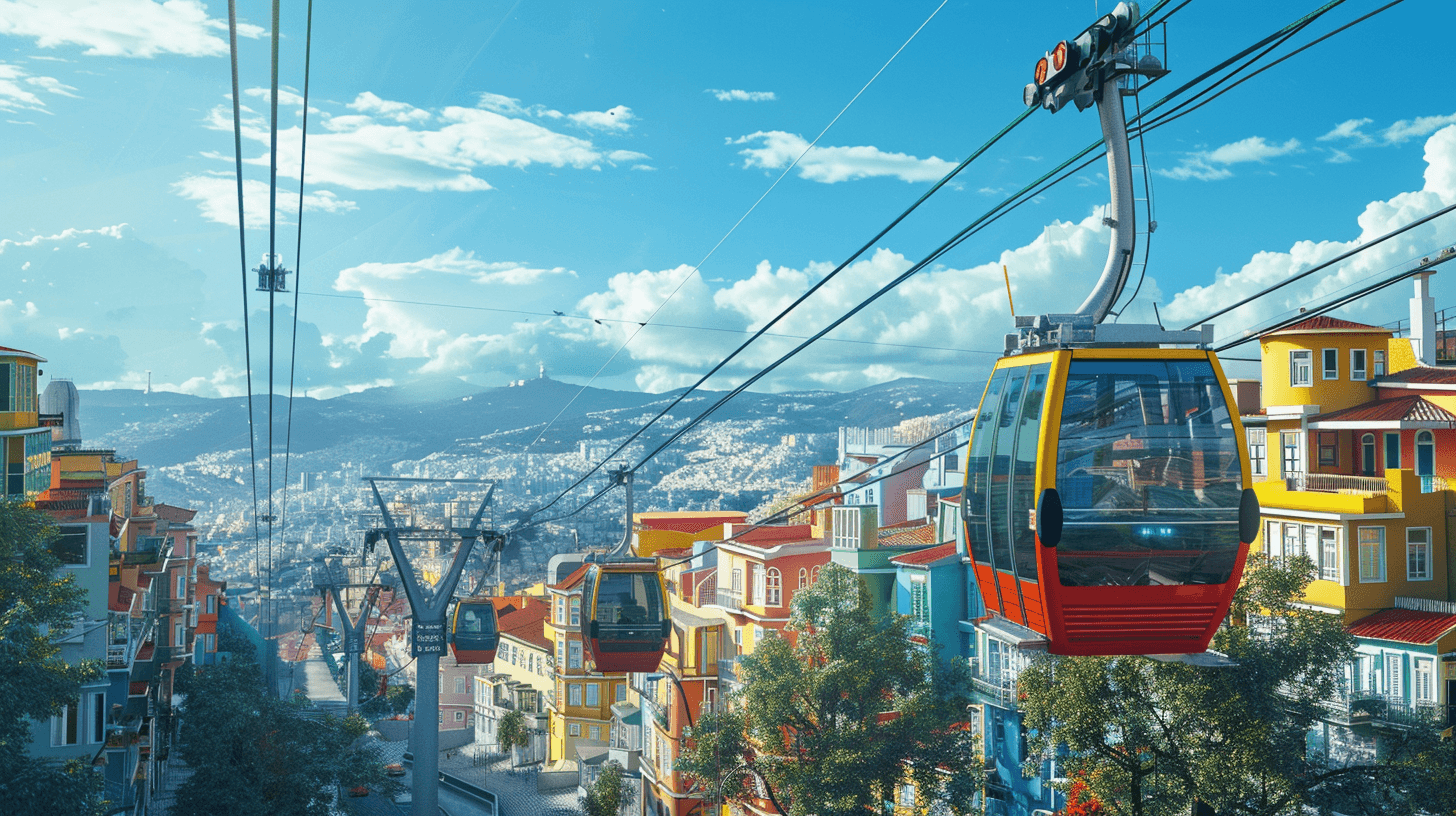
Urban congestion and limited space for expanding road infrastructure pose significant challenges to modern cities. Aerial urban gondolas, also known as cable cars or aerial trams, offer an innovative solution to these problems by providing an efficient and sustainable mode of transportation. Unlike traditional ground-based systems, these gondolas glide above the city, bypassing traffic and utilising underused airspace.

An aerial urban gondola system comprises a network of suspended cabins supported by cables anchored to strategically placed towers. These cabins, often running on electric power, can transport passengers swiftly across urban landscapes, reducing travel time and minimising the environmental footprint. The cabins move continuously along the cable, with passengers boarding and disembarking at designated stations. This seamless operation ensures a steady flow of movement, reducing wait times and enhancing the overall efficiency of the urban transit network.

As urban populations continue to grow, the need for innovative and scalable transportation solutions becomes increasingly critical. Cable cars offer a viable alternative to traditional public transit systems, which often struggle with congestion and delays. By providing a reliable and quick means of transport, these systems can alleviate pressure on existing infrastructure, reduce traffic congestion, and improve air quality by decreasing reliance on fossil-fuel-powered vehicles.

Furthermore, aerial urban gondolas can be integrated into the existing public transport network, providing last-mile connectivity and enhancing the city's overall accessibility, especially to hilly urban areas. Their installation is typically less disruptive than constructing new roads or rail lines, making them an attractive option for cities looking to upgrade their transport infrastructure with minimal environmental and social impact.

Technology Readiness Level
9/9Fully Operative
Diffusion of Innovation
2/5Early Adopters
Technology Life Cycle
2/4Growth
Category
Hardware

Related Organizations

Doppelmayr Seilbahnen GmbH

Austria · Company

100%

The world market leader in ropeway engineering, manufacturing urban cable cars for cities like La Paz and London.

Developer
Leitner

Italy · Company

100%

A major manufacturer of ropeway systems, part of the HTI Group, providing urban gondola solutions globally.

Developer
Metro de Medellín

Colombia · Government Agency

100%

Operator of the Metrocable system in Medellín, Colombia, the first major city to use cable cars for public mass transit.

Deployer
Mi Teleférico

Bolivia · Government Agency

100%

The state-owned operator of the aerial cable car urban transit system in La Paz and El Alto, Bolivia.

Deployer
Bartholet Maschinenbau AG

Switzerland · Company

90%

A Swiss manufacturer of ropeway systems and amusement park rides, focusing on innovation in urban transport.

Developer
MND Group

France · Company

90%

A French industrial group designing and building cable transport solutions for urban mobility.

Developer
SCJ Alliance

United States · Company

90%

A consulting and engineering firm with a specialized Cable Propelled Transit (CPT) division.

Researcher
Transport for London (TfL)

United Kingdom · Government Agency

85%

The local government body responsible for the transport system in Greater London, which designed, implemented, and manages the world's most prominent ULEZ.

Deployer
UNStudio logo
UNStudio

Netherlands · Company

80%

An architecture network that has designed major urban cable car systems, including the Gothenburg cable car project.

Developer
WSP logo

WSP

Canada · Company

75%

A global engineering professional services firm that provides technical expertise for ropeway and cable car projects.

Developer

Supporting Evidence

Paper

A lifeline for the disconnected: A longitudinal study of a cable car's impact on accessibility, satisfaction, and leisure activities

World Transit Research · Aug 27, 2025

A longitudinal study investigating the impact of a new cable car line in Bogotá, Colombia, on accessibility, public transport satisfaction, and leisure activities, comparing treatment and control areas.

Support 95%Confidence 95%

Paper

Assessing the impact of the new Mexico cable car on air pollution

World Transit Research · Aug 27, 2025

Study using a Diff-in-Diff model showing a drop in NO2 levels of approximately 13% in areas near the new Mexico City cable car system, highlighting environmental benefits.

Support 92%Confidence 95%

Paper

Enhancing Urban Mobility with Aerial Ropeway Transit (ART): Future Accessibility Impacts of Multimodal Transit Expansion Scenarios

World Transit Research · Dec 11, 2025

Evaluates the impact of introducing Aerial Ropeway Transit (ART) in Varanasi, India, assessing spatial accessibility improvements to critical facilities like hospitals and educational institutions.

Support 90%Confidence 95%

Report

Medellín – MetroCable Case Study

Lee Kuan Yew World City Prize · Apr 14, 2025

Case study of Medellín’s MetroCable, the first cable car system designed as mass transit, which connected marginalised mountain communities to the city center and catalyzed urban regeneration.

Support 90%Confidence 95%

Article

Bogotá: The cable car that changes lives

Seilbahnen International · Apr 16, 2025

Analysis of the TransMiCable in Bogotá, which reduced travel times from one hour to 16 minutes for residents of Ciudad Bolívar, improving reliability and reducing emissions.

Support 85%Confidence 90%

Article

CABLE CARS: URBAN TRANSPORT OF THE FUTURE

simagazin.com

A study by PwC examined the numerous advantages of urban cable cars and the extent to which they are practicable. The results clearly indicate how viable this model is for the future.

Support 50%Confidence 80%

Article

CABLE CARS: A LOW-CARBON TRANSIT SOLUTION FOR GROWING CITIES

shiftcities.org

Medellín’s experience adapting cable cars to an urban context provides an inspiring and practical solution for congestion, air quality and a host of other challenges faced by cities in the Global South.

Support 50%Confidence 80%

Article

Research into cable cars as an urban means of transport

arcadis.com

Support 50%Confidence 80%

Article

Mexico City Opens First 1.7 km New Cable Car Line, Cuts Travel Time and Inequality

smartcitiesconnect.org

Mexico City Mayor Claudia Sheinbaum has formally opened the first 1.7-kilometer section of a new cable car line in the north of the city that aims to cut commuters travel time and reduce inequality.

Support 50%Confidence 80%

Article

Mi Teleferico: La Paz’s Cable Car System

lapazlife.com

Operating at 4000 m (13,000 ft) above sea level, the world’s highest cable car ride has revolutionised the way locals travel between La Paz and neighbouring El Alto. Shuffling 3000 people between the two locations every hour, the cable cars have cut commute times down from 1 hour to just 10 minutes; a significant difference to La Paz’s long suffering commuters. Travel costs have also been reduced with a one way cable car ticket costing only 3 bolivianos compared to the 5 bolivianos charged for a one way bus ticket.

Support 50%Confidence 80%

Article

The Metrocable: transport by urban cable car in Medellín

centreforpublicimpact.org

At the turn of the century, the Colombian city of Medellín had the reputation of being an exceptionally violent and dangerous place and a global centre of drug crime. There were major problems of social exclusion: the residents of the hillside barrios that sat above the city were not well served by public transport. Within the wider context of urban integration, the city introduced the Metrocable, a cable car which connected the people of the barrios with the city centre in the valley below.

Support 50%Confidence 80%

Article

Urban Cable Cars: Sustainable Public Transport for Future Cities

unstudio.com

As cities consider how to get people moving again post-corona – in healthier, more sustainable ways, urban cable cars present a viable option that can be integrated into existing public transport networks.

Support 50%Confidence 80%

Connections

Hardware
Hardware
Self-driving Bus

Autonomous public transit vehicles using AI and sensors to navigate urban routes without drivers

Technology Readiness Level
7/9
Diffusion of Innovation
2/5
Technology Life Cycle
1/4
Hardware
Hardware
Cycling Infrastructure

Dedicated bike lanes, parking, and storage systems that reduce traffic and promote sustainable transport

Technology Readiness Level
9/9
Diffusion of Innovation
3/5
Technology Life Cycle
3/4
Applications
Applications
Micromobility

Small electric vehicles like e-scooters and e-bikes for short urban trips and last-mile delivery

Technology Readiness Level
9/9
Diffusion of Innovation
3/5
Technology Life Cycle
3/4

Book a research session

Bring this signal into a focused decision sprint with analyst-led framing and synthesis.
Research Sessions